
Buying
New Water Heater Regulations: The 2029 DOE Rule
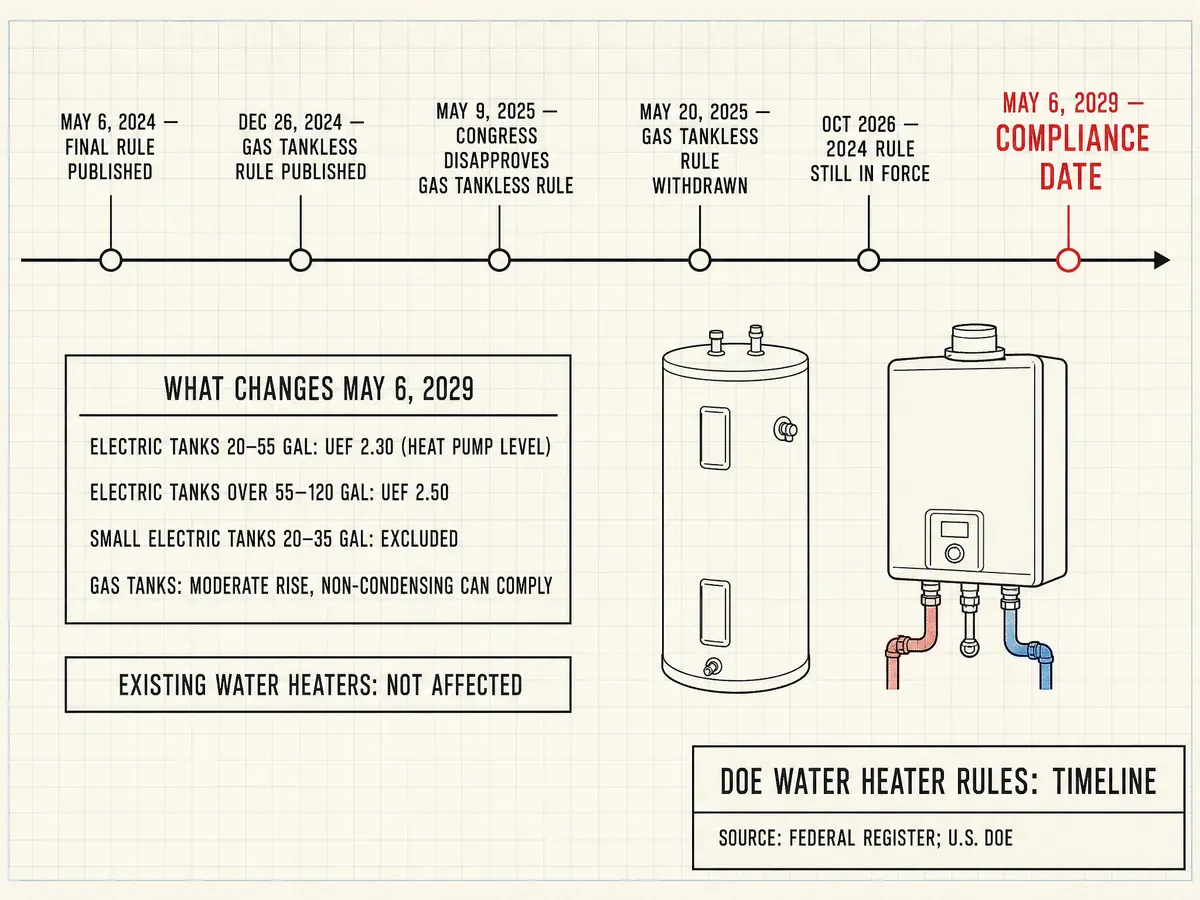
The new water heater regulations take effect May 6, 2029: most new electric tanks must reach heat-pump efficiency, gas tanks get a modest rise, and heaters already installed are not affected.
Compiled by the Tank & Tankless desk · Revised
On this page
- What are the new water heater regulations?
- What do the regulations require for electric tanks?
- What do the regulations require for gas tanks?
- What happened to the tankless water heater rule?
- Are gas water heaters being banned?
- Is the 2029 rule still in effect?
- Should you replace your water heater before 2029?
- Frequently asked
At a glance
- DOE's final rule (89 FR 37778) was published May 6, 2024; compliance is required for units made on and after May 6, 2029.
- Electric storage tanks of 20–55 gallons must reach a UEF of 2.30, and tanks over 55 up to 120 gallons 2.50, levels only heat pump designs reach.
- "Small" electric tanks of 20–35 gallons with a first-hour rating under 51 gallons are excluded and keep today's standard.
- Gas storage tanks get a moderate increase that non-condensing designs with flue dampers can meet; the rule does not require condensing gas tanks.
- The separate gas tankless rule was disapproved by Congress (signed May 9, 2025) and withdrawn May 20, 2025; gas tankless stays at the existing 0.81 UEF minimum.
- DOE's consumer water heater page still listed the May 6, 2029 date when re-checked on October 26, 2026.
What are the new water heater regulations?
The new water heater regulations are federal minimum efficiency standards that DOE finalized in 2024 for residential water heaters built from May 6, 2029. The Federal Register notice set an effective date of July 5, 2024 and a compliance date five years later. Manufacturers must meet the new minimums; homeowners do not have to do anything.
DOE picked the level it calls TSL 2, which it describes as "heat pump efficiency levels" for most electric tanks and "a moderate increase in efficiency" for gas tanks. The codified minimums sit in 10 CFR 430.32(d) under the heading for water heaters manufactured on or after May 6, 2029. Efficiency is measured as UEF, the rating explained on the efficiency and running costs page.
- May 6, 2029Compliance date for the 2024 consumer water heater standardsFederal Register, 89 FR 37778
- 2.302029 minimum UEF, electric tanks 20–55 gal (excluding small tanks)eCFR, 10 CFR 430.32
- 3% → 61%Heat pump share of electric tank sales, 2023 vs DOE's 2030 projectionFederal Register, 89 FR 37778
- May 20, 2025Gas tankless rule withdrawn after Congressional disapprovalFederal Register, 90 FR 21390
What do the regulations require for electric tanks?
Most electric storage tanks of 20 to 120 gallons must reach heat-pump-level efficiency. In DOE's words, "all electric storage water heaters, excluding small electric storage water heaters, would need to incorporate heat pump technology." Today's federal minimum for a 50-gallon medium-draw electric tank works out to about 0.92 UEF (derived from the current eCFR formula); in 2029 it jumps to 2.30.
Three groups are treated differently. Small electric tanks, which DOE describes as 20–35 gallons with a first-hour rating under 51 gallons, are excluded and stay at the resistance-level standard. Tanks over 120 gallons also keep a resistance-level formula. Electric tanks over 55 gallons already need heat pump efficiency under the current standard (about 2.03 UEF for an 80-gallon medium-draw tank, derived), so 2029 mainly changes the common 30- to 55-gallon sizes. And DOE notes that the levels leave room for 120-volt plug-in models and split systems, which matters for closets and gas-to-electric swaps; see the 120-volt heat pump page.
| Product | Minimum now | Minimum from May 6, 2029 |
|---|---|---|
| Electric tank, 20–55 gal (not "small") | ≈0.92 at 50 gal | 2.30 |
| Electric tank, over 55 to 120 gal | ≈2.03 at 80 gal (already heat pump level) | 2.50 |
| Small electric tank, 20–35 gal, FHR under 51 | Resistance-level formula | Unchanged |
| Gas tank, 20–55 gal, medium draw | ≈0.56 at 50 gal | ≈0.62 at 50 gal |
| Gas tankless, medium draw | 0.81 | 0.81 (2024 tankless rule withdrawn) |
What do the regulations require for gas tanks?
Gas storage tanks get a moderate increase, not a condensing requirement. DOE set gas tanks at efficiency level 2 and says condensing technology appears only at the top level it rejected (TSL 6). At the lower levels it lists "gas-actuated or electric flue dampers instead of condensing technologies," and it quotes a commenter calling a pressure-actuated damper "likely the lowest cost pathway."
In numbers, the medium-draw minimum for a 20–55 gallon gas tank moves from 0.6483 − 0.0017 × volume to 0.7046 − 0.0017 × volume. For a 50-gallon tank that is roughly 0.56 to 0.62 UEF (derived). ENERGY STAR gas tanks already rate 0.81 or higher, so many current efficient models clear the bar; the gas tank page covers venting styles.
What happened to the tankless water heater rule?
The gas tankless rule was cancelled before it took effect. DOE published condensing-level standards for gas-fired instantaneous (tankless) heaters on December 26, 2024, with a December 26, 2029 compliance date and UEF levels of 0.89 to 0.93. Its effective date was delayed twice in 2025: to March 21 (90 FR 9951) and then to May 20 (90 FR 13054).
On May 9, 2025, the President signed a joint resolution disapproving it under the Congressional Review Act, and DOE's withdrawal notice says the rule "is withdrawn" as of May 20, 2025. The eCFR 2029 table has no gas tankless row, so gas tankless units keep the existing 0.81 UEF minimum (0.80 for the very-small draw bin). Non-condensing tankless models remain legal to make; the condensing vs non-condensing page compares the two.
Are gas water heaters being banned?
No. Gas water heaters are not banned by the 2024 rule. Gas tanks face a modestly higher UEF floor that non-condensing designs can meet, gas tankless units keep their current minimum, and nothing in the rule requires anyone to remove or convert a working gas heater.
The rule also does not reach existing equipment. It applies to new units manufactured from May 6, 2029. Units built before that date can still be sold and installed, and any heater already in a home can be repaired and kept.
Is the 2029 rule still in effect?
Yes. As of October 2026, the 2024 rule remained in force with its May 6, 2029 compliance date. DOE's consumer water heater page, re-opened for this page on October 26, 2026, still states that compliance "is required on and after May 6, 2029," and its most recent listed action is the May 2025 tankless withdrawal. The eCFR text dated October 1, 2026 still carries the 2029 table.
No delay, withdrawal or repeal of the 2024 rule had been published as of October 2026. A July 7, 2026 DOE proposal to revise how future standards are chosen could shape later rules, but it does not amend this one. Rules can change, so check the DOE page before relying on the date.
Should you replace your water heater before 2029?
Replace a water heater when it is near the end of its life, not because of the rule. A tank usually lasts 10–15 years (DOE), and ENERGY STAR suggests planning a replacement once one is more than 10 years old; the lifespan page lists the warning signs.
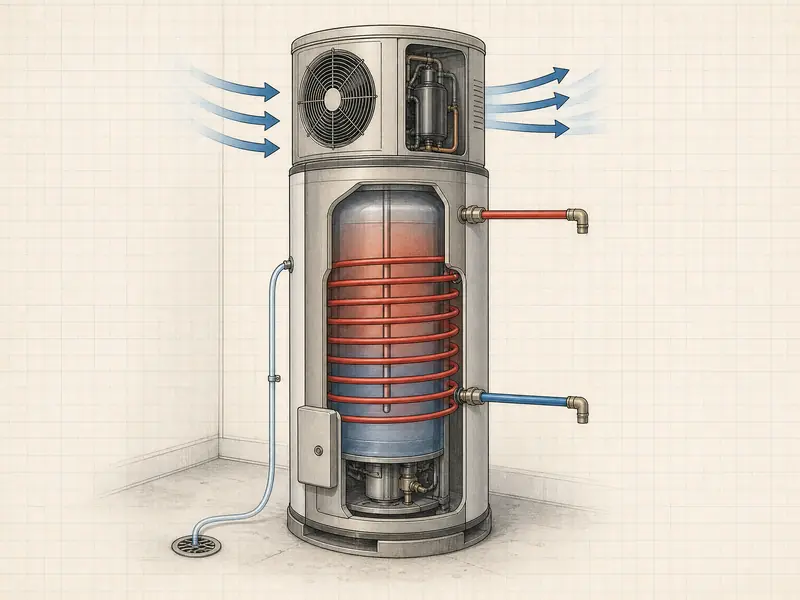
If an electric tank will need replacing around 2029, the useful question is whether a heat pump fits now. DOE's own analysis puts the average installed cost of an electric tank at TSL 2 at $1,855 versus $1,578 for a gas tank, and estimates average lifetime savings of $859 for 20–55 gallon electric buyers, with 35% of them seeing a net cost. A heat pump needs air space and a condensate drain, covered on the space and climate page. The federal 25C tax credit does not cover heaters put into service in 2026 or later (IRS), so price the job without it.
Sources and scope
This page is based on the Federal Register final rules and notices (89 FR 37778, 89 FR 105188, 90 FR 9951, 90 FR 13054, 90 FR 21390, 91 FR 42034), the eCFR text of 10 CFR 430.32 as of October 1, 2026, DOE's consumer water heater page (re-opened October 26, 2026), a Federal Register search for DOE water heater notices since June 2026, and the IRS guidance on 25C. UEF examples for a 50-gallon tank are calculated from the eCFR formulas and marked as derived. Left out: trade-press predictions, contractor sales claims, and any statement about lawsuits, since no primary record was checked.
Frequently asked
Does the 2029 rule apply to water heaters already in my house?
No. It applies to water heaters manufactured on or after May 6, 2029. A heater already installed can stay, be repaired and be used until it fails.
Can stores still sell non-heat-pump electric tanks after May 2029?
Units manufactured before May 6, 2029 can still be sold and installed. Electric tanks built after that date must meet the new UEF, except small 20–35 gallon tanks and tanks over 120 gallons.
Will a 30-gallon electric water heater still be available?
Yes, if it qualifies as a small electric storage water heater: DOE's class covers 20–35 gallons with a first-hour rating under 51 gallons, and its standard is not amended.
Does the rule require a condensing gas water heater?
No. DOE chose a moderate gas-tank level that it says can be met with flue dampers rather than condensing technology. Condensing gas tanks remain an option, not a requirement.
Is the gas tankless rule coming back?
It was disapproved under the Congressional Review Act and withdrawn on May 20, 2025. DOE's 2025 regulatory agenda says it is still considering tankless standards, but no new proposal had been published as of October 2026.
What does the July 2026 DOE proposal change?
It proposes new procedures, including a "significant energy savings" threshold, for choosing future standards. It does not amend or delay the 2024 water heater rule.
Where can homeowners check whether the date has changed?
DOE's Appliance Standards page for consumer water heaters lists every notice, and the Federal Register publishes any delay or amendment. The eCFR shows the codified minimums.
Related reading
Start over at the water heater type index · more in Buying