
Heat pump
Heat Pump Water Heater Space Requirements and Climate
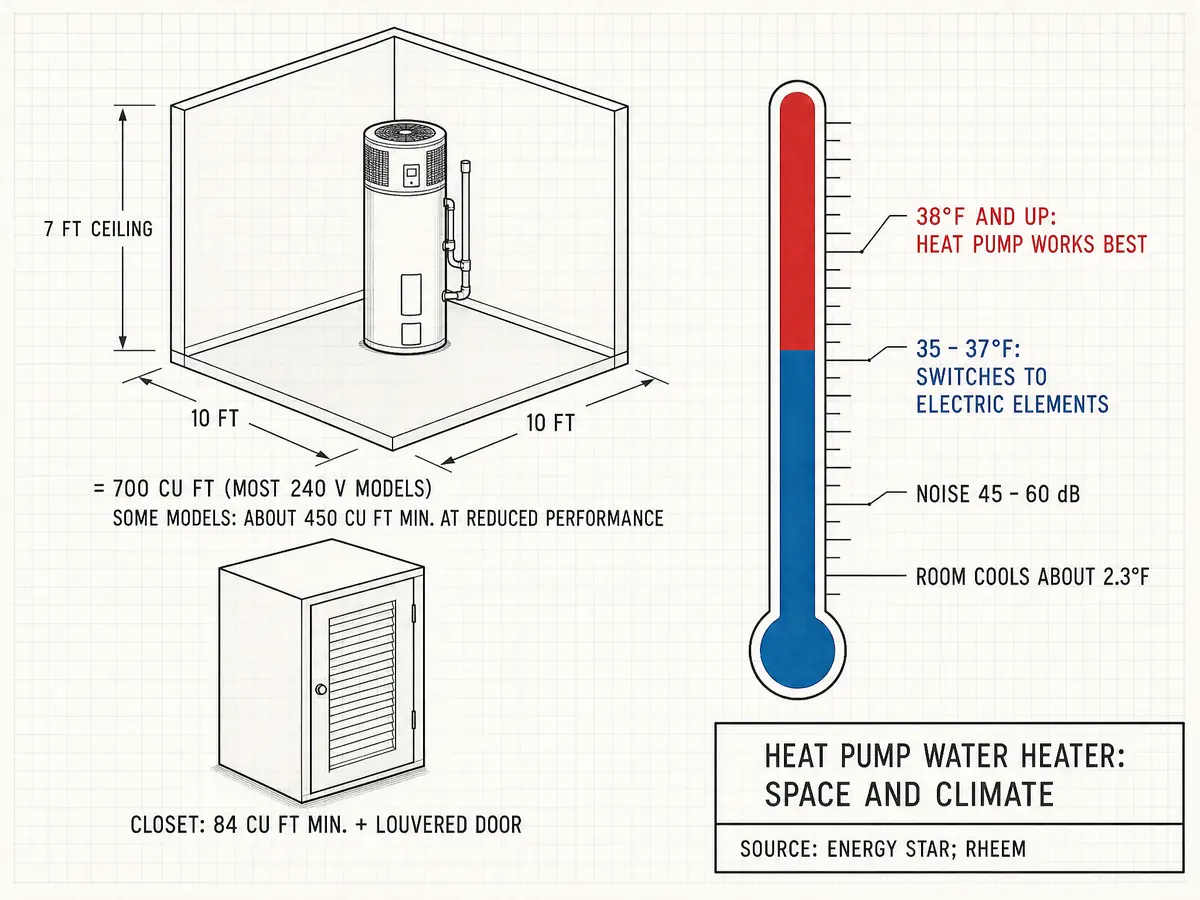
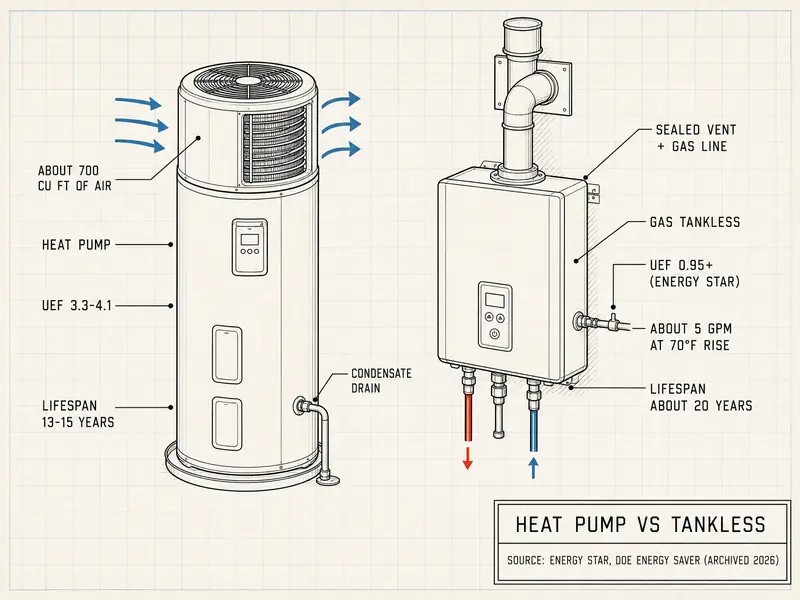
Heat pump water heater space requirements come down to air and warmth: about 700 cubic feet for most 240 V models, or louvers or ducting, in a room that stays above the high 30s °F.
Compiled by the Tank & Tankless desk · Revised
On this page
At a glance
- ENERGY STAR's 2024 installer guide sets a 700-cubic-foot minimum for most 240 V units and as little as 450 for a few.
- A closet of 84 cubic feet or more can work with a fully louvered door, per the same guide.
- DOE's older Energy Saver advice (archived) asked for 1,000 cubic feet and 40 to 90°F year-round, the conservative end.
- Rheem rates its ProTerra units for 37 to 145°F ambient air; ENERGY STAR says units switch to resistance heat below about 35°F.
- In a 2022 study of 81 homes cited by ENERGY STAR, basements cooled by an average of 2.3°F.
- Most new models run at 45 to 60 dB.
- 700 cu ftAir space for most 240 V models, e.g. 10 × 10 × 7 ftENERGY STAR
- 84 cu ftSmallest closet with a fully louvered doorENERGY STAR
- 37–145°FAmbient operating range of one maker's unitsRheem
- 2.3°FAverage basement temperature drop, 81 homesENERGY STAR
How much space does a heat pump water heater need?
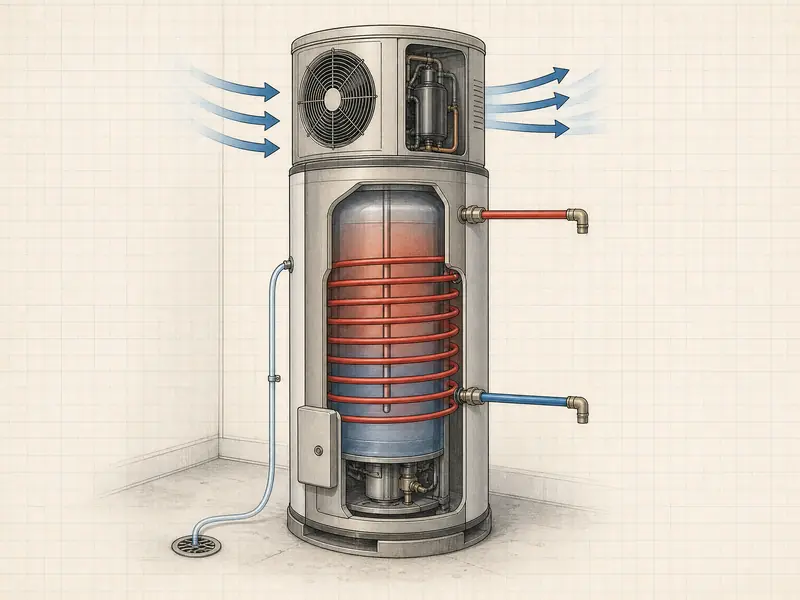
A heat pump water heater needs about 700 cubic feet of air around it for most 240 V models, such as a 10 by 10 foot room with a 7 foot ceiling. ENERGY STAR adds that "some need as little as 450 cubic feet," and that 120V models built to replace gas units may need more than 700 (ENERGY STAR install guide). The air is the heat source: the unit cools it as it heats the water, so a small sealed room runs cold and the compressor loses ground.
Other published figures bracket that number. Rheem's ProTerra sheet treats rooms over 700 cubic feet as needing "No additional ventilation," and allows operation down to 450 "at reduced energy efficiency and reduced performance output" (Rheem spec sheet). PNNL's installer checklist uses 750 cubic feet "or as specified by the manufacturer." DOE's older Energy Saver page said 1,000.
Room volume is length × width × ceiling height. Open doorways to a larger connected space usually count only if the manual says so, which is why the model's own space table decides.
| Source | Room air | Smaller rooms | Temperature |
|---|---|---|---|
| ENERGY STAR guide, 2024 | 700 cu ft typical for 240 V units, 450 for a few | 84 cu ft closet with louvered door; duct kits | Best in spaces not regularly below 38°F |
| Rheem ProTerra spec sheet | Over 700 cu ft, no added ventilation | Full louvered door or two louvers; runs to 450 cu ft at reduced output | 37–145°F ambient |
| PNNL installer checklist | 750 cu ft or per the maker | Not stated | Not stated |
| DOE Energy Saver (archived) | 1,000 cu ft | Not stated | 40–90°F year-round |
Will a heat pump water heater fit in a closet?
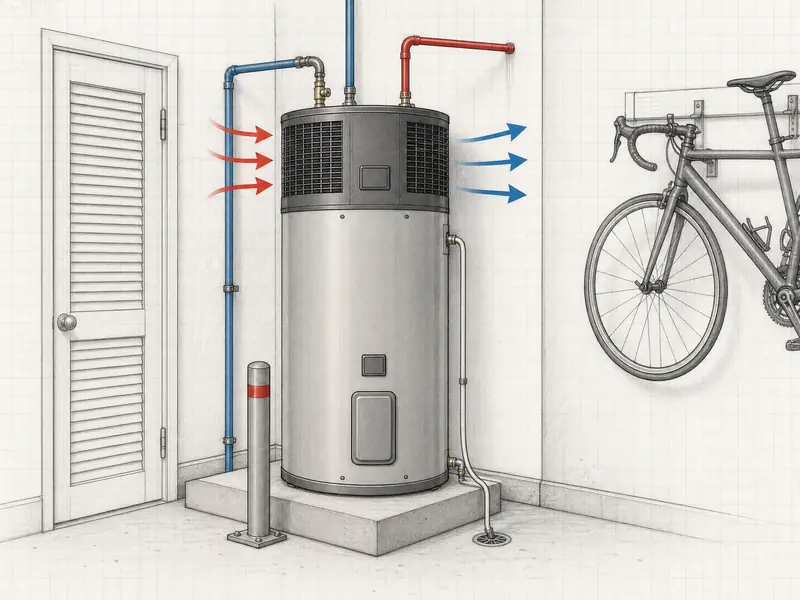
A heat pump water heater fits in a closet if the closet holds at least 84 cubic feet and has a fully louvered door, per ENERGY STAR, or if the model is ducted. Rheem lists the same two fixes for small rooms: "Full louvered door OR two louvers top and bottom." The louvers let room air circulate past the evaporator; a solid door turns the closet into a small cold box.
Ducting is the third option. ENERGY STAR notes that duct and venting kits are sold by all manufacturers, and when exhaust air is ducted it should point away from thermostats and occupied areas, with at least 1 foot of clearance from walls, ceiling and nearby objects. A closet inside the heated space also borrows a little warmth from the house in winter, which is part of why placement is a whole-house decision. The step list for ducting and louvers is on the installation page.
Is a garage a good spot for a heat pump water heater?
A garage suits a heat pump water heater when it stays mostly above freezing; ENERGY STAR calls a basement or garage "a great option if the space typically remains above freezing." In mild climates a garage is often ideal: large volume, summer heat to harvest and no living space to cool. In cold climates an unheated garage spends winter below the compressor's cutoff, so the unit runs on its elements at standard electric efficiency.
Garages bring code items too. California's rules, for example, require water heaters whose heating elements or switches can ignite vapors to sit at least 18 inches above the garage floor, and seismic straps in the upper and lower thirds of the tank (San Diego RESD-5-1). A. O. Smith's manuals also call for a vehicle stop where a car could strike the tank. Local rules vary; the installer and permit office have the final word (installation and code basics).
How cold is too cold for a heat pump water heater?
Most heat pump water heaters stop using the compressor somewhere in the high 30s °F and switch to resistance heat below that. ENERGY STAR's myth-busting article puts it at 35°F; its installer guide says units "perform best in spaces that do not regularly get colder than 38F"; Rheem rates its ProTerra range down to 37°F (ENERGY STAR). Below the cutoff the tank still makes hot water, only at about the efficiency of a standard electric unit.
ENERGY STAR's Version 5.0 criteria require makers to report the "ambient temperature (°F) below which the compressor cuts off," so the figure for a given model is on record (ENERGY STAR key criteria). For very cold sites, split-system heat pump water heaters put the compressor outdoors; ENERGY STAR says that design works "in temperatures as low as -25°F" (ENERGY STAR).
Does a heat pump water heater cool the room?
Yes, a heat pump water heater cools and dehumidifies the room it is in, because it pulls heat from that air. ENERGY STAR cites a 2022 study of 81 households that found "minimal temperature reductions of 2.3° F" in basements on average, returning to normal within four hours. In summer that is a bonus: ENERGY STAR notes it "can help cool and dehumidify the space."
In winter the heat comes partly from the house. In a heated room, some of the energy the water gains is replaced by the furnace or heat pump that warms the home; in an unheated basement or garage the effect is a cooler room rather than a bigger heating bill. The trade is part of the heat pump vs electric tank comparison.
How loud is a heat pump water heater?
Most new heat pump water heaters run at 45 to 60 dB, which ENERGY STAR compares to "the quiet hum of a kitchen refrigerator (45 dB)" at one end and "a modern window AC unit (60 dB)" at the other. One maker's 120V dedicated-circuit model lists 55 dBA on its spec sheet. The noise comes from the compressor and fan and only while the heat pump runs.
Placement does most of the work. A basement, garage or utility room is fine; a closet next to a bedroom is where complaints start. ENERGY STAR suggests low-cost fixes: a rigid foam pad under the unit, vibration-damping standoffs on seismic straps, and cushioned or webbing straps so the cabinet does not buzz against the wall.
Sources and scope
Sources: ENERGY STAR's 2024 installer guide, its cold-climate and myth-busting articles (2024), its Version 5.0 key criteria, Rheem's ProTerra 240 V and 120 V spec sheets, PNNL's installer checklist, DOE's archived Energy Saver page on heat pumps and the San Diego RESD-5-1 bulletin, all checked October 2026. Not used: forum reports of noise or cold-room performance, and single-home measurements.
Frequently asked
Is an attic a workable location?
Some manuals allow it, but attics run hot in summer and below freezing in winter in much of the US, and a leak overhead does damage. California rules call for a drain pan piped to a visible spot for attic water heaters; the model's manual sets the temperature limits.
Will a chilly basement hurt efficiency?
Yes if the basement stays in the high 30s °F or warmer, which most do. It will cool the space slightly, by about 2.3°F on average in ENERGY STAR's cited study.
How is room volume measured for a heat pump?
Multiply length by width by ceiling height in feet. ENERGY STAR's own example, 10 × 10 × 7 feet, works out to 700 cubic feet.
Can the exhaust air be ducted outside?
Many models accept duct kits for intake, exhaust or both. Ducting cold exhaust outdoors avoids chilling the room, but the manual sets duct length and diameter limits.
Do heat pump water heaters work in hot climates?
Yes. Warm air is easier to heat water from, and Rheem rates its units up to 145°F ambient. The cooling side effect is a plus in a hot garage.
Is a split-system heat pump water heater quieter indoors?
It moves the compressor outdoors, which removes most compressor noise from the room. ENERGY STAR notes split units operate down to -25°F.
Related reading
Start over at the water heater type index · more in Heat pump