
Other types
Combi Boilers and Indirect Water Heaters
A combi boiler heats the house and makes hot water on demand in one appliance, while an indirect water heater stores boiler-heated water in a separate tank; both only make sense with hydronic heat.
Compiled by the Tank & Tankless desk · Revised
On this page
At a glance
- DOE says an indirect water heater on a high-efficiency boiler with a well-insulated tank "can be the least expensive means of providing hot water."
- Combination water and space heating systems are scored on combined appliance efficiency (CAE); DOE reports values between 0.59 and 0.90.
- Navien's NCB-240/130H condensing combi boiler lists 95% AFUE and 5.1 gallons per minute of hot water at a 70°F rise.
- Lochinvar's 40-gallon Squire indirect tank lists a first-hour delivery of 208 gallons on 180°F boiler water.
- DOE calls tankless coil heaters "an inefficient choice for many homes, especially for those in warmer climates."
- DOE says sizing a combination system "is best left to a qualified plumbing and heating contractor."
- 0.59–0.90CAE ratings reported for combined water and space heatingDOE Energy Saver (archived)
- 95%AFUE of one maker's condensing combi boilerNavien
- 5.1 gpmHot water from that combi boiler at a 70°F riseNavien
- 208 galFirst-hour delivery of a 40-gallon indirect tank on 180°F boiler waterLochinvar
What is a combi boiler?
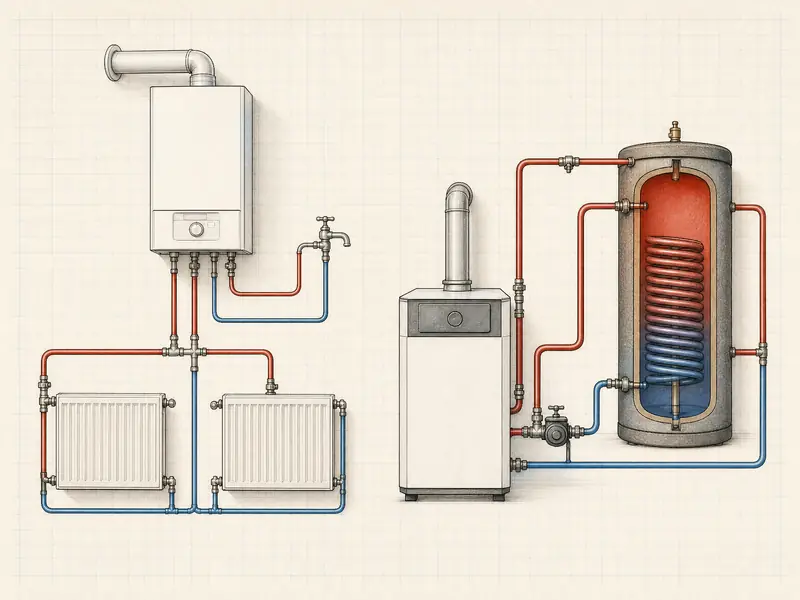
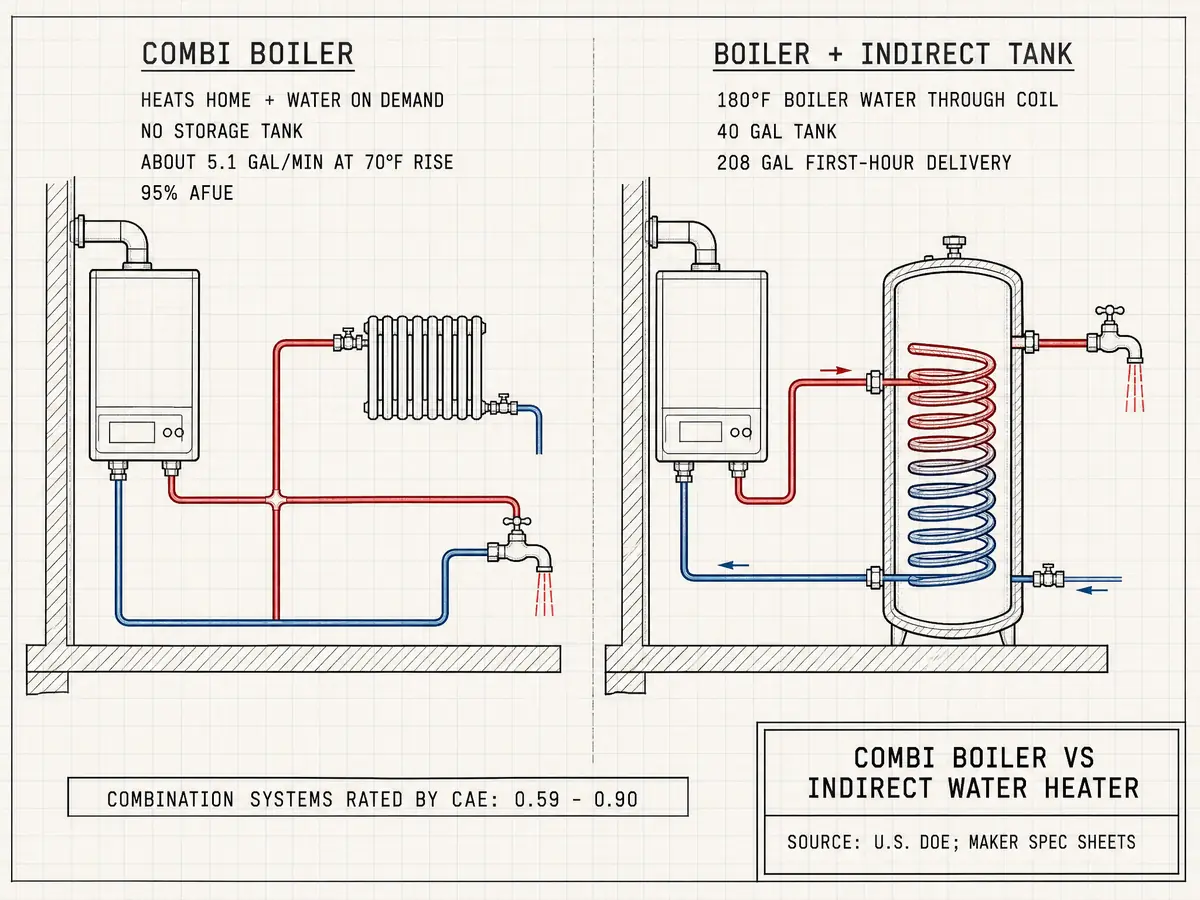
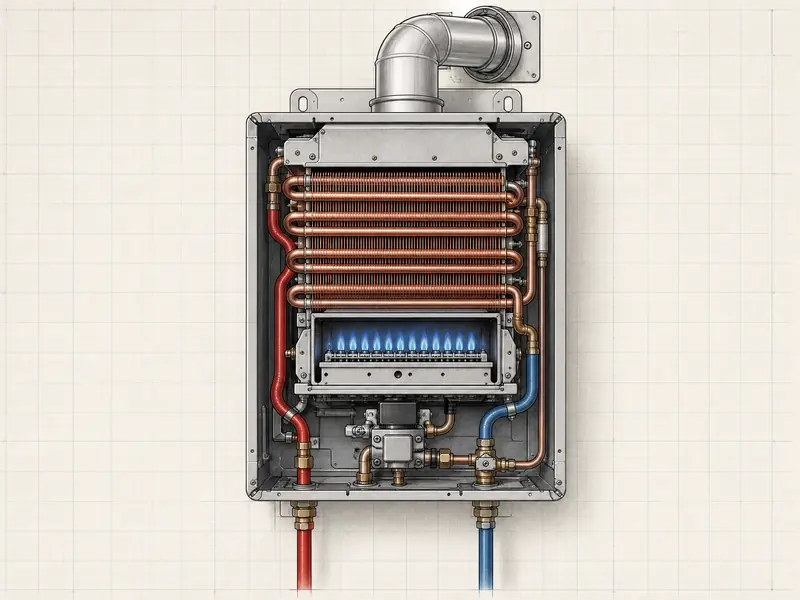
A combi boiler is a single gas boiler that heats the home through radiators or radiant floors and also heats domestic water as it flows, through a built-in heat exchanger. On the hot water side it behaves like a tankless water heater: there is no stored water, and output is limited by burner size and temperature rise. Many current models, including the example below, are condensing.
Navien's NCB-240/130H is a typical example. Its spec page lists a space-heating input of 13,000 to 130,000 Btu/h, a hot water input of 13,000 to 199,900 Btu/h, 95% AFUE, ENERGY STAR certification and hot water flow of 5.1 gallons per minute at a 70°F rise, falling to 4.0 at a 90°F rise (Navien NCB-240/130H). The smaller NCB-190/060H lists 4.1 gallons per minute at a 70°F rise (Navien NCB-190/060H). DOE's rule of thumb for a gas tankless heater, about 5 gallons per minute at a 70°F rise, is in the same range.
Condensing units also bring the condensing requirements: PVC venting and a condensate drain. The difference between the two designs is on condensing vs non-condensing.
What is an indirect water heater?
An indirect water heater is an insulated storage tank with a heat-exchange coil inside, heated by water from a boiler (or, in some systems, a furnace) rather than by its own burner or element. DOE describes it as using "the main furnace or boiler to heat a fluid that's circulated through a heat exchanger in the storage tank" (DOE Energy Saver (archived)).
Because a boiler has far more output than a typical water heater burner, indirect tanks deliver large volumes. Lochinvar's Squire submittal lists, for its 40-gallon SIT040, a first-hour delivery of 208 gallons and continuous delivery of 181 gallons per hour, provided the boiler supplies at least 115,000 Btu/h at 14 gallons per minute of 180°F water (Lochinvar Squire submittal). Those ratings assume 58°F incoming water and a 77°F rise.
DOE notes that indirect systems "can be fired by gas, oil, propane, electric, solar energy, or a combination of any of these," and that the stored energy "allows the furnace to turn off and on less often, which saves energy."
Combi boiler vs indirect water heater: which delivers more?
An indirect water heater usually delivers more hot water in a peak hour than a combi boiler, because it starts with a full tank and reheats with the boiler's whole output. The combi boiler's advantage is space: one appliance and no tank. At heavy simultaneous use, such as two showers and a washer, the combi's flow limit sets the ceiling, just as with any tankless water heater.
The table puts maker figures side by side. They are measured differently: a combi boiler is rated in gallons per minute at a given rise, an indirect tank by first-hour delivery.
| System | Hot water rating | Heat source | Space use |
|---|---|---|---|
| Combi boiler, Navien NCB-240/130H | 5.1 gpm at 70°F rise; 4.7 gpm at 77°F | Built-in burner, up to 199,900 Btu/h for hot water | No storage tank |
| Combi boiler, Navien NCB-190/060H | 4.1 gpm at 70°F rise | Built-in burner, up to 160,000 Btu/h for hot water | No storage tank |
| Indirect tank, Lochinvar SIT040 (40 gal) | 208 gal first-hour delivery | Boiler, at least 115,000 Btu/h at 180°F | Floor-standing tank plus boiler |
| Standard electric tank, A. O. Smith ENJ-40 (38 gal) | 54 gal first-hour rating | 4,500 W element | Floor-standing tank |
Sizing is different for both. DOE says the sizing of a combination system "involves some different calculations than those used for sizing a separate water heating or space heating system." For a stand-alone water heater, the first-hour rating worksheet is the starting point.
How efficient are combi and indirect systems?
Combi and indirect systems are as efficient as the boiler behind them and the losses around it. DOE rates combination water and space heating systems by combined appliance efficiency (CAE): "The higher the number, the more energy efficient. Combination appliance efficiency ratings vary from 0.59 to 0.90." A condensing boiler's AFUE, such as Navien's 95%, describes space heating; it is not the same number as a water heater's UEF, which ENERGY STAR explains is the federal measure for water heaters.
For indirect systems, DOE's condition is "a high-efficiency boiler and well-insulated tank," ideally with the boiler set to "cold start" so it does not keep its water hot between calls. By that logic, a large old boiler held at temperature all summer to serve a tank gives up much of the advantage, and a separate water heater can come out ahead. For the main efficiency metrics, see water heater efficiency and energy costs.
What about tankless coil water heaters?
A tankless coil water heater heats domestic water as it flows through a coil inside the boiler or furnace, with no storage tank. DOE says these units "are most efficient during cold months when the heating system is used regularly but can be an inefficient choice for many homes, especially for those in warmer climates" (DOE Energy Saver (archived)). The reason is the same summer problem: the boiler has to fire just to make hot water.
DOE also calls indirect water heaters "a more efficient choice for most homes, even though they require a storage tank." DOE lists tankless coil systems as typically electric, oil or gas-fired. Replacing one is a natural point to compare an indirect tank, a combi boiler and a stand-alone heater.
Which homes suit a boiler-fed water heater?
A boiler-fed water heater suits homes that already heat with a hot-water boiler, radiators or radiant floors. DOE notes that most combination systems "are usually designed for new construction," though "some retrofit units" work with an existing water heater, and that combination systems usually cost more up front than separate units while installation and maintenance "may be less," since there is one heat source and fewer parts.
Rough fits, based on the maker figures above: an indirect tank for larger households with high peak demand and a good boiler; a combi boiler for smaller homes short on space with modest simultaneous use; a stand-alone water heater for homes with forced-air heat or an oversized, aging boiler. DOE says installation is best left to "a qualified plumbing and heating contractor," and gas, venting and boiler work often needs a permit; the local building department sets the rules. The buying guide covers fuel and cost questions that apply to all of them.
Sources and scope
Sources: the archived DOE Energy Saver page on tankless coil and indirect water heaters (June 2026 snapshot), the DOE sizing page (archived), Navien's NCB-240/130H and NCB-190/060H product pages, Lochinvar's Squire SIT-Sub-03 submittal and A. O. Smith's AOSRE50603 spec sheet, checked October 2026. One maker's figures are shown per row as examples only. Not used: installer prices, unsourced heating-load rules of thumb or brand rankings.
Frequently asked
Can a combi boiler run two showers at once?
It depends on the model and the incoming water temperature. A combi boiler rated at about 5 gallons per minute at a 70°F rise covers two 2.5 gpm showers on paper, with nothing left for a third fixture.
Do I need a boiler to use an indirect water heater?
Yes, or another hydronic heat source. DOE notes indirect systems can be fired by gas, oil, propane, electric or solar sources, but the tank itself has no burner.
Does a combi boiler need a condensate drain?
Condensing models do, along with PVC or other approved venting. The manual lists the vent and drain requirements.
Is an indirect water heater worth it with an old boiler?
Less often. DOE's efficiency case assumes a high-efficiency boiler and a well-insulated tank; an old boiler that must fire in summer just to heat the tank loses much of the advantage.
What is the difference between AFUE and UEF?
AFUE rates a boiler or furnace for space heating over a season. UEF rates a water heater on DOE's hot water test. Combined water and space heating systems carry a CAE instead, on a 0.59 to 0.90 spread per DOE.
Can a tankless coil be replaced without changing the boiler?
Sometimes. Whether the existing boiler can feed an indirect tank depends on its output and controls, which a heating contractor should check before anything is bought.
Related reading
Start over at types of water heaters compared · more in Other types