
Other types
Solar Water Heaters: How They Work and Fit
A solar water heater uses roof collectors to preheat water into a storage tank; ENERGY STAR says a certified system can halve annual hot water costs, with a gas or electric backup covering the rest.
Compiled by the Tank & Tankless desk · Revised
On this page
At a glance
- DOE divides systems into active (pumps and controls) and passive (none) in its Energy Saver solar page (archived).
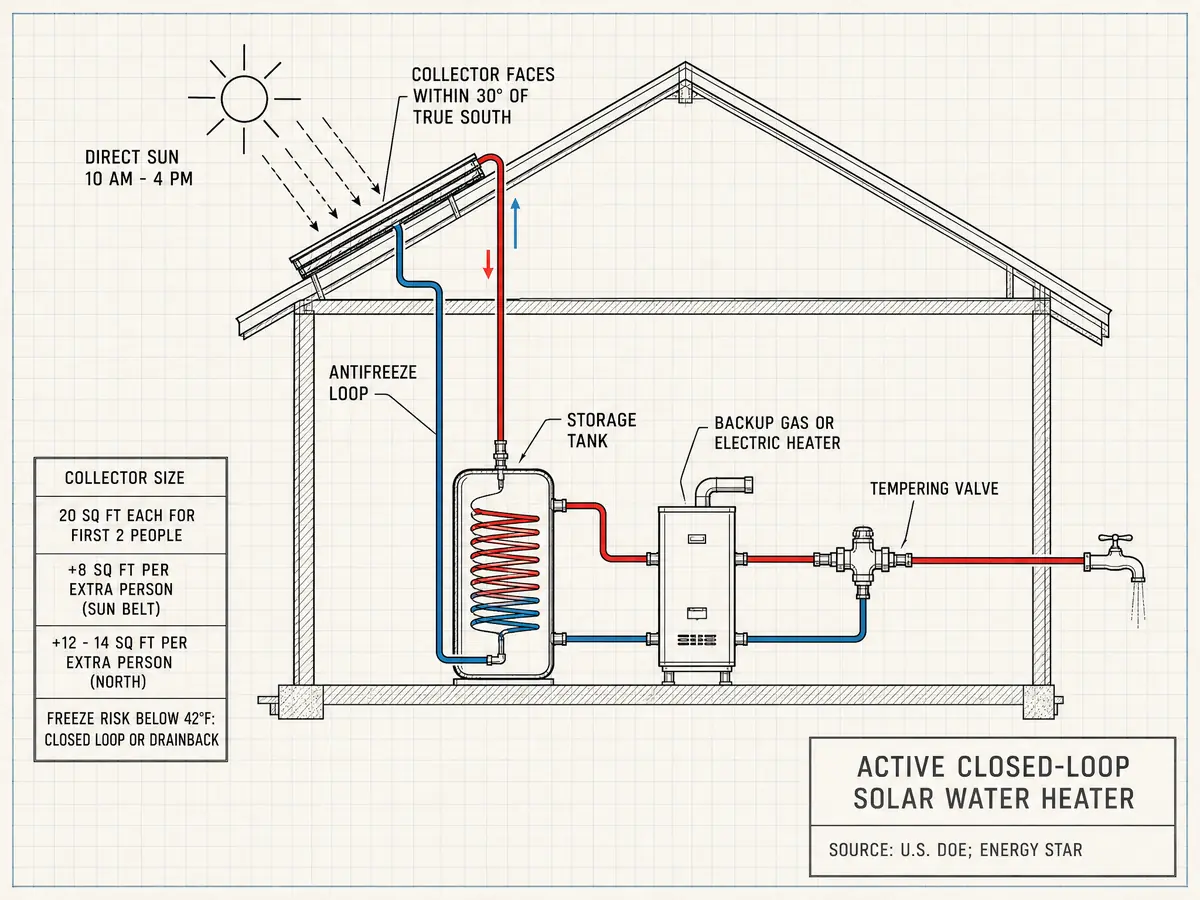
- DOE sizing: about 20 square feet of collector for each of the first two people, then 8 square feet per extra person in the Sun Belt or 12 to 14 in the north.
- Where temperatures may fall below 42°F, ENERGY STAR advises a closed-loop antifreeze or drainback system.
- ENERGY STAR certification sets solar uniform energy factor (SUEF) floors of 3.00 (electric backup) and 1.80 (gas backup).
- DOE puts routine service on simple systems at once every 3 to 5 years, and closed-loop glycol is normally replaced on that cycle too.
- The federal 25D credit ended for expenditures after December 31, 2025 (IRS).
- 1/2Cut in annual hot water costs from an ENERGY STAR systemENERGY STAR
- 20 sq ftCollector area per person for the first two peopleDOE Energy Saver (archived)
- 42°FFreeze-risk threshold for choosing antifreeze or drainbackENERGY STAR
- 3–5 yrsTypical service interval for simple systemsDOE Energy Saver (archived)
How does a solar water heater work?
A solar water heater circulates water or a heat-transfer fluid through collectors on the roof, where sunlight warms it, and stores the heat in an insulated tank. The tank then feeds a conventional water heater, which tops up the temperature on cloudy days and at times of heavy use. ENERGY STAR describes certified systems as "generally designed for use with an electric or gas back-up water heater" (ENERGY STAR).
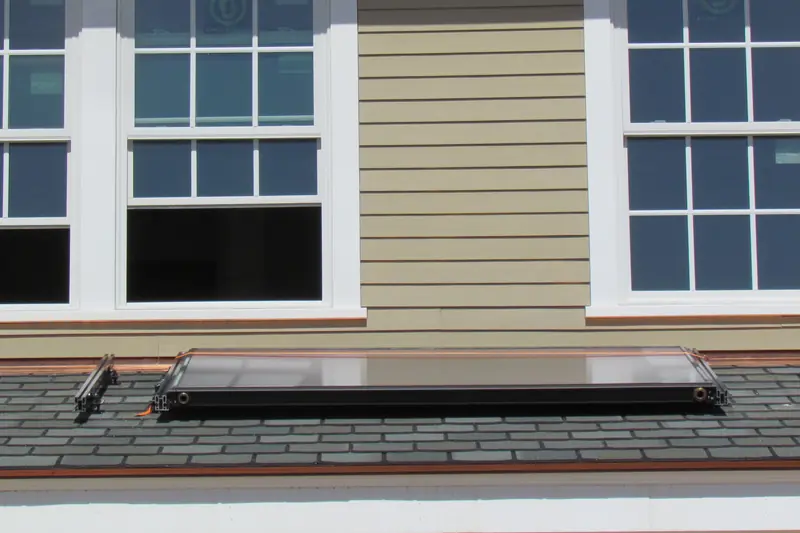
Collectors come in three main forms. Flat-plate collectors are the common rooftop panel; ENERGY STAR says two of them provide "roughly half of the hot water needed to serve a family of four." Evacuated-tube collectors are the most efficient, work down to -40°F and can cost twice as much per square foot. Batch, or integral collector-storage (ICS), units heat water in the collector itself (ENERGY STAR how it works).
Active or passive solar water heater?
An active solar water heater uses pumps and controls to move fluid; a passive one relies on the sun and gravity alone. DOE says passive systems "are typically less expensive than active systems, but they're usually not as efficient," and "may be more reliable and may last longer" (DOE Energy Saver (archived)).
Active systems split further. Direct systems pump household water through the collectors and "work well in climates where it rarely freezes." Indirect systems pump "a non-freezing, heat-transfer fluid through the collectors and a heat exchanger," which suits cold regions. Passive designs include batch units and thermosyphon systems, where the tank sits above the collector and warm water rises into it; DOE notes most thermosyphon systems hold 40 gallons.
| Design | Moves fluid by | Freeze handling | Trade-off |
|---|---|---|---|
| Active direct | Pump, household water | For climates where it rarely freezes | Household water in the collector |
| Active indirect (closed loop) | Pump, antifreeze fluid and heat exchanger | ENERGY STAR option below 42°F | Glycol change every 3–5 years |
| Drainback | Pump; fluid drains back automatically | ENERGY STAR option below 42°F | Collectors sit empty when idle |
| Passive thermosyphon | Natural convection, tank above collector | Per maker | Fewer parts; most hold 40 gal |
| Passive batch (ICS) | None; water heats in collector | Per maker | Can get very hot; tempering valve |
How big a solar water heater do you need?
A solar water heater for a typical household needs about 20 square feet of collector for each of the first two people, plus 8 square feet per additional person in the Sun Belt or 12 to 14 square feet in the northern US, according to DOE's sizing page (DOE Energy Saver (archived)). By that rule, a family of four needs about 56 square feet in the Sun Belt and 64 to 68 square feet farther north.
Storage follows the collector. DOE says a 50- to 60-gallon tank usually suffices for a small household and an 80-gallon tank works well for three to four people; active systems typically use about 1.5 gallons of storage per square foot of collector. That puts a 56-square-foot array near 84 gallons. Siting matters as much as size: ENERGY STAR wants the collector in direct sun between 10 a.m. and 4 p.m. all year and a collector facing within 30° of true south, not magnetic south.
The backup heater is sized the normal way, against peak-hour demand, since it must carry the house through a run of gray days. The worksheet is on the water heater sizing page.
What about freezing weather?
In freezing weather a solar water heater needs either antifreeze in a closed loop or a drainback design. ENERGY STAR's rule: "if there is a good chance that temperatures will fall below 42°F, choose either a closed-loop system with antifreeze as the heat transfer fluid, or a system that automatically drains back," per ENERGY STAR's solar page. Note that the threshold sits 10 degrees above freezing, so a climate with only light frosts still qualifies.
Direct and batch systems carry the most risk, since household water sits in the collector. Evacuated tubes hold up best in cold sun. Overheating is the opposite hazard: ENERGY STAR warns that in batch systems water "can remain in the collector for long periods of time if household demand is low, making it very hot," and calls a tempering valve "your protection from scalding at the tap." CPSC's burn times (2 seconds at 150°F) show why (temperature and scalds).
How much can a solar water heater save?
A certified solar water heater can cut annual hot water costs in half, ENERGY STAR says. Water heating is about 18% of home energy use, per DOE, so the household-level effect is real but bounded. How much a given home saves depends on sun hours, hot water use, the backup fuel and its price.
The certification floors show how much the backup matters: an ENERGY STAR system needs an SUEF of 3.00 or higher when the backup is electric and 1.80 or higher when it burns gas, plus warranties of at least 10 years on the collector (ENERGY STAR key criteria).
Federal help is gone. The 25D credit "will not be allowed for any expenditures made after December 31, 2025," and an installation completed after that date counts as a later expenditure, per the IRS. A heat pump water heater is the usual comparison for an all-electric home; see the heat pump section.
How much upkeep does a solar water heater need?
A solar water heater needs little routine upkeep: DOE puts regular service on simple systems at once every 3 to 5 years, ideally done by a solar specialist. Systems with pumps and controllers "usually require a replacement part or two after 10 years." Glycol in closed loops "normally should be changed every 3–5 years" (DOE Energy Saver, maintenance (archived)).
Hard water scales collectors too. DOE suggests a water softener or circulating "a mild acidic solution (such as vinegar)" through the collector or domestic loop every 3 to 5 years. The backup tank needs the usual care: flushing, anode checks and a T&P valve test, covered in the maintenance schedule.
Sources and scope
Sources: archived DOE Energy Saver pages on solar water heaters, sizing and solar maintenance (May–July 2026 snapshots), ENERGY STAR's solar product and how-it-works pages and Version 5.0 key criteria, CPSC Publication 5098 and the IRS notice on 25D, checked October 2026. Collector areas for a family of four and the 84-gallon storage figure are calculated from DOE's rules. Not used: solar lifespan claims (no primary source found), installer prices and payback promises.
Frequently asked
How long does a solar water heater last?
No federal source gives a single lifespan figure. DOE says passive systems may last longer than active ones and that systems with electrical parts usually need a replacement part or two after 10 years; ENERGY STAR requires at least a 10-year collector warranty.
Does a solar water heater work in winter?
Yes, at lower output. Indirect closed-loop and drainback systems are built for freezing climates, and evacuated tubes work down to -40°F, per ENERGY STAR; the backup heater does more of the work in short winter days.
Can a solar water heater go on a north-facing roof?
ENERGY STAR's guidance is south-facing, within 30° of true south, with direct sun from 10 a.m. to 4 p.m. A north-facing roof misses that; a ground or wall mount may work instead.
Is a tankless heater a good backup for solar?
Only a model the maker approves for preheated water. Many tankless units cap the inlet temperature; one maker's small electric tankless line lists a maximum inlet of 86°F, which solar-heated water can exceed.
Is a point-of-use heater enough as a solar backup?
No. ENERGY STAR rules them out for this job because a fixture-sized heater cannot carry the whole house when the collectors are idle.
What is the difference between solar water heating and solar panels?
Solar water heating collects heat directly in fluid. Photovoltaic panels make electricity, which can run a heat pump or electric water heater; the two are separate systems with separate ratings.
Related reading
Start over at types of water heaters compared · more in Other types