
Tank
Gas Water Heater Guide
A gas water heater burns natural gas or propane under a 20- to 80-gallon tank and vents the exhaust outdoors; the vent type, the first-hour rating and the UEF decide which model fits.
Compiled by the Tank & Tankless desk · Revised
On this page
At a glance
- Most gas storage tanks use non-condensing burners vented through Type B metal pipe by natural draft, per DOE's 2024 final rule.
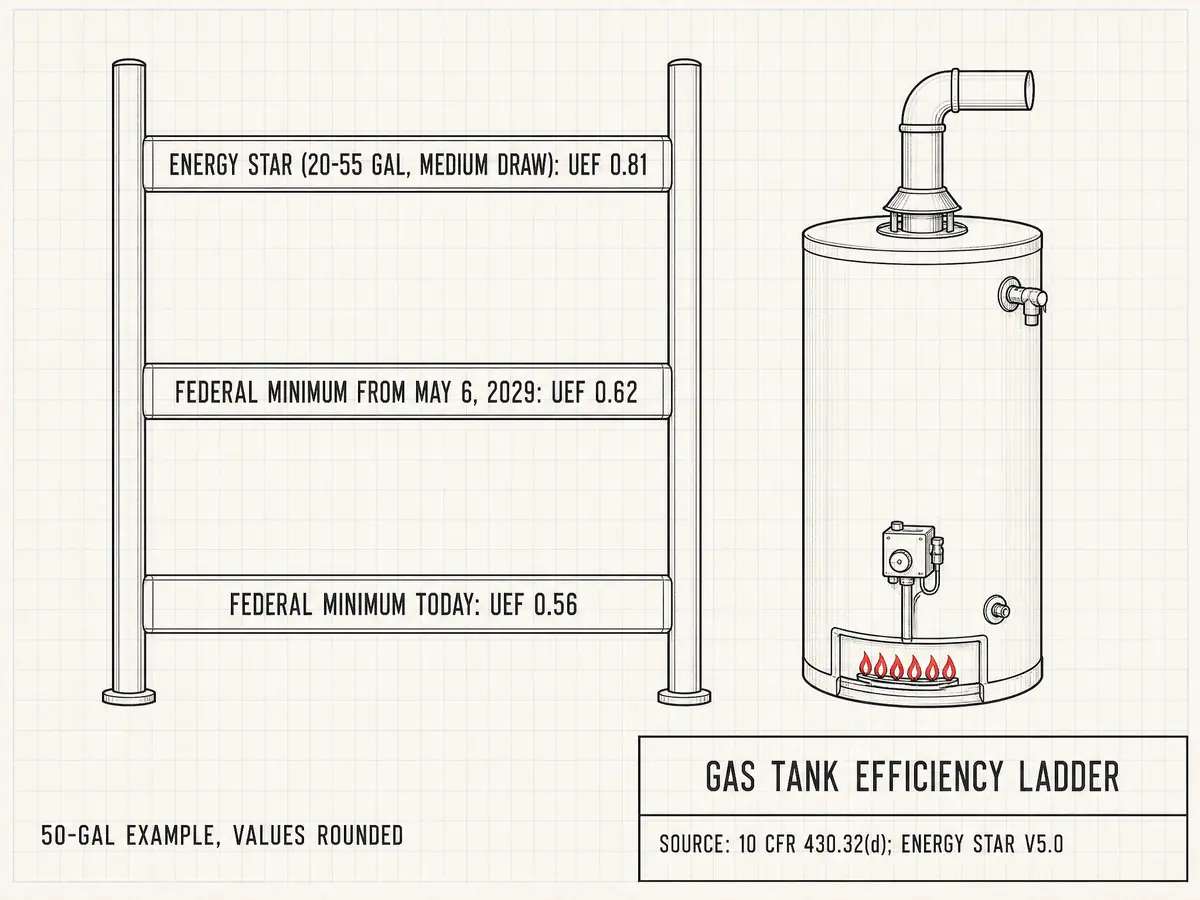
- For a 50-gallon medium-draw gas tank, the federal minimum works out to about 0.56 UEF today and about 0.62 from May 6, 2029 (derived from 10 CFR 430.32).
- ENERGY STAR gas tanks reach 0.81 UEF or more (55 gallons or less, medium draw) and save a family of four about $25 a year.
- The 2029 rule asks gas tanks for a moderate gain that non-condensing designs with flue dampers can meet; gas water heaters are not banned.
- A. O. Smith's manual calls for draining and flushing at six months and at least yearly after that, and for operating the T&P valve once a year.
- DOE's rulemaking used an average installed cost of $1,578 for a gas storage water heater.
- 0.81+ENERGY STAR UEF for a medium-draw gas tank of 55 gal or lessENERGY STAR
- $25/yrSaving of an ENERGY STAR gas tank for a family of fourENERGY STAR
- $1,578DOE's average installed cost for a gas storage tankFederal Register
- $179–$235EnergyGuide yearly cost range, medium-FHR natural gas tank16 CFR Part 305
How does a gas water heater work?
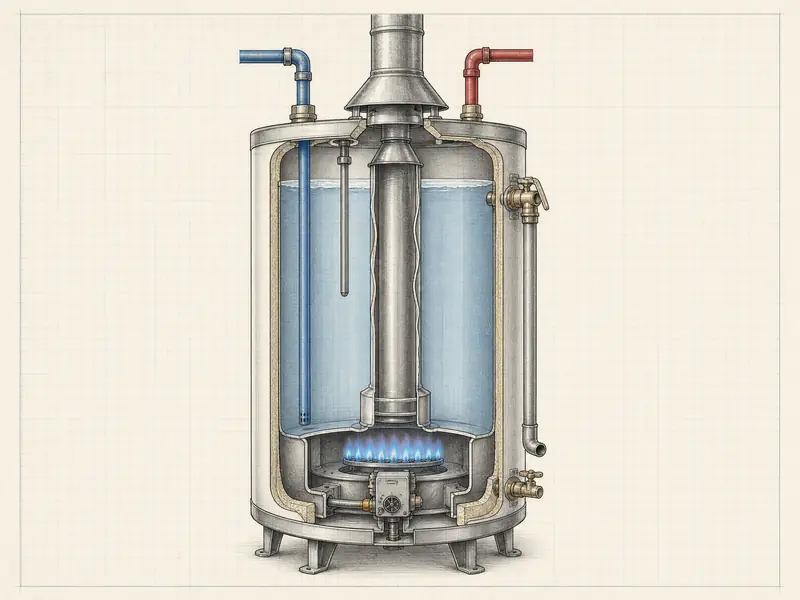
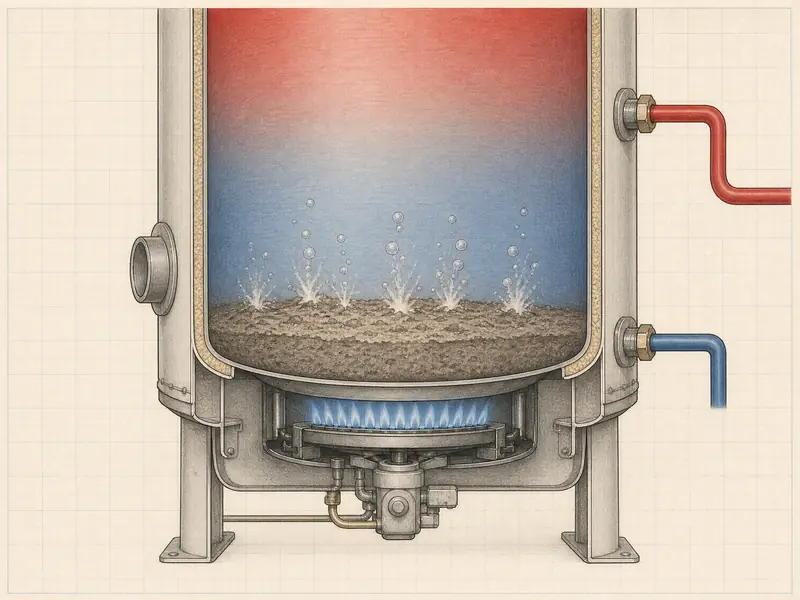
A gas water heater runs a burner under the bottom of a steel tank, and the hot exhaust rises through a flue pipe up the center of the tank before it leaves through the vent. Cold water enters near the bottom through the dip tube and hot water leaves from the top, the same flow pattern every storage tank uses. A thermostat on the gas valve lights the burner when the tank cools below its setting.
The fuel is natural gas or propane. ENERGY STAR notes that a round 3- to 4-inch exhaust vent on top of the tank is the giveaway that a heater burns gas.
Because the flue runs through the water, a gas tank loses heat up the vent as well as through its walls. That is why DOE says an insulating blanket does little on a gas model: most of the loss goes up the flue, not through the jacket.
What are the gas water heater venting types?
Gas tanks come in three broad venting styles: atmospheric (natural draft), power vent and direct vent. Which one fits depends on where the heater sits and where the exhaust can go.
- Atmospheric. Hot exhaust rises on its own through a Type B metal vent, usually into a chimney or a vertical vent shared with a furnace. DOE notes this is how the vast majority of gas storage tanks are built.
- Power vent. A fan pushes the exhaust out, which allows longer or sideways vent runs through a wall. Bradford White sells this as its PV Series, and DOE lists fan-assisted designs among those that cut venting losses.
- Direct vent and power direct vent. These draw combustion air from outdoors and send exhaust back out through a sealed system. A. O. Smith sells "Power Direct Vent" gas models, and DOE names the atmospheric sealed-combustion heater as another design that trims venting losses.
A shared vent has to be sized for every appliance on it. The San Diego water heater bulletin says Type B vents must be sized for the new water heater plus any other gas appliances that share the system. Condensing gas tanks are a fourth, rarer case: ENERGY STAR says they vent through vertical PVC and need a condensate drain. The condensing vs non-condensing comparison explains why the exhaust cools enough to condense.
How efficient is a gas water heater?
A standard gas water heater converts a little over half of its fuel into delivered hot water on the federal test: about 0.56 UEF for a 50-gallon medium-draw tank, using the volume formula in 10 CFR 430.32 (derived). ENERGY STAR's Version 5.0 criteria set 0.81 or more for medium-draw tanks of 55 gallons or less, 0.86 for high-draw tanks and for anything over 55 gallons, plus an FHR of at least 51 gallons.
The certified models get there with better insulation, heat traps and more efficient burners. ENERGY STAR says that adds up to 8% less energy and a $25 yearly saving for a family of four.
The yellow EnergyGuide label gives a yearly cost range by size. For natural gas tanks with a medium first-hour rating (51 to 74.9 gallons), the FTC ranges run $179 to $235 a year; high-FHR tanks of 75 gallons or more run $227 to $336. Propane costs about twice as much on the same label. EIA's 2025 residential gas price averaged $15.34 per thousand cubic feet, about $1.48 a therm (derived).
The May 2029 standard raises the gas floor only a little. For the same 50-gallon tank it becomes about 0.62 UEF (derived). DOE chose that "moderate increase" over its condensing-level option, and noted that a gas-actuated flue damper is likely the cheapest way to meet it. The 2029 rules page has the full status as of October 2026.
| Measure | Standard gas tank | ENERGY STAR gas tank |
|---|---|---|
| UEF, 50 gal medium draw | About 0.56 today, 0.62 from 2029 (derived) | 0.81 or more |
| UEF, over 55 gal | Formula by volume | 0.86 or more |
| Minimum first-hour rating | None set | 51 gallons |
| Warranty | Maker's choice | 6 years or more on the system |
| EnergyGuide cost, medium FHR | $179–$235 a year (whole range) | Low end of the range |
What size gas water heater do you need?
Pick the gas tank whose first-hour rating at least matches your busiest hour of hot water use. DOE's archived sizing worksheet counts 20 gallons per shower, 2 per shave, 3 for hand dishwashing, 7 per dishwasher load and 25 per top-loading wash (15 for a front-loader). A morning with three showers, a shave and some dishwashing needs about 66 gallons.
Tank volume alone does not set the FHR. Per DOE, burner input matters as much as gallons, so two 40-gallon tanks can carry different ratings. Compare the "Capacity (first hour rating)" figure on each EnergyGuide label; the sizing guide has the full worksheet.
What does a gas water heater need to be installed safely?
A gas water heater needs a correctly sized gas line, a vent that carries all exhaust outdoors, a T&P discharge line and usually a permit; that work belongs to a licensed plumber or gas fitter. Rules are local, but California's rules show the usual list. San Diego's bulletin calls for a plumbing permit on new and replacement heaters, and it bars gas-fired heaters from bathrooms, bedrooms and clothes closets unless they are direct vent.
- Garages. Burners and pilots must sit at least 18 inches above the floor where flammable vapors could collect.
- Earthquake strapping. California requires straps in the upper third and lower third of the tank, with the lower strap at least 4 inches above the controls.
- T&P discharge. The relief line must not be reduced in size or fitted with a shutoff, and it may not end in the drain pan.
- Drain pan. A. O. Smith recommends a metal pan at least two inches wider than the heater, piped to a drain.
Never cap, plug or disable the T&P valve. The installation and code guide covers expansion tanks and discharge piping in more detail.
How do you maintain a gas water heater?
Drain and flush the tank, test the T&P valve and check the anode on the schedule in the maker's manual. The A. O. Smith gas manual says to drain, flush and pull the anode for inspection after the first six months, then at least once a year. It says to operate the T&P lever yearly, inspect the valve every 2–4 years per its label, and have a qualified person inspect the valve and discharge pipe at least every five years.
The anode must stay in the tank; A. O. Smith says the warranty is void without one. Softened water uses it up faster, so check it yearly from the start in a softened home; DOE's older advice of every three to four years is looser than the maker's. If the hot water smells of rotten eggs, the rotten egg smell guide covers the anode swap the makers suggest. Keep the setpoint at 120°F, the setting DOE and the CPSC recommend, unless a household health need calls for hotter storage with a mixing valve.
Sources and scope
Based on the May 2024 DOE final rule (89 FR 37778), 10 CFR 430.32 and 16 CFR Part 305 on eCFR, ENERGY STAR's Version 5.0 criteria and savings pages, DOE Energy Saver pages (archived May–July 2026), EIA price data, the City of San Diego water heater bulletin RESD-5-1 and the A. O. Smith residential gas manual, all checked October 2026. The 50-gallon UEF figures come from the federal volume formulas (derived). Left out: brand rankings, retail prices, carbon monoxide statistics and installer anecdotes.
Frequently asked
Is a power vent gas water heater worth it?
It makes sense when the heater cannot reach a chimney or vertical vent, because the fan lets the exhaust leave sideways through a wall. The fan needs a nearby electrical outlet, so the heater depends on household power.
Can a gas water heater go in a closet or bedroom?
In California, for example, only a direct-vent gas heater may be installed in a bathroom, bedroom or clothes closet. Check your local code before planning a location.
Why is a gas water heater raised 18 inches in a garage?
Gasoline and solvent vapors are heavier than air and collect near the floor. Raising the burner and pilot at least 18 inches keeps the ignition source above them, which is what California's code requires.
How often should a gas tank's T&P valve be tested?
A. O. Smith says to lift the lever once a year and to have a qualified person inspect the valve and its discharge pipe at least every five years. DOE's older guidance suggested a check every six months. If the valve keeps dripping or will not reseat, have it replaced.
Does an insulation blanket help a gas tank?
DOE says a blanket does little on a gas heater, because most of its heat loss goes up the flue. Blankets are an electric-tank measure.
Where do I find a gas tank's FHR?
On the yellow EnergyGuide label, in the top left corner, listed as "Capacity (first hour rating)". ENERGY STAR measures it at a 125°F outlet temperature, starting from a fully heated tank.
Are gas water heaters being phased out in 2029?
No. The 2029 federal standard asks gas tanks for a modest efficiency gain that non-condensing designs can meet. New gas tanks stay on sale.
Related reading
Start over at the water heater type index · more in Tank