
Care
Hard Water and Your Water Heater
Hard water and water heaters don't mix well: heated calcium and magnesium drop out as sediment in tanks and scale in tankless heat exchangers, so test hardness and plan care around it.
Compiled by the Tank & Tankless desk · Revised
Ownership note. Tank & Tankless has the same owners as SoftPro Water Systems and Quality Water Treatment, two water treatment stores. We link to them only on pages about hard water, scale and well-water odor, and only for products they sell. Figures come from DOE, ENERGY STAR, the Federal Register, IRS, USGS and maker manuals, checked October 2026. Store product descriptions are the store's own claims. Ownership and store links
On this page
At a glance
- USGS classes water over 180 mg/L as calcium carbonate as very hard and 0–60 mg/L as soft.
- USGS says scale from heated hard water can shorten equipment life, raise heating costs and lower electric heater efficiency.
- Rinnai's manual lists 200 mg/L (about 12 gpg) as its total-hardness limit; Noritz's warranty does not cover damage from water harder than 12 gpg.
- A. O. Smith's gas Use & Care Guide ties the amount of tank sediment to the hardness of the tap water.
- A softener removes hardness, but A. O. Smith says softened water wears the tank's anode rod faster.
- 1 grain per gallon equals about 17.1 mg/L, which lets you compare test kits with utility reports.
- >180 mg/LHardness USGS classes as very hardUSGS
- 200 mg/LRinnai's listed total-hardness limit for its tankless unitsRinnai
- 12 gpgHardness above which Noritz's warranty excludes damageNoritz
- 17.1mg/L in one grain per gallonDerived from Rinnai and Noritz tables
How does hard water affect water heaters?
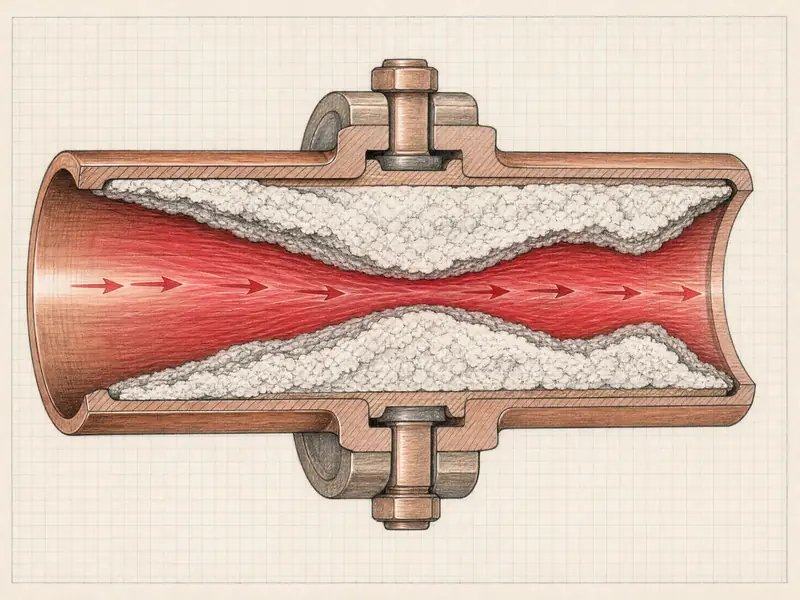
Hard water affects water heaters by leaving mineral deposits wherever the water is heated. The USGS Water Science School explains that when hard water is heated, solid calcium carbonate can form, and that this scale can reduce equipment life, raise water heating costs, lower the efficiency of electric water heaters and clog pipes.
The deposit shows up differently by heater type. In a storage tank, loose minerals settle to the bottom as sediment. In a tankless unit, they bake onto the walls of the heat exchanger as scale. Both are made worse by heat: Rinnai's manual says scale builds faster at a high temperature setting, and DOE's archived guidance notes that a 120°F setting slows mineral buildup. The temperature setting guide explains the trade-offs.
Hard water doesn't mean a heater will fail early, but it shortens the gap between maintenance visits. It is also the main reason makers write hardness limits into their warranties.
How hard is your water?
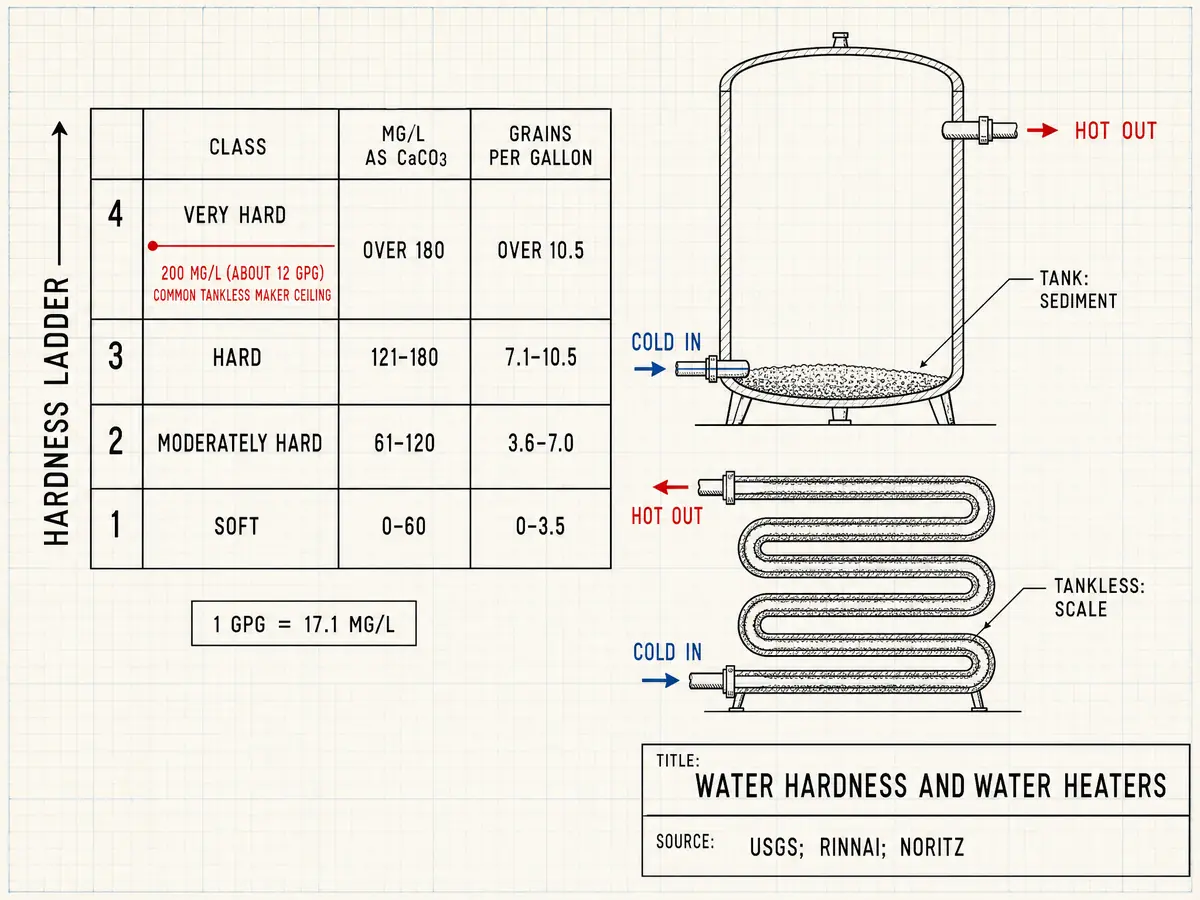
Find out how hard your water is with a test kit or your utility's annual water quality report, then compare the number with the USGS classes. City water reports usually list hardness in mg/L or ppm; test strips and softener sellers often use grains per gallon.
| USGS class | mg/L as calcium carbonate | Grains per gallon (approx.) |
|---|---|---|
| Soft | 0–60 | 0–3.5 |
| Moderately hard | 61–120 | 3.6–7.0 |
| Hard | 121–180 | 7.1–10.5 |
| Very hard | Over 180 | Over 10.5 |
The grain figures come from dividing by 17.1, the ratio Rinnai's and Noritz's tables use (Noritz equates 12 gpg with 200 mg/L). Private wells aren't covered by utility reports, so well owners need their own test at the tap. Well owners should also check for iron and hydrogen sulfide, which cause different problems; see the rotten-egg smell guide.
What does sediment do inside a tank?
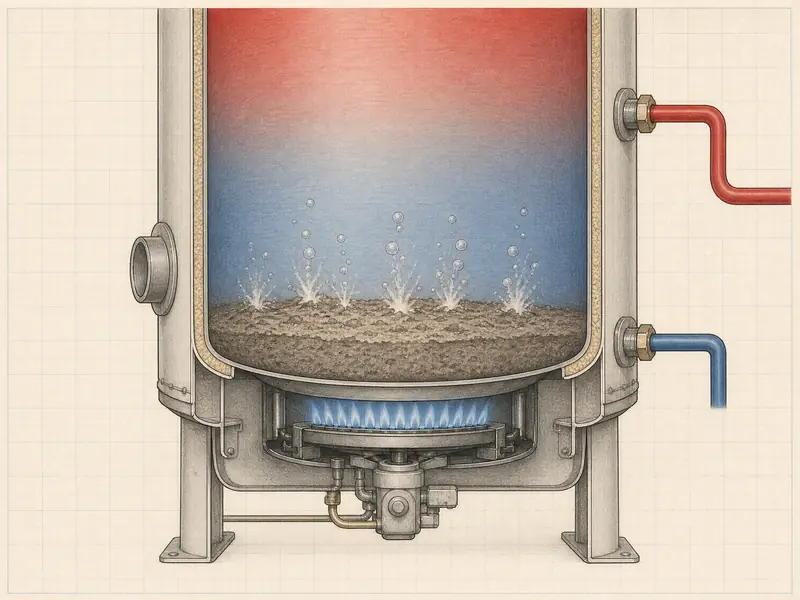
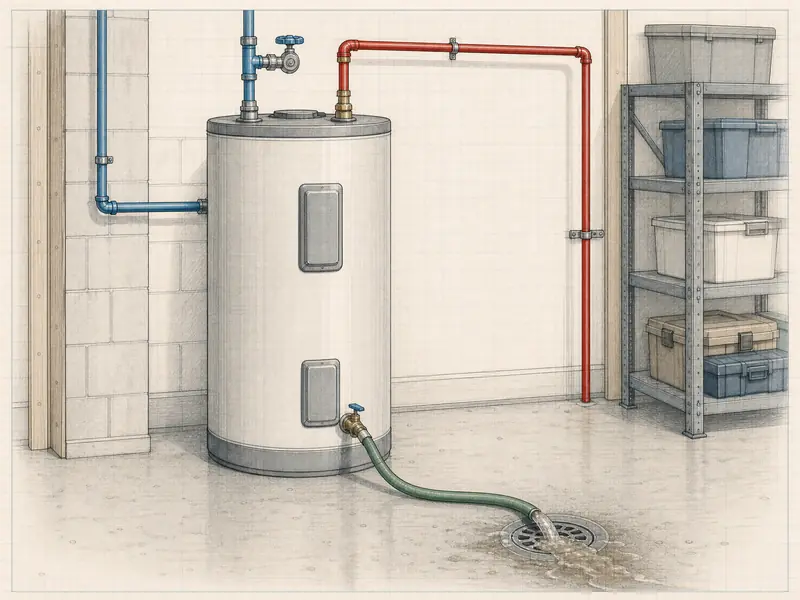
Sediment inside a tank settles on the bottom, where the heat is applied, and slowly reduces how much hot water the heater can deliver. A. O. Smith's gas guide lists sediment or lime in the tank as a cause of getting some hot water but less than before, says buildup can reduce efficiency, and warns that heavy deposits can damage the heater.
On electric tanks, A. O. Smith's installation instructions say sediment on the tank bottom creates noise and may cause premature tank failure. The fix in both manuals is the same: drain and flush the tank, first at six months to see how fast sediment builds, then on the schedule the result suggests. The flushing guide has the steps.
Storage tanks last about 10 to 15 years by DOE's estimate. Hard water doesn't change that figure on paper, but a tank full of sediment works harder and wears its drain valve, so skipping flushes on hard water costs more than on soft.
What does scale do inside a tankless unit?
Scale inside a tankless unit coats the heat exchanger, the part that heats water on demand. American Water Heater's tankless guide says the layer acts as a thermal insulator and that the heater never fully regains peak efficiency once scale has formed, even after cleaning. It gives no percentage, so none is given here.
Makers treat this as a water quality issue, not a defect. Rinnai's manual says components damaged by water quality are not covered and recommends a water softener or its own scale-prevention product from 61 mg/L (its "slightly hard" band, about 4 gpg in its table), with stronger wording from 161 mg/L and a requirement past 200 mg/L. Noritz drops coverage past 12 gpg, and Navien excludes hard water deposits. The tankless hard water guide covers what each maker requires.
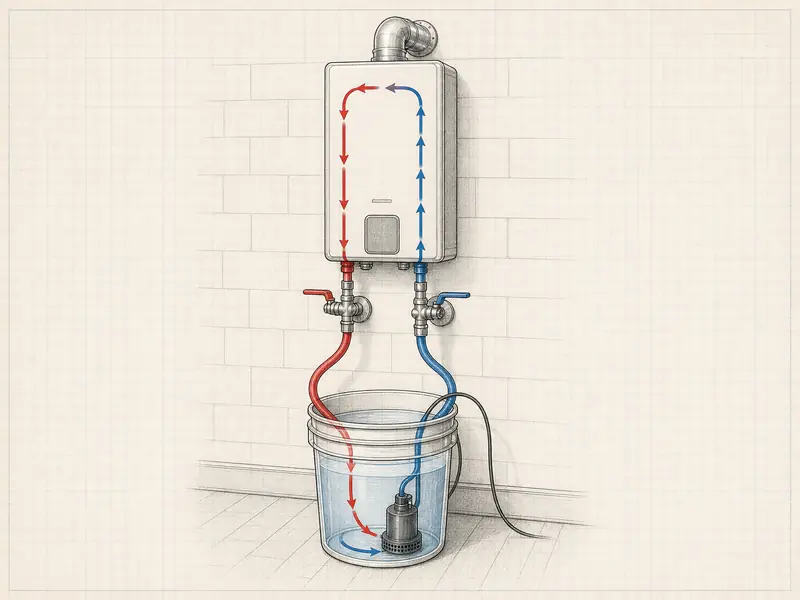
The routine fix is descaling: pumping vinegar or a maker-approved solution through the heat exchanger at least once a year. The tankless descaling guide has the procedure.
What are the signs of hard water damage?
The signs of hard water damage are less hot water, new noises, and white crust at fixtures and fittings. In a tank, rumbling or popping during heating and a drop in hot water supply point to sediment, per A. O. Smith's troubleshooting sections. The water heater noises guide separates sediment sounds from others.
In a tankless unit, watch for temperature swings, slower hot water, a flow that trips off, and maintenance alarms such as Navien's E760 code. White deposits on showerheads and faucet aerators are a sign the water is hard, though not proof of heater damage. A drain that clogs during a flush is another clue; if a tank won't drain, A. O. Smith's guidance is to call a qualified person.
How do you protect a water heater from hard water?
Protect a water heater from hard water by testing first, keeping to the maintenance schedule, keeping the setpoint near 120°F, and treating the water when the hardness calls for it. Flushing a tank and descaling a tankless unit are the baseline; neither depends on buying equipment.
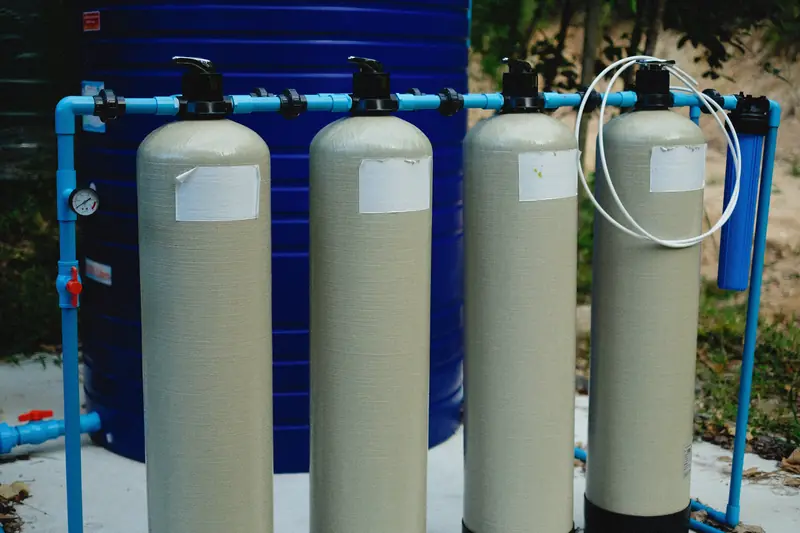
Treatment is optional, and it should follow a test. A water softener removes calcium and magnesium by ion exchange, and it is the treatment Rinnai's manual names alongside its own product. The Fleck 5600SXT (sold by Quality Water Treatment, same owners as this site) is a metered, on-demand softener that its store lists with up to 48,000 grains of capacity. For well water, the SoftPro ECO Well Water Softener (sold by SoftPro Water Systems, same owners as this site) is sold for homes on wells, with the store describing it as reducing hardness.
A softener has a cost for tanks. A. O. Smith says softened water is more corrosive to the tank because sodium replaces calcium and magnesium, and it calls for an anode inspection every year on softened water. Size the softener to the measured hardness and household use, and add yearly anode checks to the plan; the anode rod guide shows what to look for. The softener and scale prevention guide compares softeners with salt-free conditioners.
Sources and scope
Sources: USGS Water Science School on water hardness, Rinnai's SENSEI RX manual, the Noritz N-0751M-DVC warranty, Navien's NPE-A warranty page and operation manual, American Water Heater's tankless guide, A. O. Smith's 2023 gas guide and its electric instructions, plus DOE Energy Saver's archived pages, all opened in October 2026. Grain-per-gallon figures are derived from mg/L. Store product details are the stores' own listings. Percentage efficiency-loss claims for scale, national hard-water statistics and forum reports were left out because no primary source supports them.
Frequently asked
What hardness level damages a water heater?
There is no single threshold. Rinnai lists 200 mg/L (about 12 gpg) as its limit and recommends treatment once water reaches 61 mg/L; Noritz won't cover damage from water above 12 gpg.
Does hard water void a water heater warranty?
It doesn't void the whole warranty, but tankless warranties exclude the damage. Rinnai, Noritz and Navien all exclude scale or hard-water damage. Tank warranties tie coverage to following the manual's care steps.
Is ppm the same as mg/L for water hardness?
For drinking water, yes in practice: 1 ppm is about 1 mg/L. Divide by about 17.1 to get grains per gallon.
Does a tank or a tankless heater handle hard water better?
Both suffer. A tank collects sediment it can flush out; a tankless unit gets scale on its heat exchanger that has to be descaled, and its warranty usually sets a hardness limit.
Will a water softener stop sediment in a tank?
It removes the hardness minerals that make most of it, though grit from pipes or wells can still settle. Keep flushing, and check the anode yearly with softened water.
What flushing schedule suits a heater on hard water?
More often than the yearly minimum. A. O. Smith suggests the first flush at six months shows how fast sediment builds, which sets the interval.
Can hard water cause a water heater to make noise?
Yes. A. O. Smith says sediment on the tank bottom causes varying noise during heating and may lead to early tank failure.
Related reading
Start over at every water heater type, side by side · more in Care