
Fix
Water Heater Leaking: Find the Source
A water heater leaking is most often a loose fitting, a dripping relief valve or startup condensation; only water seeping from the tank body itself means the heater has reached the end of its life.
Compiled by the Tank & Tankless desk · Revised
On this page
At a glance
- First shut off the heat source (breaker, or gas knob to OFF), then close the cold water supply valve at the top of the tank.
- "Almost all leaks occur at connections and are not a tank leak," says the A. O. Smith gas use and care guide.
- A dripping T&P valve usually means house pressure is too high or a thermal expansion tank is missing; A. O. Smith suggests a pressure reducing valve set to 50–60 psi.
- A cold gas tank can drip condensation onto the burner when first lit. It is normal and stops once the water is hot.
- Water from the tank wall or seams cannot be fixed. A. O. Smith notes the tank "will eventually leak" from normal corrosion, and DOE puts tank life at 10–15 years.
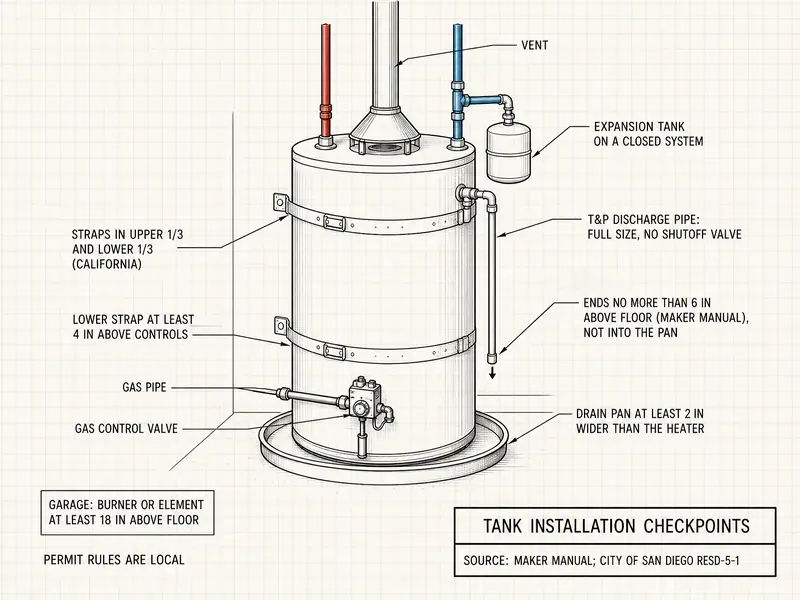
- A metal drain pan at least 2 inches wider than the heater, piped to a drain, limits the damage (A. O. Smith).
- 50–60 psihouse water pressure A. O. Smith recommends setting a PRV toA. O. Smith
- 100 psipressure some homes now exceed, which can cause early tank leaksA. O. Smith
- 6 inmaximum height of the T&P discharge pipe's end above the floorA. O. Smith
- 2 inhow much wider than the heater the drain pan must beA. O. Smith
- 10–15 yrtypical life of a storage tank water heaterDOE Energy Saver (archived)
What should you do first when a water heater is leaking?
When a water heater is leaking, cut the heat source first, then stop the water. On an electric tank, switch off the breaker. Do not touch the heater or the panel while standing in water; if you cannot reach the breaker from a dry spot, call an electrician. For gas, set the control knob to OFF. Then close the cold water supply valve on the pipe entering the top of the tank.
This matches the maker's advice. If a relief valve will not reseat and keeps releasing water, the A. O. Smith electric manual says to disconnect power, close the cold water inlet valve and call a qualified person. For a gas heater sending large amounts of very hot water out of the T&P pipe, the gas guide says to turn the gas off and call for service.
Next, find the source. Dry every pipe, fitting and valve with a towel, then watch where water reappears. Water runs down the outside jacket, so a puddle at the base often starts at the top.
Why is the water heater leaking from the top?
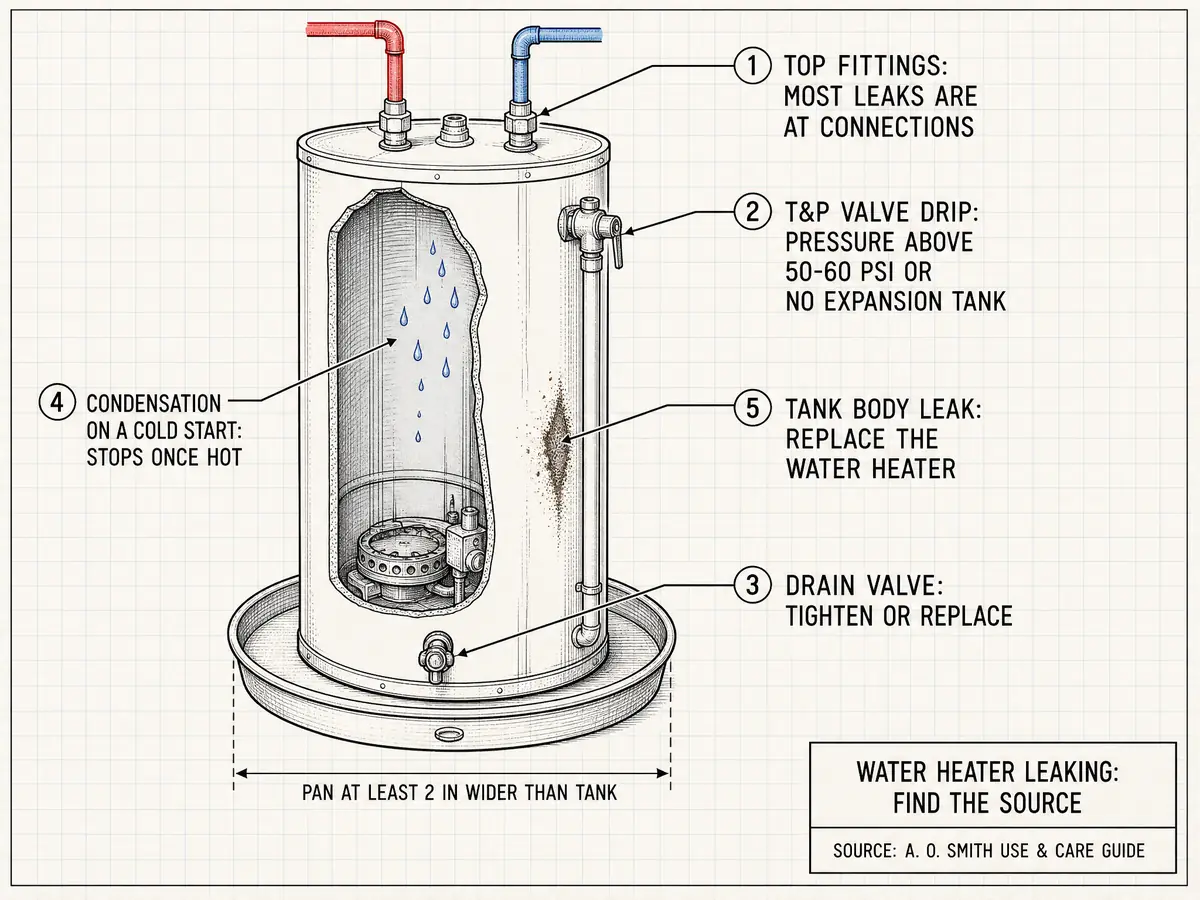
A water heater leaking from the top is almost always leaking at a connection, not from the tank. The usual spots are the hot and cold nipples, the unions or flexible connectors on them, the shutoff valve stem and the threads of the T&P valve or anode port. The A. O. Smith gas guide says it plainly: leaks are frequently in the plumbing system, not the water heater.
A slow drip at a threaded joint can sometimes be stopped by snugging the fitting a little. Corroded nipples, a weeping shutoff valve or a leaking anode port mean draining the tank and replacing parts. If the anode was ever replaced, the maker's steps end with a leak check at its threads, so look there too (see water heater anode rods).
Why is the water heater leaking from the bottom?
A water heater leaking from the bottom has four common sources: the drain valve, the T&P discharge pipe, condensation, or the tank itself. The drain valve sits near the base and can drip from its stem or outlet, especially after a flush stirs sediment into its seat. A drain valve cap or a replacement valve often fixes it (the flushing guide covers this).
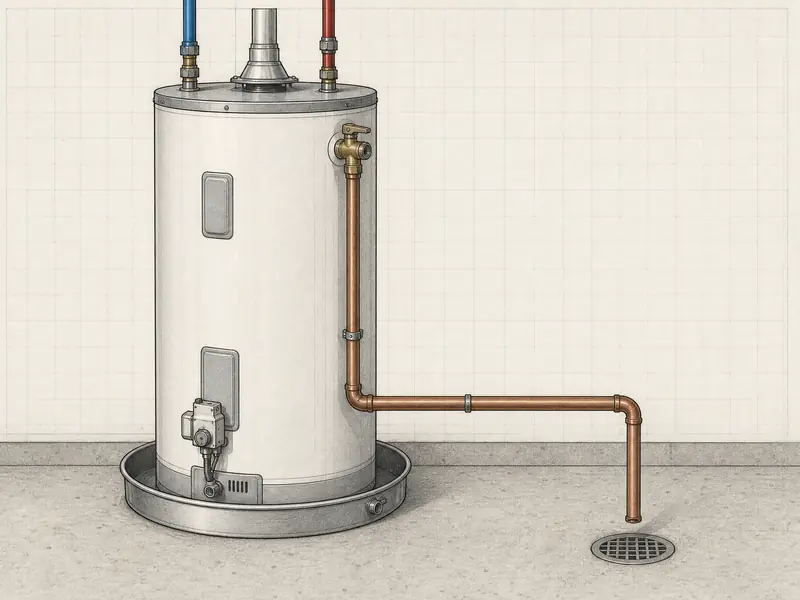
The T&P discharge pipe can fool you. A. O. Smith requires its open end within 6 inches of the floor, so a relief valve release can look like a puddle under the tank. Feel the pipe's open end. If it is wet or warm, the leak is the relief valve, not the tank.
Electric tanks add one more spot: the element gaskets behind the access covers. Turn the power off before opening a cover. A wet element or wet insulation is a job for a pro; if the thermostats have been soaked, A. O. Smith says to replace the whole heater.
If none of those is wet and water seeps from under the jacket or the base, the steel tank has likely corroded through. The A. O. Smith electric manual explains why: once the anode rod is used up, the tank starts to corrode and eventually leaks.
Why is the relief valve dripping?
A relief valve that drips is usually doing its job. The temperature and pressure (T&P) valve opens when tank pressure or temperature is too high. A. O. Smith lists four causes, in order:
- High water pressure. Some homes now exceed 100 psi. The fix is a pressure reducing valve (PRV) on the main line, set to 50–60 psi.
- Thermal expansion. Heated water expands. Most homes now have a check valve or backflow preventer at the meter, so the extra volume has nowhere to go. A sized and pre-charged expansion tank absorbs it. A toilet that runs briefly at night for no reason can be a sign of this pressure spike.
- Debris on the seat. Lifting the lever briefly can flush it out. Stand clear, since the water can be scalding.
- A failed valve. If pressure is 50–60 psi, the expansion tank is working and the valve still drips, a qualified person should replace it.
Never cap, plug or remove a T&P valve or its discharge pipe; the manual warns this could cause an explosion. In California, for example, the San Diego water heater bulletin requires an expansion tank wherever a check valve or backflow preventer closes the system. See water heater installation and code for the parts a correct install should have.
Is it condensation or a leak?
It is condensation if the water shows up only when the tank is cold and stops once it heats. The A. O. Smith gas guide says a freshly lit or refilled gas tank often forms condensation inside. You may hear drips or sizzling on the burner and see a small puddle, and it "will go away once the tank reaches normal operating temperature." Large hot water draws that refill the tank with cold water can bring it back briefly.
Two heater types make water on purpose. Heat pump water heaters produce clean condensate that must run to a drain or condensate pump. ENERGY STAR's installation guide notes the unit must be level for the line to flow. Condensing gas heaters also need a condensate drain. A wet floor near either one may be a blocked or kinked condensate line, not a water leak.
To tell them apart, dry the area and watch: condensation stops once the water is hot, a fitting drips at any temperature, and rusty water from the base points to the tank.
Can a leaking water heater be repaired?
A leaking water heater can be repaired when the leak is at a part: a fitting, connector, drain valve, T&P valve, anode port or element gasket. When the steel tank itself leaks, the heater needs replacing.
DOE puts storage tank life at 10–15 years (DOE Energy Saver, archived), and ENERGY STAR suggests planning a replacement once a tank passes 10 years (ENERGY STAR). Replacement costs and options are on how long water heaters last.
When the new heater goes in, make it leak-tolerant. A. O. Smith recommends a metal drain pan piped to a drain and an automatic leak detector that shuts off the water. In California, San Diego requires a safe pan with a ¾-inch drain wherever a leak could cause damage. A permit is commonly required for replacement, and the rules are local.
| Where the water appears | Likely source | Typical outcome |
|---|---|---|
| Top of tank, on pipes | Nipple, connector, union or shutoff valve | Tighten or replace the fitting |
| T&P discharge pipe | High pressure, thermal expansion, debris or failed valve | PRV, expansion tank or a new T&P valve |
| Drain valve at base | Worn washer or debris in the seat | Cap or replace the valve |
| Inside burner area, cold tank only | Condensation | Normal; stops when hot |
| Element cover (electric) | Element gasket | Gasket or element replaced, power off |
| Tank body or seams, often rusty | Corroded tank | Replace the water heater |
Sources and scope
Sources: A. O. Smith gas (2023) and electric use and care manuals, San Diego bulletin RESD-5-1 (May 2025), ENERGY STAR's 2024 heat pump install guide and DOE's archived pages, checked October 2026. San Diego is only a code example. Not included: repair quotes, sealant products and forum anecdotes.
Frequently asked
Is a leaking water heater dangerous?
It can be. Water near a 240 V heater or panel is a shock risk, and a relief valve releasing very hot water is a burn risk and can mean the tank is overheating. A slow drip at a fitting is mainly a water damage risk. Shut off the heat source and the cold supply, then sort out the cause.
Why is water in the water heater drain pan?
A pan collects anything from condensation on a cold start to a T&P release or a tank leak. Note when it fills. Water only after the tank refills cold points to condensation, while a steady fill points to a fitting, valve or the tank.
Why does a new water heater leak?
In the first days, the cause is usually a connection that was not fully tightened, or condensation while the tank first heats. A T&P valve that drips on a new heater often means high house pressure or a missing expansion tank. The tank itself rarely fails new.
Can you use a water heater that is leaking?
If the leak is a slow drip at a fitting, many owners keep using the heater briefly while a repair is arranged, with a pan or bucket in place. If the tank body leaks or the relief valve keeps discharging, shut it down and arrange a replacement or service.
Why is the water heater leaking from the overflow pipe?
The "overflow" pipe is the T&P discharge pipe. Water there means the valve opened because pressure or temperature was too high, or because debris or wear keeps it from seating. The usual fixes are a pressure reducing valve, an expansion tank or a new valve.
How do you stop a tankless water heater from leaking?
Close the isolation valves and shut off power and gas. Common leak points are the valve fittings, the pressure relief valve and, on condensing units, the condensate line. A unit that froze can crack its heat exchanger. Rinnai notes that freeze damage is not covered by its warranty, so drain units that may freeze during a power loss.
Related reading
Start over at every water heater type, side by side · more in Fix