
Care
Descaling a Tankless Water Heater
Descaling a tankless water heater means pumping white vinegar or the maker's descaler through the heat exchanger for 45 to 60 minutes, then rinsing, at least once a year.
Compiled by the Tank & Tankless desk · Revised
Ownership note. Tank & Tankless has the same owners as SoftPro Water Systems and Quality Water Treatment, two water treatment stores. We link to them only on pages about hard water, scale and well-water odor, and only for products they sell. Figures come from DOE, ENERGY STAR, the Federal Register, IRS, USGS and maker manuals, checked October 2026. Store product descriptions are the store's own claims. Ownership and store links
On this page
- Why does a tankless water heater need descaling?
- How often should you descale a tankless water heater?
- What do you need for descaling a tankless water heater?
- How do you descale a tankless water heater step by step?
- Vinegar or descaling solution?
- How can you slow scale between descalings?
- Frequently asked
At a glance
- Rinnai says to flush mineral deposits from its tankless units at least once a year.
- Rinnai's SENSEI RX manual calls for 4 gallons of undiluted white vinegar circulated for at least 1 hour at 4 gallons per minute.
- Navien calls for a diluted cleaning solution circulated for at least 45 minutes, then a 5-minute water rinse.
- Rinnai's manual says scale damage is not covered by its warranty, and Navien's warranty excludes hard water deposits.
- Hard water speeds scale: Rinnai recommends a water softener or its own scale-prevention product from 61 mg/L (about 4 gpg in its table) and requires one above 200 mg/L.
- Isolation valves with service ports make descaling possible without cutting pipe; Rinnai strongly recommends them.
- 1 yrLongest interval between flushes for a Rinnai home unitRinnai
- 4 galUndiluted white vinegar in Rinnai's procedureRinnai
- 45 minMinimum circulation time in Navien's procedureNavien
- 5 minClean-water rinse after the cleaning loopNavien
Why does a tankless water heater need descaling?
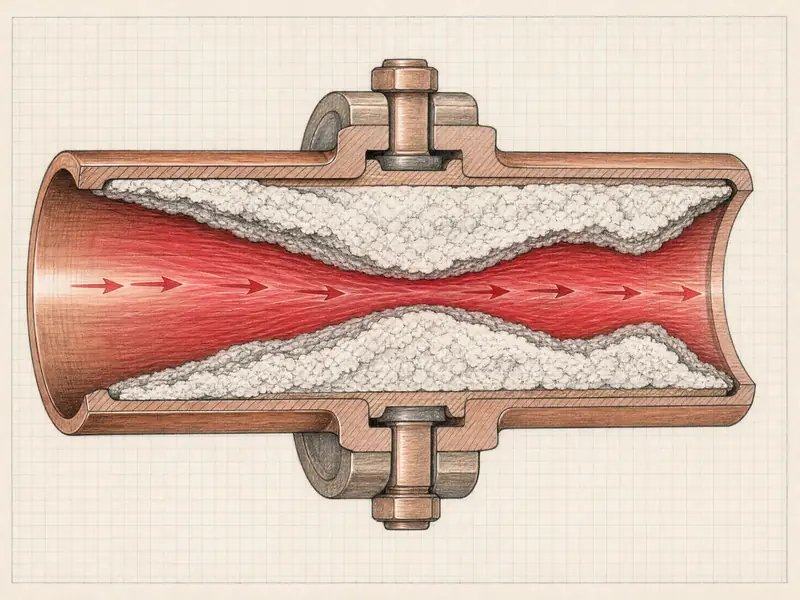
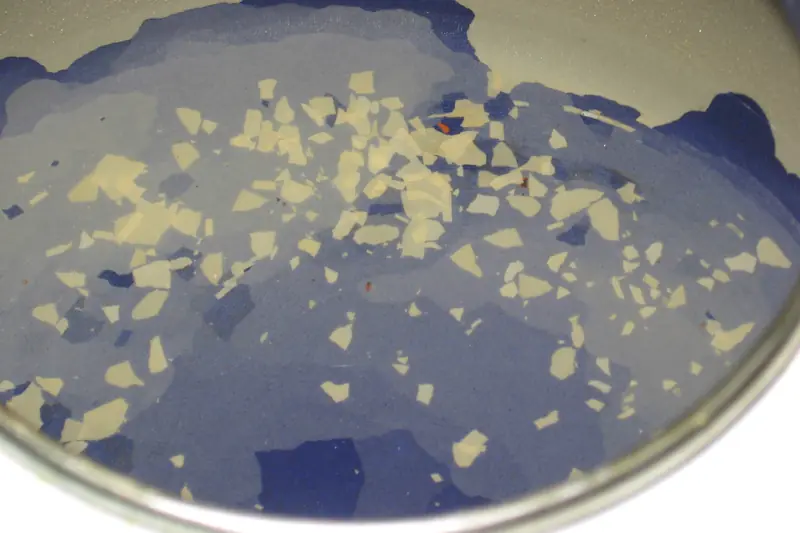
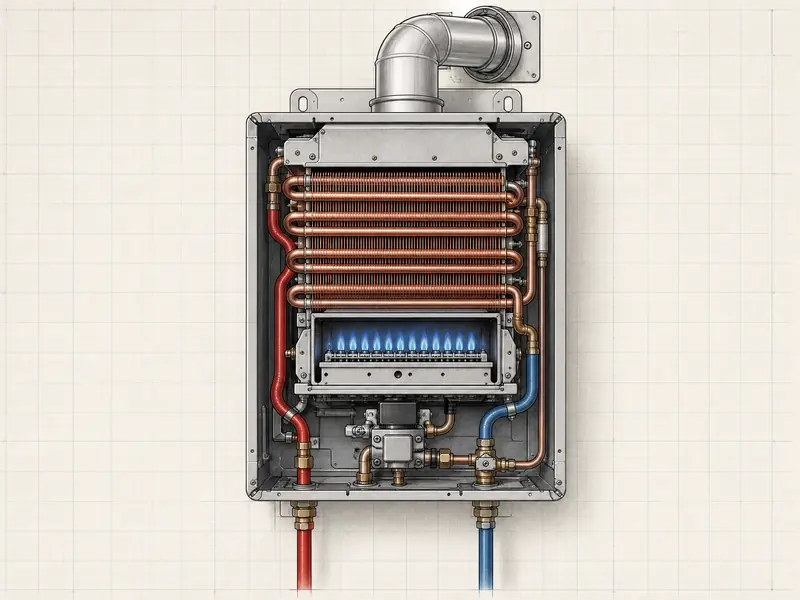
A tankless water heater needs descaling because hard water leaves mineral scale inside its heat exchanger. USGS explains that heated hard water forms solid calcium carbonate, and a tankless unit heats every gallon in narrow tubes, so that is where the crust collects.
American Water Heater's tankless guide says scale on the heat exchanger acts as an insulator, and that once it forms the heater never fully returns to peak efficiency even after cleaning. The maker gives no percentage loss, and none is claimed here. The practical signs are hot water that swings in temperature, longer waits, and service codes; Navien units show an E760 flushing alarm when service is due.
Money is the other reason. Rinnai's manual says failure to flush damages the heat exchanger and that lime or scale damage is not covered by its warranty. Navien's warranty page excludes hard water deposits and mineral build-up. Descaling on schedule keeps the unit inside those terms. For the wider picture, see tankless water heaters and hard water.
How often should you descale a tankless water heater?
Descale a tankless water heater at least once a year; hard water may call for a shorter cycle. Rinnai's web procedure sets once a year as the floor, and its manual says homes in hard-water areas may need a more frequent schedule.
The water's hardness sets the pace. Rinnai's treatment table recommends a softener or its scale-prevention product starting at 61 mg/L, which its table equates with roughly 4 gpg, with a flush once a year for homes and twice a year for commercial use. At 161 to 200 mg/L (9 to 12 gpg), the same table calls treatment strongly recommended, and above 200 mg/L it calls it required. Noritz's warranty excludes damage caused by hardness above 12 grains per gallon.
A high setpoint speeds scaling too; Rinnai notes it in the same section. Keeping the output at 120°F helps, as the temperature setting guide explains. Measure hardness first, with a test kit or your utility's water quality report, so the schedule matches the water.
What do you need for descaling a tankless water heater?
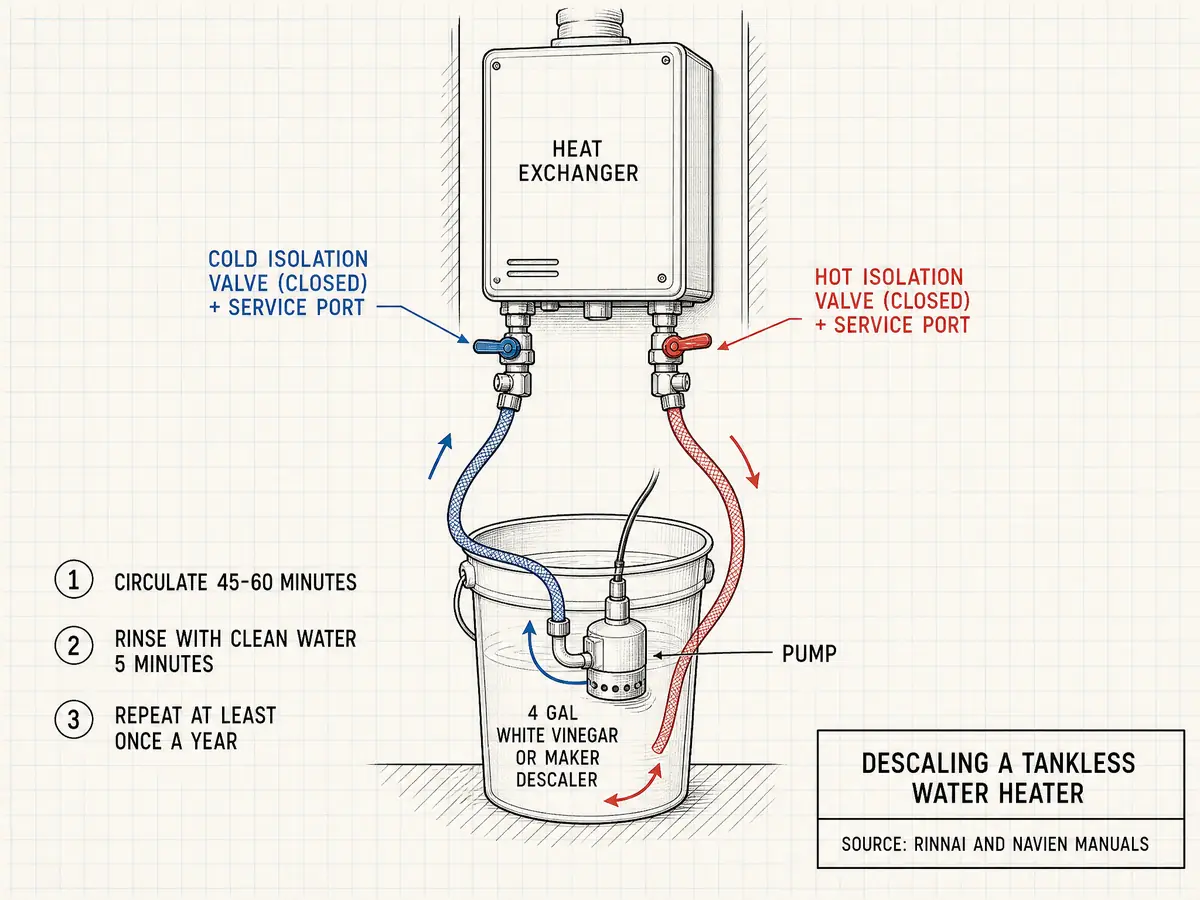
Descaling a tankless water heater takes a bucket, a small pump, hoses and a cleaning solution, plus isolation valves already fitted below the unit. Navien's operation manual lists:
- A bucket of 5 gallons or larger
- A water circulation pump
- Three hoses
- A cleaning solution diluted with water, as the manual specifies
Rinnai's version swaps the solution for 4 gallons of undiluted, food-grade white vinegar and warns against any other chemical solution. Its web page adds that a sump pump may be needed. Both makers rely on isolation valves: a cold and a hot valve with service ports, so the heater can be closed off from the house and the pump loop connected. Rinnai's manual strongly recommends installing them; if your unit has none, a licensed plumber can add them.
How do you descale a tankless water heater step by step?
To descale a tankless water heater, isolate it, connect a pump loop through the service ports, circulate the solution for 45 to 60 minutes, then rinse with clean water and restore service. Follow your own model's manual; these steps combine Rinnai's and Navien's.
- Shut off the unit. Turn off power to the heater and close its gas supply valve.
- Close the isolation valves on the cold inlet and hot outlet, so no house water flows through the heater.
- Relieve pressure. Open the service ports slowly, with a bucket below to catch water.
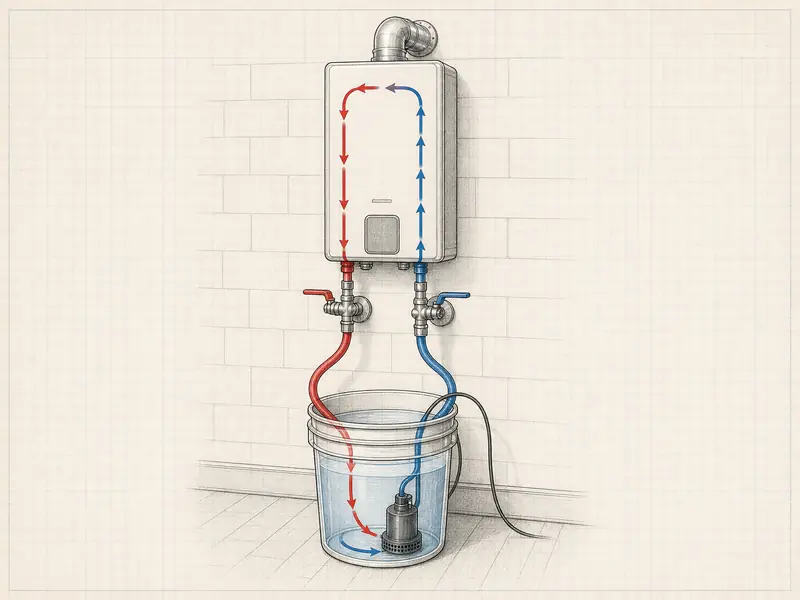
- Connect the hoses. Run one from the pump outlet to the cold-side service port, and another from the hot-side port back into the bucket. Put the pump in the bucket.
- Add the solution. Pour in white vinegar or the maker's descaler.
- Circulate. Run the pump for 45 to 60 minutes. Rinnai's manual says at least 1 hour at 4 gallons per minute; Navien says at least 45 minutes.
- Rinse. Remove the pump hose, open the cold isolation valve and let clean water run through to the bucket for 5 minutes.
- Restore service. Close the service ports, open both isolation valves, clean the inlet filter if the manual lists one, then restore gas and power.
Vinegar or descaling solution?
Use white vinegar or the maker-approved descaler, whichever your manual names. The two leading procedures disagree, so the manual for your model is the tiebreaker.
| Maker source | Solution | Circulation | Rinse |
|---|---|---|---|
| Rinnai web procedure | 4 gal undiluted white vinegar; no chemical solutions | Up to 45 minutes | Clean water |
| Rinnai SENSEI RX manual | 4 gal food-grade white vinegar | At least 1 hour at 4 gpm | 5 minutes |
| Navien NPE manual | Cleaning solution diluted with water | At least 45 minutes | 5 minutes |
Vinegar is cheap and Rinnai allows nothing else. Navien's wording leaves room for a maker-specified cleaner, which its manual describes. Don't substitute any other chemical without the maker's approval, since the warranty is written around the manual's procedure. Dispose of spent solution per local rules.
How can you slow scale between descalings?
Slow scale by treating the water before it reaches the heater and keeping the setpoint moderate. Rinnai's manual names two treatments: a water softener, or Rinnai's own scale-prevention product. Those are the options its warranty language is written around.
A softener removes the hardness minerals, calcium and magnesium, through ion exchange. Salt-free conditioners work differently: they don't remove hardness, and their scale-prevention claim comes from the seller rather than from Rinnai or Navien. The SoftPro FORTRESS, for example, is described by its store as a system that manages mineral buildup without salt. The SoftPro Elite Salt Free Conditioner (sold by SoftPro Water Systems, same owners as this site) is listed by its store as reducing scale buildup without salt, for city water. Neither is the product a tankless manual names, so read your warranty before relying on one, and keep descaling yearly either way.
Test the water first. Rinnai's table lists no treatment for soft water of 0 to 60 mg/L, the same band USGS calls soft. The softener and scale prevention guide compares softeners with conditioners in more depth, and the water heater maintenance hub covers the other yearly jobs.
Sources and scope
This page is based on Rinnai's online flushing procedure and SENSEI RX installation and operation manual, Navien's NPE operation manual and NPE-A warranty page, the Noritz N-0751M-DVC warranty, American Water Heater's tankless product guide, and the USGS page on water hardness, all opened in October 2026. Store product descriptions are the stores' own claims and were not tested. Contractor service prices, video walkthroughs, forum tips and brand rankings were left out.
Frequently asked
Can you use 30% vinegar to descale a tankless water heater?
Rinnai specifies undiluted, food-grade white vinegar and no other chemical solutions. Cleaning vinegar at higher strength isn't what the manual names, so use it only if your maker approves.
What happens if you never descale a tankless water heater?
Scale builds in the heat exchanger, and makers say it acts as insulation and can damage the part. Rinnai and Navien exclude scale damage from warranty coverage.
Do you have to descale a tankless water heater with soft water?
Rinnai still sets once a year as the minimum for its units. Soft water slows scale, so the job is quicker, but the yearly service also covers filters and checks.
How long does descaling a tankless water heater take?
Plan on about 90 minutes: 45 to 60 minutes of circulation plus setup, a 5-minute rinse and restart.
Can you descale a tankless water heater without isolation valves?
Not practically. The pump loop connects through the valves' service ports. A licensed plumber can install a valve kit, which Rinnai strongly recommends.
Does a salt-free conditioner replace descaling?
No. It doesn't remove hardness, and its scale claims are the seller's. Keep descaling at least yearly per the manual.
How do you winterize a tankless water heater?
Follow the manual's freeze-protection and draining steps, which differ by model and by indoor or outdoor installation. A drained unit must be refilled fully before it is restarted.
Related reading
Start over at the water heater type index · more in Care