
Compare
Condensing vs Non-Condensing Tankless Water Heaters
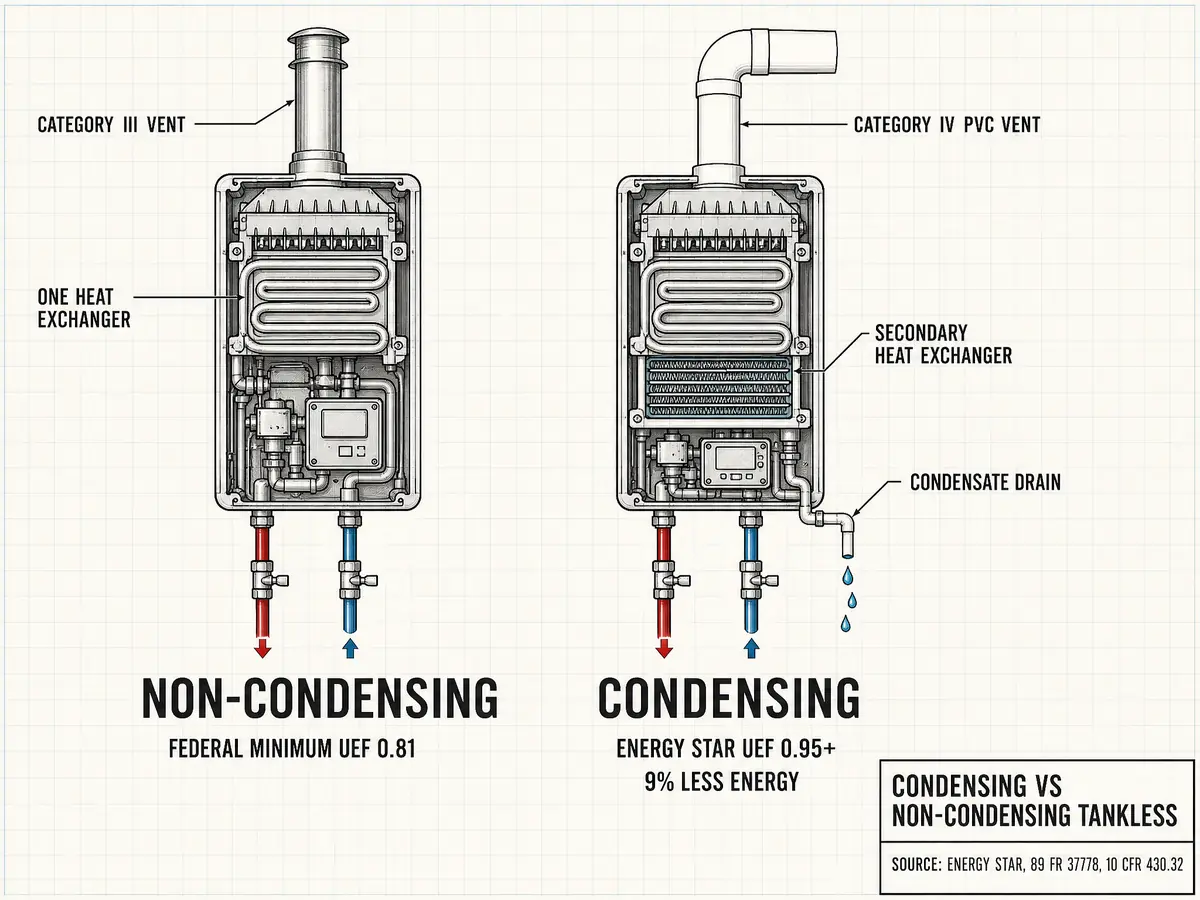
Condensing vs non-condensing tankless: a condensing unit adds a second heat exchanger to reach UEF 0.95 or more and vents through plastic pipe, while a non-condensing unit sits nearer the 0.81 floor and needs Category III vent.
Compiled by the Tank & Tankless desk · Revised
On this page
At a glance
- ENERGY STAR says a certified gas tankless unit uses a secondary heat exchanger to use 9 percent less energy than a conventional gas tankless unit.
- Federal law sets a 0.81 UEF floor for gas tankless units; ENERGY STAR certification needs 0.95.
- DOE's 2024 rulemaking classes non-condensing tankless venting as Category III and condensing venting as Category IV.
- Rinnai's condensing manual calls for a 1/2-inch condensate drain in corrosion-resistant pipe and offers a neutralizer kit to raise the condensate's pH.
- DOE estimated a condensing unit costs $217–$337 more installed than a non-condensing one, and sometimes less in new construction.
- A 2024 rule that would have made condensing efficiency mandatory was disapproved by Congress and withdrawn on May 20, 2025.
- 9%Energy saved by an ENERGY STAR condensing tankless unit vs a conventional oneENERGY STAR
- 0.81Federal minimum UEF for most gas tankless units10 CFR 430.32
- $217–$337DOE estimate of the extra installed cost of condensing over non-condensingFederal Register
- $20/yrExtra yearly gas saving of an ENERGY STAR unit over a conventional tankless modelENERGY STAR
What makes a tankless water heater condensing?
A condensing tankless unit has a second heat exchanger that pulls enough heat from the exhaust to make water vapor condense. A non-condensing unit has one heat exchanger and sends hotter exhaust out the vent. ENERGY STAR's gas tankless explainer describes the secondary heat exchanger as what separates a certified model from a conventional one.
The cooler exhaust changes everything downstream. Because the flue gas is cool enough to condense, the vent can be plastic, and the water it produces must be drained. Rinnai's condensing manual shows the layout: primary heat exchanger, secondary heat exchanger and a built-in condensate trap in one cabinet.
Both types share the rest of the tankless design. A flow sensor starts the burner, cold water passes through the heat exchanger, and output depends on flow rate and temperature rise. The tankless section covers how the type works in general.
How much more efficient is a condensing tankless unit?
A condensing unit rates roughly 12–17% higher on the label (derived from the UEF figures below) and uses about 9% less energy in ENERGY STAR's estimate. DOE's efficiency levels for a medium-draw unit run from 0.81 UEF at the non-condensing baseline to 0.91 at the level DOE adopted in 2024, and 0.93 at the maximum it found technically possible. ENERGY STAR certification requires 0.95, and the unit must still deliver 2.8 GPM or more through a 67°F rise.
In dollars, ENERGY STAR puts the gap at about $20 a year, or $300 over the unit's life, for a family of four. DOE's 2024 analysis came out similar: an average first-year operating cost of $303 for a baseline unit and $277 at the 0.91 level, in 2023 dollars (89 FR 105188).
Either type beats a gas storage tank on energy. ENERGY STAR says a certified tankless unit saves a family of four $95 a year against a standard gas tank. See tankless vs tank for that comparison.
| Spec | Non-condensing | Condensing |
|---|---|---|
| Heat exchangers | One | Primary plus secondary |
| Typical UEF | 0.81 federal floor and up | 0.91–0.96 in DOE's analysis; 0.95+ for ENERGY STAR |
| Vent category | Category III | Category IV |
| Vent material | Listed Category III vent | PVC, CPVC or polypropylene where the maker allows |
| Condensate drain | Not needed | Required; neutralizer optional |
| DOE average installed cost (2023 dollars) | $2,087 | $2,318 at 0.91 UEF |
| DOE first-year operating cost | $303 | $277 at 0.91 UEF |
| Lifespan in DOE's analysis | 20 years | 20 years |
How does venting differ between condensing and non-condensing?
Condensing units vent through plastic pipe; non-condensing units need a listed Category III vent system. DOE's 2024 final rule records that non-condensing gas tankless units use Category III venting and condensing ones Category IV. Neither can reuse the Type B metal vent of an atmospheric gas tank.
For one condensing model, the Rinnai SENSEI RX manual lists a 2-inch PVC, CPVC or polypropylene vent connection, or a 3-inch/5-inch concentric kit that brings in combustion air around the exhaust. Plastic pipe is cheaper and easier to route, which is part of why DOE found condensing installs can cost less in new homes.
Vent length, terminations and clearances come from the model's manual and local code, and a licensed gas fitter or plumber should design the run. The venting and gas line guide covers both, including the gas pipe sizing that applies to either type.
What does the condensate drain need?
A condensing unit needs a drain line that runs downhill to a floor drain or a condensate pump, in pipe that will not corrode. Rinnai's manual calls for PVC pipe or plastic hose at least the size of the 1/2-inch drain port, kept short, pitched down and open to the air at its end. It must not share a line with the relief valve or an air conditioner coil drain.
The condensate is acidic enough that Rinnai sells a neutralizer kit that raises its pH to help protect the drain and the public sewer. Local codes decide where condensate may go. Where no floor drain sits below the unit, Rinnai says a condensate pump should be installed and wired to shut the heater off if the pump fails.
Freezing is the other risk. Rinnai says drain lines in cold spaces need an approved heat source, outdoor units should route the line through an interior wall, and the condensate trap must be drained by hand during a winter power outage.
Did the condensing tankless rule take effect?
No. DOE finalized a rule in December 2024 that would have required condensing-level efficiency from December 26, 2029, such as 0.91 UEF for medium-draw units. Congress disapproved it under the Congressional Review Act, the resolution was signed on May 9, 2025, and DOE withdrew the rule on May 20, 2025.
Gas tankless units therefore stay at the existing 0.81 UEF minimum in 10 CFR 430.32. DOE's Spring 2025 regulatory agenda says the agency is still considering amended standards for gas tankless units, so a future proposal is possible. The 2029 rules guide covers the separate tank rule that does take effect.
Which suits a replacement job?
A condensing unit suits most replacement jobs where a drain is close by; a non-condensing unit suits spots where no drain can be reached. When swapping out an old tankless unit, the existing vent decides a lot: a Category III vent can serve a new non-condensing unit if the maker approves it, while a condensing unit needs its own plastic or listed Category IV vent.
When replacing a gas tank, both types need new venting, so the plastic vent often tips the job toward condensing. DOE estimated the installed premium at $217–$337 and a simple payback of 8.9 years at the 0.91 level, against a 20-year life. The installer still has to confirm the gas line, power for the fan and the vent route, as ENERGY STAR advises.
Hard water hits both types the same way. Rinnai's manual sets a 200 mg/L hardness limit and excludes scale damage from the warranty, so plan a yearly flush either way; see the descaling guide.
Sources and scope
Built from ENERGY STAR's gas tankless explainer, savings page and Version 5.0 criteria; DOE's December 2024 gas tankless final rule, its May 2025 withdrawal and the Spring 2025 Unified Agenda in the Federal Register; DOE's May 2024 rule; 10 CFR 430.32; and the Rinnai SENSEI RX installation manual, checked October 2026. Cost and payback numbers are DOE model averages. Left aside: installer quotes, venting brand comparisons and owner reviews.
Frequently asked
Can a condensing tankless unit be installed outdoors?
Many can, using the maker's outdoor vent cap. Rinnai advises running the condensate line through an interior wall or inside insulation to keep it from freezing.
Can a non-condensing tankless heater use PVC vent?
Not unless its manual says so. DOE's rule places non-condensing units in Category III venting, and makers list the specific vent products each model accepts.
Is condensate from a tankless water heater harmful?
It is acidic enough to corrode some drains. Rinnai offers a neutralizer kit that raises the pH to help prevent corrosion of drains and the public sewer, and local codes set where it may discharge.
What happens if the condensate pump fails?
Rinnai has the pump's safety switch wired to the heater so it shuts down and shows a code instead of flooding. Test that switch at installation.
Is condensing worth it for a small household?
The gain is about $20 a year by ENERGY STAR's estimate for four people, and less for fewer. In a retrofit where the vent would be replaced anyway, the plastic vent can offset much of the price gap.
Do condensing units need more maintenance?
They need the same yearly descaling plus a clear condensate trap and drain line. Rinnai's manual also says to drain the trap by hand if the power fails in freezing weather.
Related reading

Start over at types of water heaters compared · more in Compare