
Fix
No Hot Water: What to Check First
No hot water usually traces to one of three things: no fuel or power reaching the heater, a safety device that has shut it off, or, on tankless units, too little flow to start the burner.
Compiled by the Tank & Tankless desk · Revised
On this page
At a glance
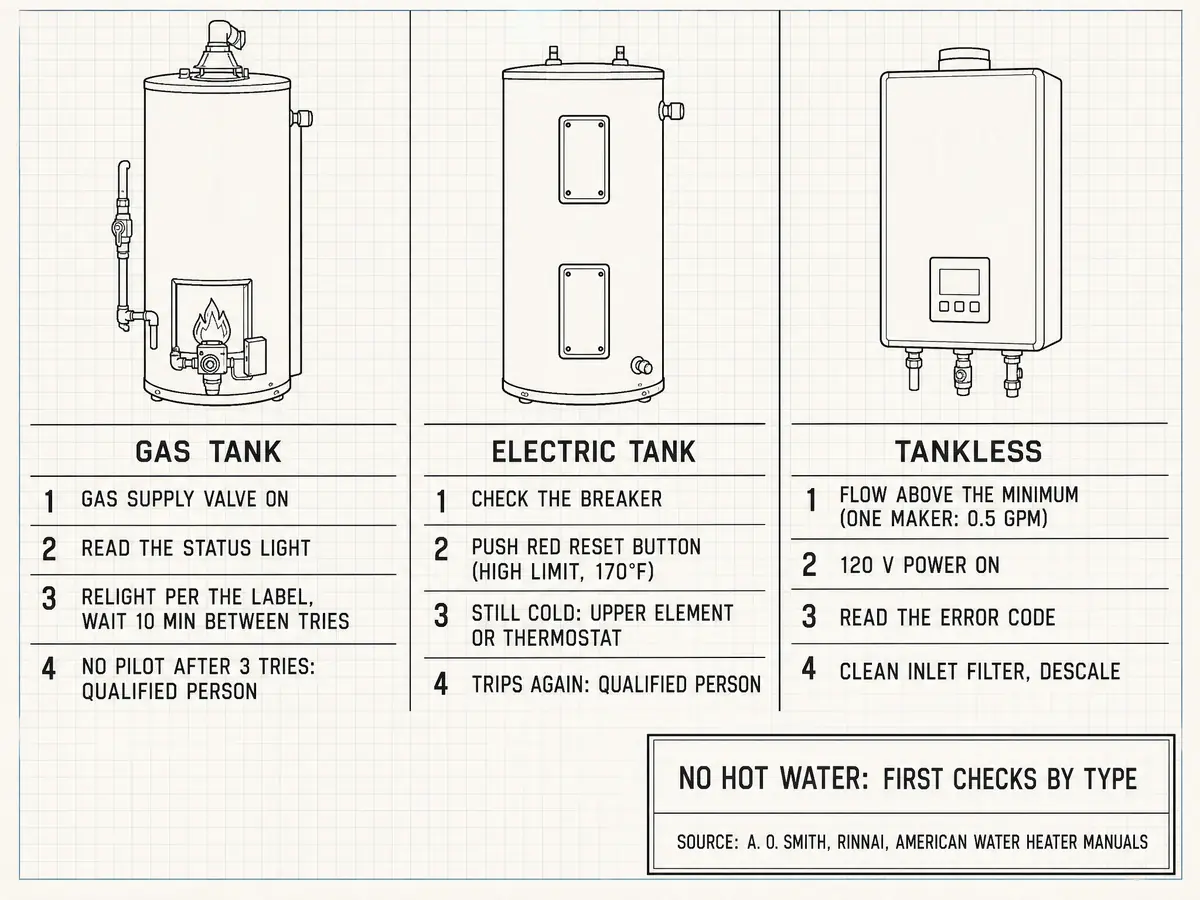
- On a gas tank, the A. O. Smith use and care guide treats a status light that flashes once every 3 seconds as normal; other patterns point to the pilot, thermopile or gas control.
- Relighting rules are strict: hold the knob, click the igniter for up to 90 seconds, and wait 10 minutes between tries. After 3 failed tries, stop and call a qualified person.
- On an electric tank, the usual causes are a tripped breaker, a high-limit switch that cut power above 170°F, or a failed upper element or thermostat (A. O. Smith electric manual).
- A tankless unit needs a minimum flow to fire. One maker lists 0.5 GPM to start and 0.4 GPM to keep running (American Water Heater).
- Hot water that runs out fast is a different fault: often an undersized heater, sediment or a failed lower element.
- If you smell gas, do not try to light anything. The maker's instruction is to call the gas supplier from a neighbor's phone.
- 3 snormal status-light blink interval on one maker's gas controlA. O. Smith
- 10 minwait between pilot lighting attemptsA. O. Smith
- 170°Fwater temperature that trips the electric high-limit switchA. O. Smith
- 0.5 GPMflow one maker's tankless needs before it ignitesAmerican Water Heater
- 20 galhot water DOE counts per shower when sizing a tankDOE Energy Saver (archived)
Why is there no hot water?
There is no hot water when the heater gets no fuel or power, when a safety control has shut it down, or when a tankless unit never sees enough flow to start. Check the simple things before opening any cover: the gas valve, the breaker, and a knob left on vacation or pilot.
Also test more than one faucet. The A. O. Smith gas manual notes that a failed mixing valve in a shower control can cut hot water at that fixture while the tank is full. A brand-new heater also needs time: the same manual says to wait two hours after lighting before you start troubleshooting.
No hot water from a gas water heater: what to check?
On a gas tank, check the gas supply first, then the pilot. Make sure the valve on the gas line is open and other gas appliances work; on propane, check the tank level.
Newer gas controls have a status light. On the A. O. Smith control in its 2023 guide, one flash every 3 seconds means the pilot is lit and the control sees no fault. No light means the pilot is out or the thermopile (the flame sensor that powers the control) is still warming up, which can take up to 90 seconds. Two flashes mean the pilot is lit but the thermopile is weak. Four, five, seven or eight flashes point to an overheat, a sensor or a gas control fault that needs a part, not a relight.
To relight, follow the label on the heater. The A. O. Smith steps are: turn the knob to PILOT, press and hold it, click the igniter about once a second for up to 90 seconds, then release once the light blinks. If it does not light, wait 10 minutes and try again. After three failed attempts, turn the knob to OFF and call a qualified person. A newly installed heater may need several tries to purge air from the gas line.
Two warnings from the same guide apply. Never disable or modify the flammable vapor ignition resistance (FVIR) thermal switch. And if you smell gas or suspect vapors near the heater, do not try to light it.
No hot water from an electric water heater: what to check?
On an electric tank, the A. O. Smith troubleshooting chart lists three causes for no hot water: no power, an open high-temperature limit switch, or a failed upper thermostat or element. Start at the panel. A tripped double-pole breaker or a blown fuse cuts both legs of the 240 V supply.
The high-limit switch shuts off the elements if the water passes 170°F. It resets with a red button on the upper thermostat, behind an access cover and insulation. Turn the power off at the breaker before you remove the cover, then press the button firmly. If the limit trips again, the manual says to have a qualified person find out why, since a stuck thermostat or a shorted element can keep heating past the setpoint.
If power is present and the limit is set, the upper element or thermostat has likely failed. Testing elements means metering a live 240 V compartment, which is a job for an electrician or plumber. One rule applies whoever does it: never power an element that is not under water, because it is destroyed and the warranty does not cover it.
Why does a tankless unit give no hot water?
A tankless unit gives no hot water when the flow is below its activation rate, when it has no power or gas, or when it has locked out on a fault. Gas tankless units still need 120 V for the fan, ignition and controls. Check the outlet or breaker first.
Flow is the next suspect. The American Water Heater tankless guide gives 0.5 GPM to start the burner and 0.4 GPM to keep it lit. The Rinnai SENSEI RX manual says water that stays cold, or alternates between hot and cold, is often flow at or near the minimum, and that opening the tap further usually solves it. A clogged inlet filter also cuts flow; Rinnai's is rinsed with the isolation valves closed.
If the display shows a code, look it up in the manual or on the data sheet inside the cover; codes differ by maker. Scale can also choke a heat exchanger in hard-water areas. Rinnai says scale damage from skipped flushing is not covered by its warranty and recommends flushing at least once a year (see descaling a tankless water heater). Rinnai's freeze protection also needs power, so a unit that lost power in a freeze may have frozen.
Why does hot water run out fast?
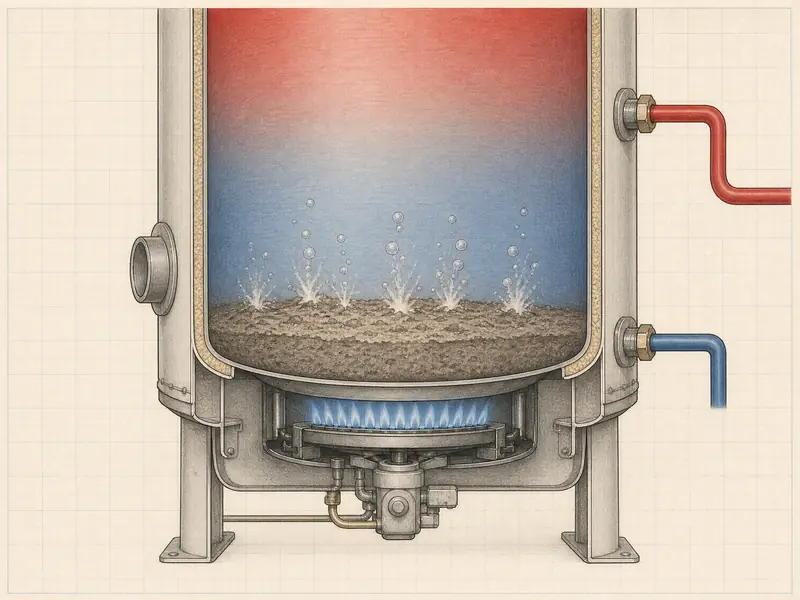
Hot water that runs out fast means the heater works but cannot keep up. The A. O. Smith guide lists the usual causes: a heater too small for the household, sediment or lime on the tank bottom, reversed hot and cold connections or a melted dip tube on a new install, a leak on the hot side, or a broken mixing valve at the fixture. On electric tanks, the chart adds a failed lower element. Then only the top of the tank heats.
To judge whether the tank is simply too small, compare its first-hour rating with your peak-hour use. DOE's sizing worksheet counts 20 gallons per shower, so three back-to-back showers need about 60 gallons in an hour (DOE Energy Saver, archived). The worked method is on what size water heater do you need. For a tankless unit, the limit is flow, not volume. DOE puts typical gas units at about 5 GPM and electric units at about 2 GPM for a 70°F temperature rise, so two showers plus a dishwasher can outrun one unit (see tankless sizing).
On an older tank that once kept up, suspect sediment; flushing removes it (see how to flush a water heater). Turning the thermostat up gives more usable hot water, but above 120°F the scald risk rises. CPSC notes that 140°F water can cause third-degree burns in six seconds, so pair a higher setting with mixing valves (see water heater temperature setting).
| Heater type | Check yourself | Leave to a pro |
|---|---|---|
| Gas tank | Gas valve open, knob not on VAC or PILOT, status light pattern, relight per label (3 tries max) | Thermopile, gas control valve, FVIR lockout, any gas smell |
| Electric tank | Breaker or fuse, red high-limit reset with power off | Element and thermostat testing, repeat high-limit trips |
| Gas tankless | 120 V power, gas on, flow above minimum, inlet filter, error code | Ignition faults, venting codes, gas pressure, descaling if no isolation valves |
| Electric tankless | Breakers, flow above minimum | Element and wiring faults |
When should a pro take over?
A pro should take over as soon as the fix means gas parts, wiring, venting or a repeat safety trip. The A. O. Smith manuals send you to a qualified person when the pilot will not light after three tries, when an electric high-limit keeps tripping, and when a T&P valve releases large amounts of very hot water. In that last case, shut off the gas or power first.
Some findings point toward replacement rather than repair. A heater whose gas control or thermostats have been under water must be replaced, according to A. O. Smith. ENERGY STAR suggests planning a replacement once a tank is past 10 years old, before it fails outright (ENERGY STAR). If the tank is also leaking, see water heater leaking. For other symptoms, start at the symptom index.
Sources and scope
Based on the A. O. Smith gas (June 2023) and electric manuals, the Rinnai SENSEI RX manual, the American Water Heater tankless guide, DOE's archived sizing page and CPSC publication 5098, all checked October 2026. Light codes and reset steps vary by model; your heater's label wins. Left out: brand rankings, repair quotes and forum fixes.
Frequently asked
Why is there no hot water after a power outage?
Gas tankless units need 120 V for the fan and controls, and ENERGY STAR notes that forced-ventilation models need power at the heater, so they stop during an outage and should restart when power returns. An electric tank's breaker may have tripped when the power came back. If a tankless unit lost power in freezing weather, check for frozen piping before you run it.
How long after relighting the pilot should hot water return?
A full tank of cold water takes time to heat. A. O. Smith tells owners to wait two hours after lighting before troubleshooting. You may hear sizzling at first, which is condensation on the burner and stops as the tank warms.
Can a thermocouple cause no hot water?
Yes. The flame sensor proves the pilot is lit; if it fails, the gas valve will not hold the pilot open. Older controls use a thermocouple, while the A. O. Smith control uses a thermopile and flags a weak one with two flashes. Replacing either is gas work for a qualified person.
Why does the electric water heater reset button keep tripping?
The high-limit switch trips when water passes about 170°F on A. O. Smith tanks, which usually means a thermostat is stuck closed or an element is shorted to the tank. Resetting it again and again hides the fault. If it keeps shutting off, A. O. Smith wants a qualified person to find the cause.
Why does the tankless water heater go cold during a shower?
Usually the flow dropped close to the unit's minimum, for example when someone turns the shower down to save water. Rinnai's manual also suggests lowering the setpoint closer to the temperature you actually use, so the fixture mixes in less cold water and keeps more flow through the heater.
Why does a tank give lukewarm water after only a few minutes?
On an electric tank, a failed lower element often leaves only the top of the tank heated, so hot water runs short; A. O. Smith's troubleshooting chart points to the lower element when there is hot water but not enough. A broken dip tube can also let incoming cold water mix at the top. On any tank, heavy sediment takes up space, which is one reason the flushing guide matters.
Related reading
Start over at the water heater type index · more in Fix