
Tankless
Tankless Water Heater Venting and Gas Line Sizing
Tankless water heater venting must be the sealed Category III or IV system the manual lists, not the old tank's metal flue, and a 199,000 Btu/h unit needs about 199 cubic feet of gas an hour.
Compiled by the Tank & Tankless desk · Revised
On this page
At a glance
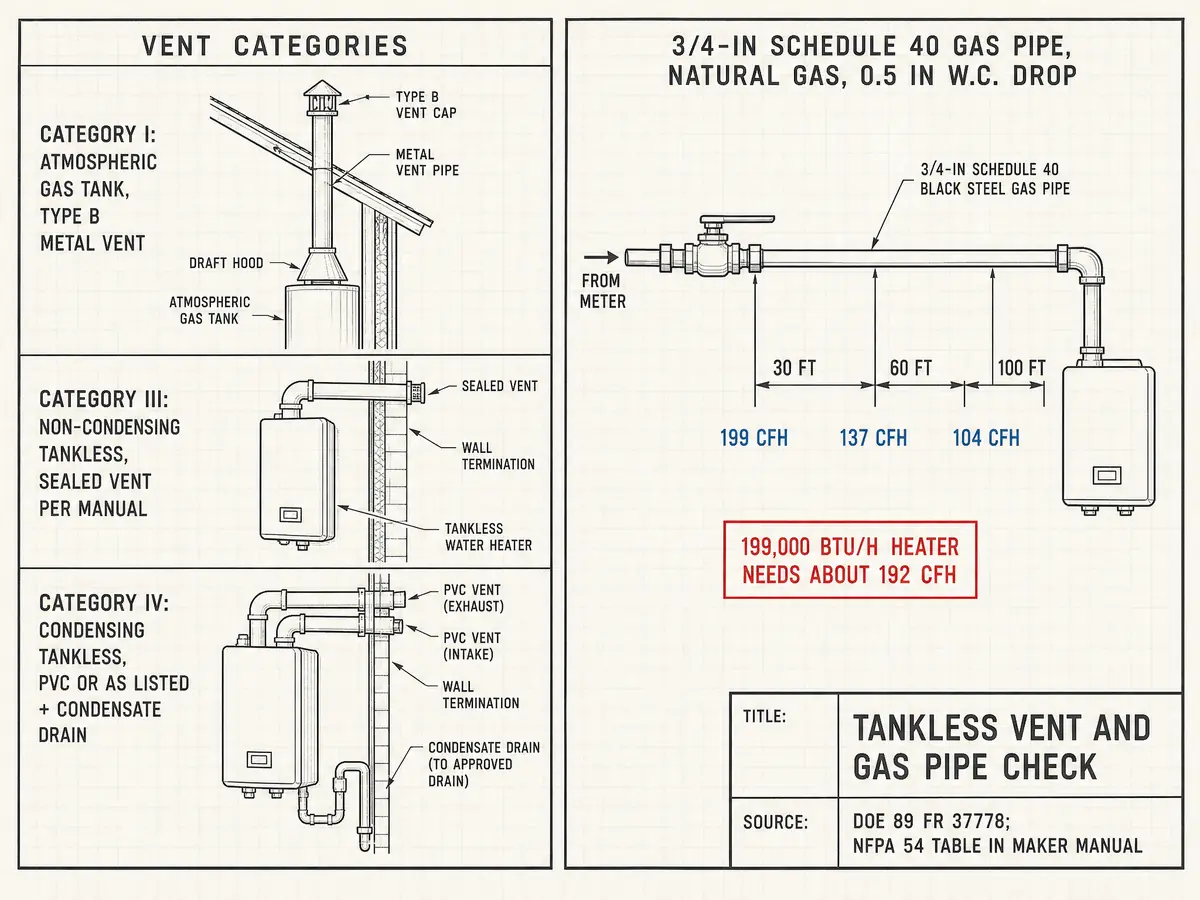
- DOE's 2024 rule notes that most gas tanks use Type B metal vent, while tankless units need Category III (non-condensing) or Category IV (condensing) venting.
- Rinnai's SENSEI manual lists 2-inch PVC, CPVC or polypropylene, or a 3-by-5-inch concentric kit, and forbids connecting to an existing vent or chimney.
- Per the NFPA 54 table printed in Rinnai's manual, 3/4-inch Schedule 40 pipe carries 199 cubic feet an hour at 30 feet but only 137 at 60 feet and 104 at 100 feet (0.5-inch w.c. drop).
- A 199,000 Btu/h heater needs about 199 cubic feet of natural gas an hour by Rinnai's 1,000 Btu-per-cubic-foot rule (about 192 at EIA's 1,037).
- Rinnai requires at least 5.0 inches w.c. of natural gas pressure (8.0 for propane) at the heater with every gas appliance running.
- Permits are local; the City of San Diego, as one California example, requires a plumbing permit to install or replace any water heater.
- 199 CFHCubic feet per hour through a 30-ft run of 3/4-inch Schedule 40, low-pressure tableRinnai manual
- 104 CFHSame pipe's capacity at 100 ftRinnai manual
- 5.0 in w.c.Minimum natural gas pressure at the heater under full loadRinnai manual
- 75,000 Btu/hTop input for a consumer gas storage tank under DOE's definitionDOE Appliance Standards
What venting does a tankless water heater need?
A gas tankless water heater needs a sealed vent of the category its manual names: Category III for non-condensing units and Category IV for condensing units. DOE's 2024 rulemaking summed up the split: the vast majority of gas storage tanks use non-condensing burners with Type B metal vent, while switching to tankless "would require Category III or Category IV venting material." ENERGY STAR adds that gas tankless exhaust leaves "through a dedicated, sealed vent system."
The difference comes from the exhaust. A tank's natural-draft flue relies on hot gas rising on its own up an open metal pipe. A condensing unit cools its exhaust until water condenses out, so its pipe must be sealed and stand up to wet, acidic flue gas. The condensing vs non-condensing comparison explains the efficiency side.
Rinnai's units can run as direct vent, drawing combustion air from outdoors through a second pipe or the outer ring of a concentric pipe. The manual allows room-air (non-direct) setups too, but only with a listed Category IV vent and enough indoor air under NFPA 54 or local code.
Can a tankless water heater use PVC vent pipe?
A condensing tankless water heater usually can, if its manual lists PVC; a non-condensing unit usually needs the maker's listed Category III vent instead. ENERGY STAR says condensing gas tankless units vent "through a vertical PVC pipe" and need a condensate drain. The Rinnai SENSEI manual shows how specific the rules get:
- Approved materials. Solid-core Schedule 40 PVC or CPVC, polypropylene, or a listed concentric kit. Never cellular-core PVC or CPVC, Radel, or galvanized pipe.
- Size and length. The vent may not be smaller than 2 inches. With a 3-by-5-inch concentric vent, the maximum run is 150 feet, and each 90-degree elbow counts as 5 feet.
- Support and slope. Support horizontal runs every 4 feet and vertical runs every 6 feet, and slope the vent 1/4 inch per foot back toward the heater so condensate drains.
- No mixing. Do not combine vent parts from different makers, and do not share a vent with another maker's appliance.
The condensate itself needs a home. Rinnai calls for a 1/2-inch drain of PVC or plastic hose, run separately from the relief valve drain, and offers a neutralizer kit to raise the condensate's pH before it reaches the drain. Rinnai also says problems caused by an improper vent are not covered by its warranty.
Can you reuse an old tank water heater vent?
Usually not. Rinnai's manual says plainly not to connect the venting system to an existing vent or chimney, and warns that when an old atmospheric appliance is replaced by a tankless unit, the original venting system may not be suitable for a Category IV appliance. A Type B metal flue is built for natural draft, not for the sealed, pressurized or condensing exhaust of a tankless unit.
Removing the water heater from a shared flue also changes the flue for anything left on it. San Diego's water heater bulletin says Type B vents must be sized for the water heater plus any other gas appliances that share the system, so a furnace left alone on an oversized vent may need its own vent work. Ask the installer to check it.
| Heater | Vent category | Typical material | Condensate drain |
|---|---|---|---|
| Atmospheric gas tank | Natural draft | Type B metal | No |
| Non-condensing gas tankless | Category III | Maker-listed sealed vent | Per manual |
| Condensing gas tankless | Category IV | Listed PVC, CPVC, polypropylene or concentric kit | Yes |
| Condensing gas tank | Condensing | Vertical PVC | Yes |
What gas line size does a tankless water heater need?
The gas line must be sized for the heater's full input plus every other gas appliance at full load, using the NFPA 54 tables for your pressure and pipe length. Rinnai's manual says the supply must handle "the entire gas load required at the location," and that sizing depends on gas type, pressure drop, supply pressure and pipe type. That is a calculation for a licensed gas fitter, not a rule of thumb.
The jump in load is the reason. DOE's definitions cap a consumer gas storage tank at 75,000 Btu/h, while tankless units such as the Rinnai RXP199i run up to 199,000 Btu/h, more than two and a half times as much (derived). At Rinnai's assumed 1,000 Btu per cubic foot, that heater needs 199 cubic feet an hour on its own.
Now compare the pipe. In Rinnai's reprint of the NFPA 54 table for natural gas at a 0.5-inch w.c. pressure drop, 3/4-inch Schedule 40 pipe carries 199 cubic feet an hour at 30 feet, 137 at 60 feet and 104 at 100 feet. So a 3/4-inch line just covers a 199,000 Btu/h heater on a short run with nothing else on it, and falls well short on a longer one. Bigger pipe, often 1-inch, or a higher-pressure design is the usual fix. The heater's own inlet is 3/4 inch, but that says nothing about the size the line feeding it must be.
Why does gas pressure matter for tankless?
Gas pressure matters because a tankless burner at full fire needs a steady supply, and long or undersized lines lose pressure. Rinnai requires at least 5.0 inches of water column for natural gas and 8.0 inches for propane at each appliance while all gas appliances run at maximum input. Below that, the unit may not reach full output.
Supply pressure also changes the sizing math. Rinnai prints a second NFPA 54 table for systems with an initial supply pressure of 8.0 inches w.c. or more and a 3.0-inch allowable drop. In that table, 3/4-inch pipe carries 360 cubic feet an hour at 60 feet, and the manual's worked example feeds a 199,000 Btu/h outlet 40 feet away with 1/2-inch pipe. Whether your utility supplies that pressure is a question for the gas company and the fitter. A tankless unit also needs a 120-volt grounded outlet for its controls and fan.
What permits and inspections apply?
Most areas require a permit and inspection for a water heater replacement, and gas and venting changes are what inspectors look at closely. Rules are local. As one example, California's City of San Diego bulletin says a plumbing permit is required for original and replacement water heater installations and bars gas-fired heaters from bedrooms, bathrooms and clothes closets unless they are direct vent.
Before work starts, ENERGY STAR suggests asking the installer to confirm the gas line is sufficient, that power is available, and how the exhaust will be vented. Rinnai adds a leak and pressure test before first firing and a manual shutoff valve on the supply. The installation and code guide covers relief valves and expansion tanks, and the sizing guide helps confirm the unit is the right size before the gas work is planned.
Sources and scope
Based on the Rinnai SENSEI RX residential installation and operation manual (venting, condensate and gas sections, including its NFPA 54 table reprints), DOE's May 2024 final rule, DOE's Consumer Water Heaters page, ENERGY STAR's gas tankless pages, EIA's heating-value conversion and the City of San Diego bulletin RESD-5-1, checked October 2026. The NFPA 54 code text itself and the IPC and UPC were not opened, so no code sections are quoted. Left out: installer price quotes, brand rankings and do-it-yourself gas work.
Frequently asked
Is a 3/4-inch gas line enough for a tankless water heater?
Only on short runs in a low-pressure system with little else on the line. Rinnai's copy of the NFPA 54 low-pressure table rates 3/4-inch pipe at 199 cubic feet an hour for a 30-foot run and 137 for 60 feet; a 199,000 Btu/h heater needs about 199.
Can a tankless vent go through the roof or a side wall?
Both are common. Rinnai's manual covers horizontal and vertical terminations with concentric or twin pipes, each with its own clearance diagram from windows, doors and other openings.
Is cellular-core PVC allowed for a tankless vent?
No. Rinnai's manual prohibits cellular-core PVC and CPVC, along with Radel and galvanized pipe; use only the materials the manual lists.
Why does a condensing tankless unit need a drain?
It cools its exhaust until water condenses. That condensate has to drain away, and Rinnai offers a neutralizer to raise its pH before it reaches the drain.
Does a tankless water heater need its own gas shutoff?
Rinnai calls for a manual gas control valve in the supply line to the heater, with a union above it for servicing.
Does propane change the gas line size?
Yes. Propane has its own NFPA 54 sizing tables and pressures; Rinnai requires at least 8.0 inches w.c. at the heater for propane.
Who can install the gas line for a tankless water heater?
Rinnai says a trained and qualified professional must install the gas supply. Local rules decide the license and permit needed.
Related reading
Start over at every water heater type, side by side · more in Tankless