
Section · Tankless
Tankless Water Heater Pros and Cons
Tankless water heater pros and cons in brief: no standby loss, 24–34% better efficiency for lighter users and about 20 years of life, against a hard cap on flow, extra install work and yearly descaling.
Compiled by the Tank & Tankless desk · Revised
At a glance
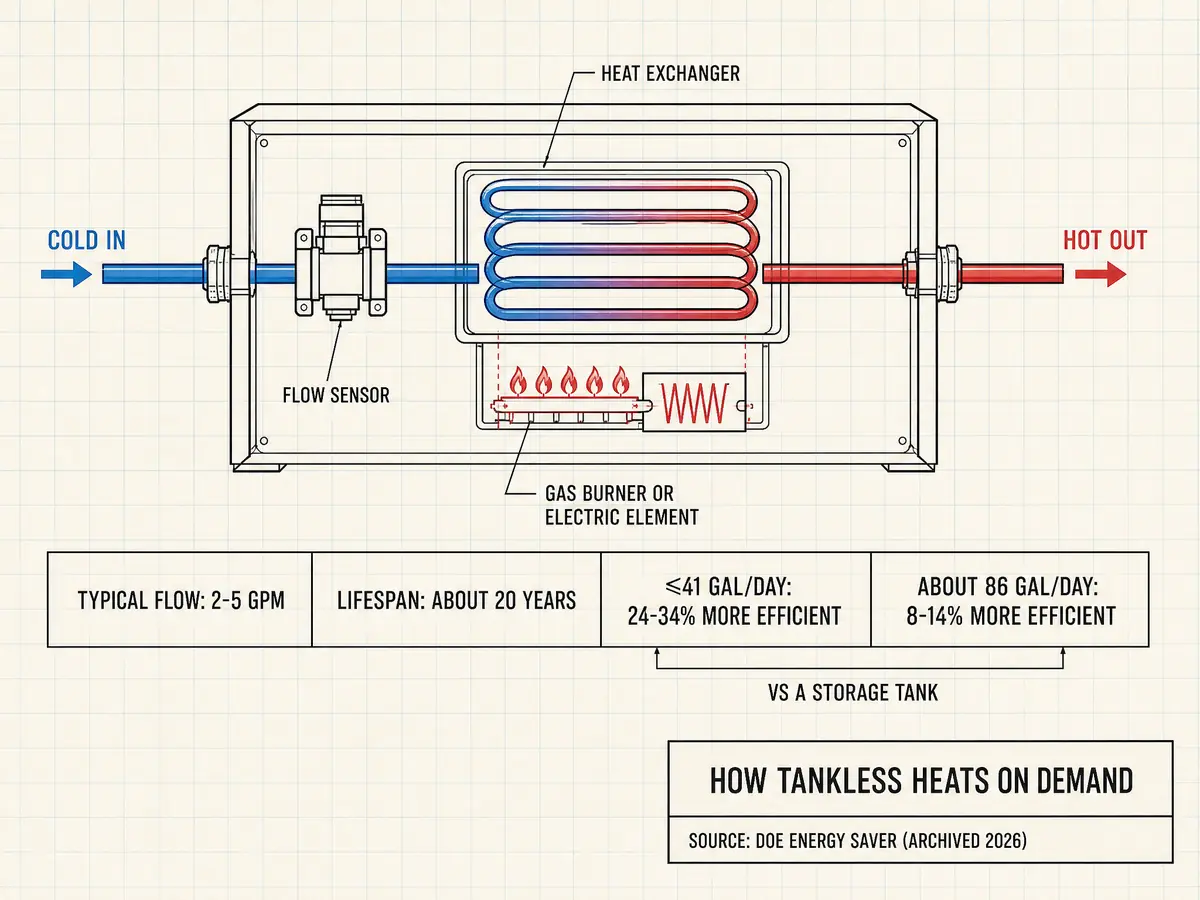
- DOE rates demand units 24–34% more efficient than storage tanks in homes using 41 gallons or less a day, and 8–14% at about 86 gallons (DOE Energy Saver, archived).
- Typical units deliver 2–5 gallons per minute; DOE expects about 5 GPM from gas and about 2 GPM from electric at a 70°F rise.
- ENERGY STAR says a certified gas tankless unit cuts a four-person household's gas bill by about $95 a year compared with a basic gas tank, and puts tankless life at about 20 years.
- ENERGY STAR certification asks for a UEF of 0.95 or more and a maximum flow of 2.8 GPM or more at a 67°F rise; the federal floor for gas tankless stays at 0.81 after Congress voided the 2024 condensing rule.
- Rinnai calls for flushing at least once a year and says scale damage is not covered by its warranty.
- 2–5 GPMTypical tankless hot water flowDOE Energy Saver (archived)
- $95/yrYearly gas saving for four people when a certified tankless unit replaces a basic tankENERGY STAR
- 0.81Federal minimum UEF for most gas tankless unitseCFR, 10 CFR 430.32
- 9%Energy cut of a condensing ENERGY STAR unit vs a conventional gas tanklessENERGY STAR
How does a tankless water heater work?
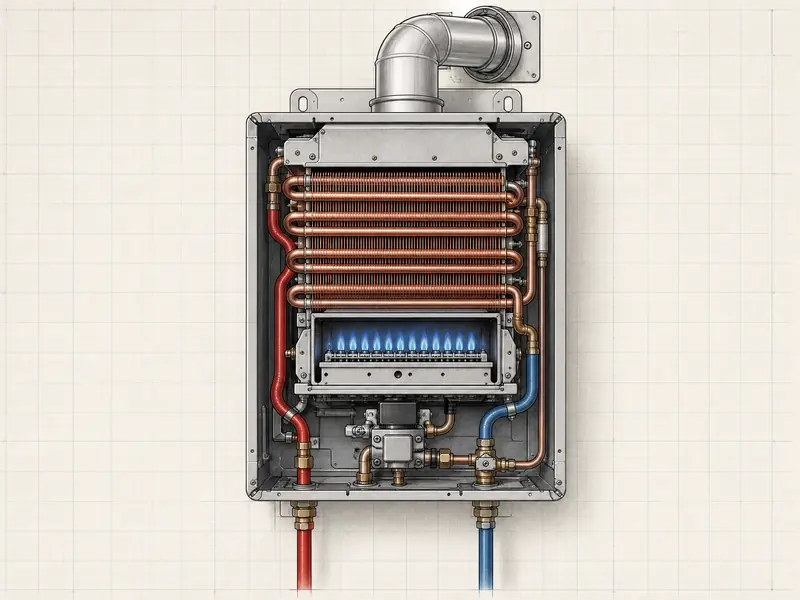
A tankless water heater heats water only while a hot tap is open: incoming water passes a heat exchanger warmed by a burner (gas) or by elements (electric) and leaves hot. DOE also calls these demand-type or instantaneous heaters. In gas models, ENERGY STAR explains, a flow sensor starts the burner and the exhaust leaves through a dedicated sealed vent.
A unit needs a minimum flow before it fires. One maker's tankless guide lists 0.5 GPM to start and 0.4 GPM to keep firing, and Stiebel Eltron's electric Tempra models need 0.37 to 0.77 GPM depending on size.
What are the pros of a tankless water heater?
The main advantages of a tankless water heater are lower energy use, endless hot water at a fixed flow and a long service life. Because nothing is stored, there is no standby heat loss, and DOE notes that only tankless designs avoid it entirely. ENERGY STAR puts the life expectancy at 20 years, against 10–15 years for a tank, and DOE adds that replaceable parts can stretch that further.
ENERGY STAR's $95 yearly figure for a family of four is measured against a standard gas tank; against a conventional gas tankless unit, a certified one saves about $20 a year.
What are the cons of a tankless water heater?
The main drawbacks are a firm limit on how much hot water flows at once, extra installation work and regular descaling. DOE warns that a shower and a dishwasher running together can stretch a unit to its limit. The savings also shrink in heavy-use homes, to 8–14% at around 86 gallons a day.
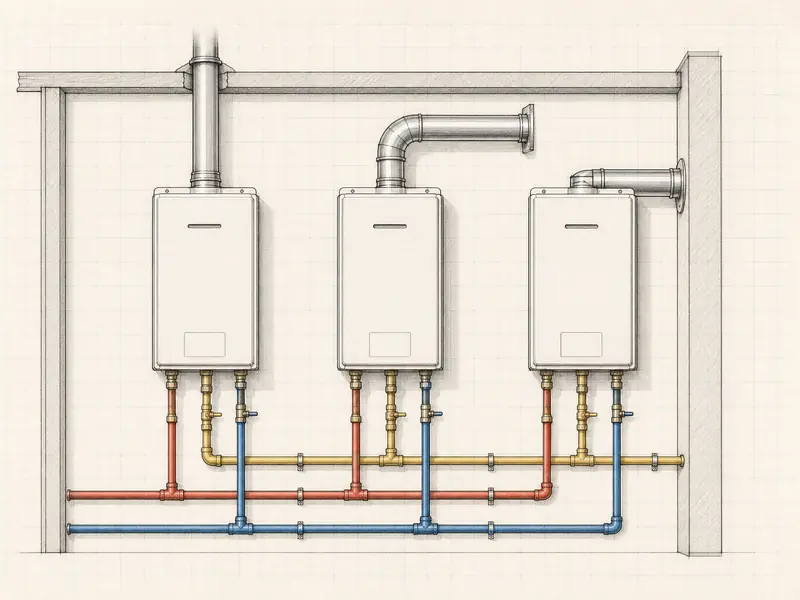
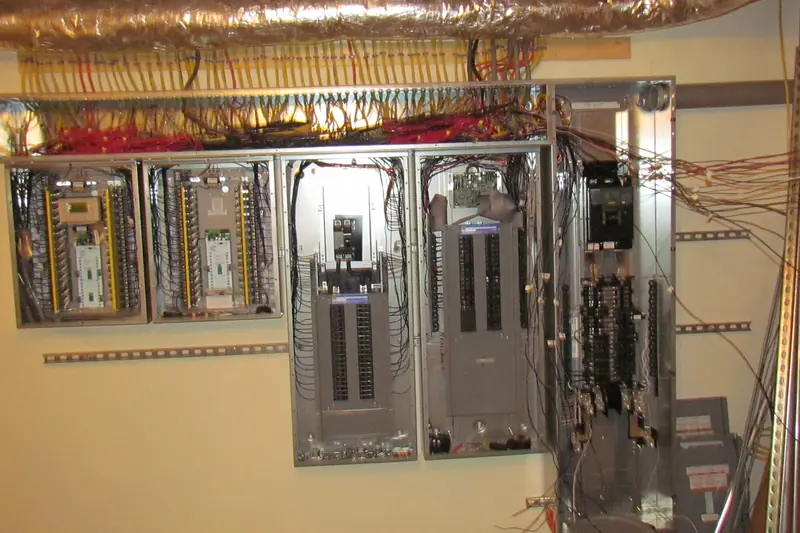
Switching from a tank often means more than a swap. ENERGY STAR tells buyers to have the installer check whether the existing gas line is big enough, whether power is near the heater for fan-driven venting, and how exhaust will leave the house. Hard water is the other cost: Rinnai says lime damage from skipped flushing is not covered by its warranty, and Noritz's warranty stops at 12 grains per gallon of hardness.
| Factor | Tankless | Storage tank | Source |
|---|---|---|---|
| Standby heat loss | None | Yes | DOE |
| Hot water supply | Endless, capped at 2–5 GPM | Stored 20–80 gal, then recovery | DOE |
| Efficiency gain vs tank | 24–34% (≤41 gal/day); 8–14% (~86 gal/day) | Baseline | DOE |
| Expected life | About 20 years | 10–15 years | ENERGY STAR, DOE |
| Yearly upkeep | Descale heat exchanger | Drain and flush tank | Rinnai, A. O. Smith |
Gas or electric tankless?
Gas tankless suits whole-house use in most climates, while electric tankless delivers less flow and needs very large electrical service. DOE's rule of thumb is about 5 GPM at a 70°F rise for gas and about 2 GPM for electric. A 36 kW Stiebel Eltron Tempra, for example, needs three 50-amp double-pole breakers at 240 V.
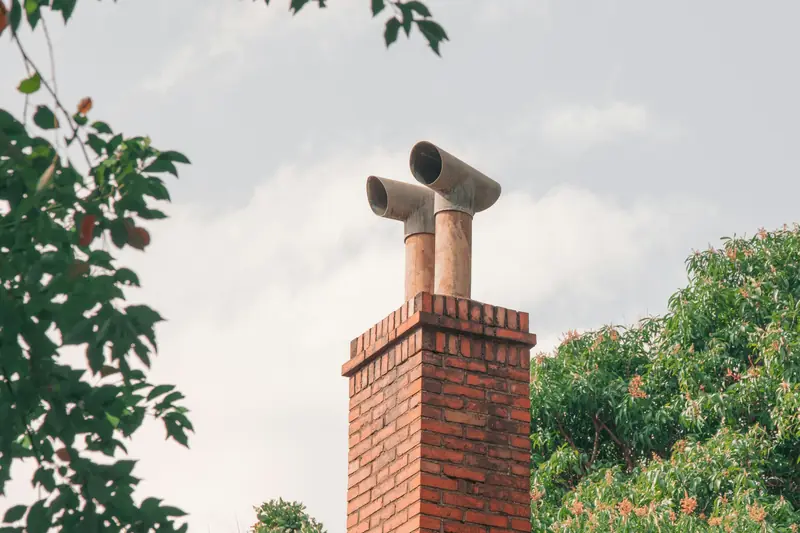
Gas units are split into condensing and non-condensing designs. ENERGY STAR says the condensing type uses a second heat exchanger to cut energy use by 9% and vents through PVC with a condensate drain. DOE's gas-tankless rule that would have required condensing levels from 2029 was voided by Congress in May 2025, so non-condensing units remain legal.
How do you size a tankless water heater?
Size a tankless water heater by the flow you need at once and the temperature rise it must deliver. DOE's method assumes 50°F incoming water unless you know better, and a 120°F target, for a 70°F rise. For fixture flows, ENERGY STAR uses 2.5 GPM per shower, 2.2 per sink and 3.3 for a washer.
What upkeep does a tankless water heater need?
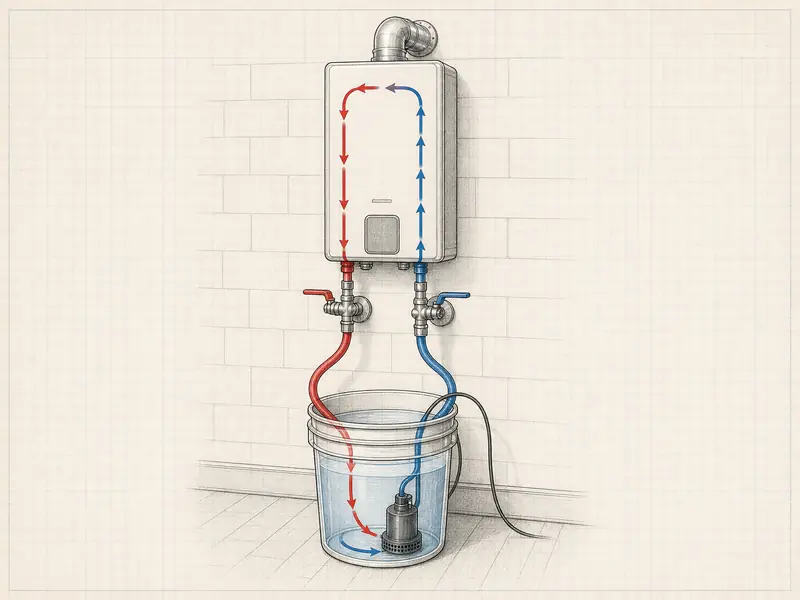
A tankless water heater needs its heat exchanger descaled about once a year, and more often on hard water. The Rinnai flushing procedure circulates undiluted white vinegar with a small pump, and its manual asks for at least an hour; Navien's manual asks for at least 45 minutes with a diluted cleaning solution. Rinnai strongly recommends isolation valves at install so the unit can be flushed.
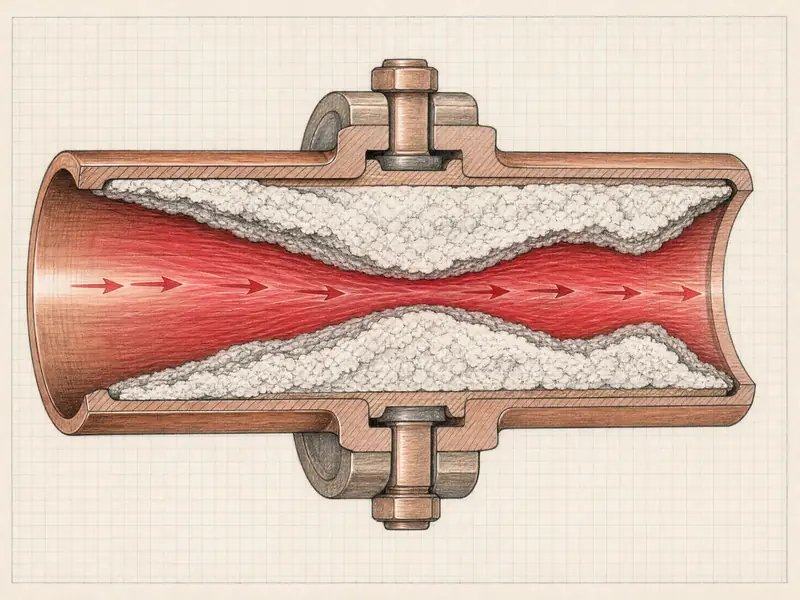
Tankless units have no anode rod, so the anode care that tanks need does not apply. Scale is the enemy instead: one maker explains that scale acts as an insulator on the heat exchanger and that the unit never fully returns to peak efficiency once it forms.
 TanklessHard water and tankless water heaters
 CareHow to descale a tankless water heater
 CareSofteners and scale prevention
Sources and scope
This hub uses DOE Energy Saver pages (archived June–July 2026), ENERGY STAR's gas tankless pages and Version 5.0 criteria, 10 CFR 430.32, the Federal Register notice withdrawing the gas tankless rule (May 20, 2025), and manuals or spec sheets from Rinnai, Navien, Noritz, American Water Heater and Stiebel Eltron, checked October 2026. Left out: installed-price quotes, brand rankings and forum stories.
Frequently asked
Why do plumbers say tankless units struggle with two showers?
Two 2.5 GPM showers need 5 GPM, which is the top of DOE's typical 2–5 GPM range for a 70°F rise. In cold-water regions, where the rise is bigger, many units deliver less.
Do tankless water heaters work in a power outage?
Fan-vented gas models need power for the blower, which is why ENERGY STAR lists an outlet near the heater as an install check, and electric units need power by definition. Check your model's manual for the rest.
Is a gas tankless unit banned after 2029?
No. The December 2024 rule that would have set condensing-level minimums was disapproved under the Congressional Review Act on May 9, 2025, and withdrawn on May 20, 2025. The 0.81 UEF minimum still applies.
Does tankless water get hot instantly at the tap?
No. The heater warms water as soon as it flows, but the hot water still has to travel the pipe from the heater to the tap, as it does from a tank.
Can a tankless unit replace a 40-gallon tank?
Often, if the gas line, vent and power can support it and the household's peak flow fits the unit's GPM at your temperature rise. Have the installer check all three first.
What is an intermittent ignition device?
It lights the burner only when needed instead of keeping a standing pilot burning. DOE suggests choosing a model with one, since a pilot light wastes energy.
Start over at types of water heaters compared