
Tankless
Electric Tankless Water Heater: Is It Enough?
An electric tankless water heater gives about 2 GPM at a 70°F rise, per DOE; a 36 kW whole-house unit reaches about 3.5 GPM but draws 150 amps at 240 volts.
Compiled by the Tank & Tankless desk · Revised
On this page
At a glance
- DOE says a 70°F rise is typically possible at about 2 GPM through electric demand heaters, against about 5 GPM for gas (DOE Energy Saver, archived).
- Stiebel Eltron's Tempra spec sheet (rev. 6.2025) runs from 12 kW on one 50-amp breaker to 36 kW on three 50-amp breakers at 240 V.
- The same sheet gives the flow rule: GPM = kW × 6.83 ÷ temperature rise in °F, so 36 kW at a 70°F rise is about 3.5 GPM (derived).
- Cold groundwater cuts flow sharply: the maker's sizing guide shows its 36 kW model at 8 GPM with 77°F inlet water but 3.6 GPM with 37°F water.
- The federal minimum UEF for electric instantaneous heaters is 0.91 (0.92 for high draw); the Tempra line rates 0.94–0.98.
- Wiring a whole-house unit is licensed electrician work and may need a service upgrade.
- 2 GPMTypical electric tankless flow at a 70°F riseDOE Energy Saver (archived)
- 150 ATotal breaker capacity for a 36 kW Tempra at 240 V (3 × 50 A)Stiebel Eltron
- 0.91Federal minimum UEF, electric instantaneous (low to medium draw)eCFR, 10 CFR 430.32
- 3.6 GPM36 kW Tempra output with 37°F incoming waterStiebel Eltron
How does an electric tankless water heater work?
An electric tankless water heater passes water over heating elements only while a tap runs, and electronics vary the power to hold the set temperature. In the Tempra series, copper-sheathed elements sit in copper cylinders: three in the 12 kW unit and up to nine in the 36 kW unit. A small turbine flow sensor tells the circuit board how much water is moving.
The unit fires only above a minimum flow, 0.37 to 0.77 GPM depending on size. Output is adjustable from 68°F to 140°F, and each heating chamber has a high-limit switch that cuts power at 185°F and must be reset by hand.
There is no tank, so there is no standby loss and no anode rod. The spec sheet also says no T&P relief valve is needed, while telling installers to check local code, which can still require one.
How much power does an electric tankless water heater draw?
A whole-house electric tankless water heater draws 12 to 36 kW, which at 240 volts means 50 to 150 amps across one to three breakers. That is several times the 30-amp circuit that ENERGY STAR calls typical for an electric tank. The Tempra spec sheet lists these requirements:
| Model | Power | Amps | Breakers | Copper wire |
|---|---|---|---|---|
| Tempra 12 | 12 kW | 50 A | 1 × 50 A double-pole | 1 × 8/2 AWG |
| Tempra 15 | 14.4 kW | 2 × 30 A | 2 × 30 A double-pole | 2 × 10/2 AWG |
| Tempra 20 | 19.2 kW | 2 × 40 A | 2 × 40 A double-pole | 2 × 8/2 AWG |
| Tempra 24 | 24 kW | 2 × 50 A | 2 × 50 A double-pole | 2 × 8/2 AWG |
| Tempra 29 | 28.8 kW | 3 × 40 A | 3 × 40 A double-pole | 3 × 8/2 AWG |
| Tempra 36 | 36 kW | 3 × 50 A | 3 × 50 A double-pole | 3 × 8/2 AWG |
The sheet requires copper conductors rated 75°C or higher. On 208-volt service the same units produce less power: the 36 kW model drops to 27 kW, and the maker's sizing guide says to step up one model.
How much hot water can electric tankless deliver?
At a 70°F rise, an electric tankless water heater delivers roughly 1.2 to 3.5 GPM depending on its size. The spec sheet's rule is GPM = kW × 6.83 ÷ temperature rise (°F). Applied at 70°F, that gives about 1.2 GPM for 12 kW, 1.9 GPM for 19.2 kW, 2.3 GPM for 24 kW and 3.5 GPM for 36 kW (derived).
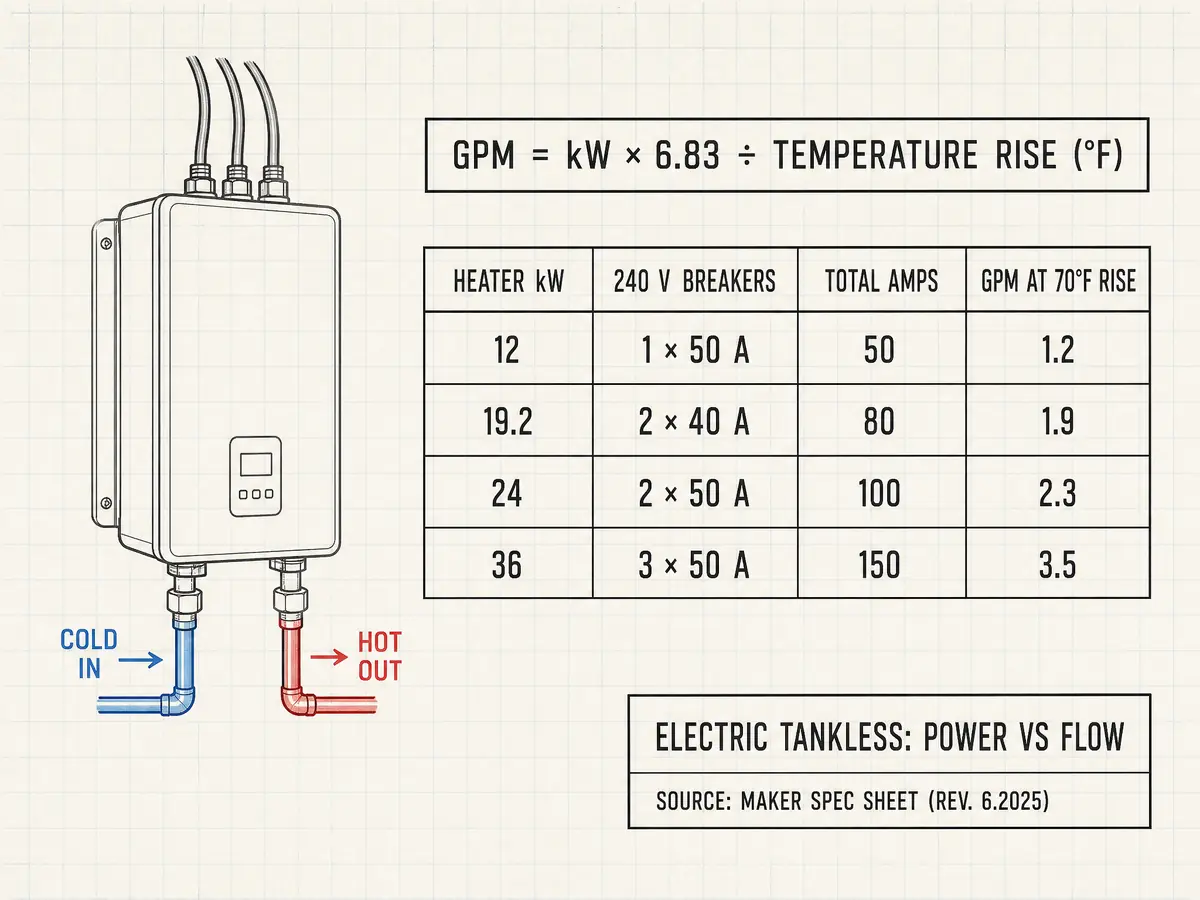
Compare those figures with demand. ENERGY STAR uses 2.5 GPM for a shower and 2.2 GPM for a sink. A 24 kW unit at a 70°F rise therefore covers one full-flow shower with little to spare, which matches DOE's general figure of about 2 GPM. A shower is usually mixed with cold water, so real draws can be lower: Stiebel Eltron's sizing guide assumes 1.5 GPM at 105°F per shower.
The spec sheet's own rise table shows the trade-off. At 240 V, the 36 kW model manages an 82°F rise at 3.0 GPM but only 55°F at 4.5 GPM. When demand exceeds capacity, the Plus models slightly reduce flow to hold the set temperature. The tankless sizing guide explains how to add up your own fixtures.
Does climate limit electric tankless?
Yes. Colder incoming water means a bigger temperature rise, and an electric unit has no extra heat to give. Stiebel Eltron's sizing guide shows the effect:
| Model | 77°F inlet | 62°F inlet | 52°F inlet | 37°F inlet |
|---|---|---|---|---|
| Tempra 12 | 2.9 GPM | 1.9 GPM | 1.55 GPM | 1.55 GPM, sink only |
| Tempra 24 | 5.9 GPM | 3.8 GPM | 3.1 GPM | 2.4 GPM |
| Tempra 36 | 8 GPM | 5.7 GPM | 4.6 GPM | 3.6 GPM |
In warm regions such as Florida or the Gulf Coast, where the guide's map shows inlet water in the 62–77°F bands, a large unit can serve several fixtures. In the coldest bands it may cover only one or two. American Water Heater's tankless guide advises measuring the cold water during the coldest season of the year.
What does the electrical work involve?
Installing a whole-house electric tankless water heater usually means new heavy circuits and a check of the home's electrical service by a licensed electrician, with a permit where required. A 36 kW unit alone needs three 50-amp double-pole breakers and three runs of 8/2 copper. Whether the panel and utility service can carry 150 amps on top of the house's other loads is a load calculation the electrician makes before anything is bought.
Plumbing is simpler than for gas: there is no vent, no gas line and no condensate drain. The Tempra connects with 3/4-inch NPT fittings and runs at 30 to 150 psi. It also accepts preheated water up to 131°F, which allows it to boost a solar or heat pump tank. Hard water still matters; the hard water and tankless guide covers scale.
Electric tankless vs gas tankless: which fits?
Gas tankless fits most whole-house jobs in cold-water regions, while electric tankless fits warm climates, small households, point-of-use spots and homes without gas. DOE's figures, about 5 GPM for gas against about 2 GPM for electric at a 70°F rise, sum up the gap.
| Factor | Electric tankless | Gas tankless |
|---|---|---|
| Flow at a 70°F rise | About 2 GPM (DOE); 3.5 GPM for a 36 kW unit (derived) | About 5 GPM (DOE) |
| Federal minimum UEF | 0.91 (0.92 high draw) | 0.81 |
| Venting and gas line | None | Sealed vent and sized gas line |
| Power needed | 50–150 A at 240 V | Outlet for fan-vented models |
| ENERGY STAR category | None in Version 5.0 | UEF 0.95 or more |
Running cost depends on local prices. Heating one gallon of water by 70°F takes about 0.17 kWh, so a 20-gallon shower, DOE's worksheet figure, uses about 3.4 kWh, or about 62¢ at EIA's August 2026 average of 18.16¢ per kWh (derived). Gas prices vary just as widely. The gas vs electric comparison and the venting and gas line guide cover the gas side, and the point-of-use guide covers small electric units at a single sink.
Sources and scope
Specifications come from Stiebel Eltron's Tempra Trend/Plus engineering spec sheet (rev. 6.2025) and sizing guide, opened October 2026, plus DOE Energy Saver's archived sizing page, ENERGY STAR's Version 5.0 criteria, 10 CFR 430.32 and EIA price data. Flows at a 70°F rise and the per-shower energy figure are calculated from the maker's formula and basic heat math, and are marked derived. One maker's line is used as a worked example, not a recommendation. Left out: prices, brand rankings and installer opinions.
Frequently asked
What is the downside of an electric tankless water heater?
Flow and power. At a 70°F rise even a 36 kW unit gives about 3.5 GPM, and it needs 150 amps of breaker capacity. In cold-water regions that can mean one shower at a time.
Can a 200-amp service run a 36 kW tankless heater?
Only an electrician's load calculation can say. The heater alone accounts for 150 amps of breaker capacity at 240 V, so the rest of the house's loads decide whether the service is enough.
Do electric tankless water heaters need a vent?
No. There is no combustion, so there is no exhaust to vent and no condensate drain.
Is electric tankless more efficient than an electric tank?
It avoids standby loss, and the federal minimum is 0.91 UEF against about 0.92 for a 50-gallon tank today. A heat pump tank, at 3.30 UEF or more under ENERGY STAR, uses far less electricity than either.
What warranty do electric tankless units carry?
It varies by maker. Stiebel Eltron lists a 7-year leakage and 3-year parts warranty on the Tempra line; read the terms on hard water before you buy, since makers can exclude scale damage.
Can an electric tankless unit boost a solar or heat pump tank?
Some can. The Tempra spec sheet allows incoming water up to 131°F for booster use, so the unit adds only the remaining rise.
Is there a tax credit for electric tankless heaters in 2026?
No federal credit applies. Under the IRS guidance on the 2025 tax law, 25C ended for equipment installed after the end of 2025.
Related reading
Start over at every water heater type, side by side · more in Tankless