
Care
Water Heater Temperature Setting: Why 120°F Is Standard
What water heater temperature setting is best? For most homes, 120°F: DOE and the CPSC both recommend it, and it balances scald risk, energy use and Legionella control.
Compiled by the Tank & Tankless desk · Revised
On this page
At a glance
- The CPSC urges all users to set water heaters to 120°F.
- At 140°F, CPSC says a six-second exposure causes third-degree burns in most adults; at 120°F it takes about five minutes.
- A tank set at 140°F can waste $36–$61 a year in standby losses, per DOE Energy Saver (archived).
- The CDC says Legionella grows best between 77°F and 113°F.
- CDC guidance for homes: keep the heater at or above 120°F; 130–140°F kills more germs but needs thermostatic mixing valves.
- Children under five and older adults suffer most tap-water scalds, per CPSC.
- 120°FSetting recommended by CPSC and DOECPSC
- 6 sExposure to 140°F water that causes third-degree burnsCPSC
- $36–$61Yearly standby loss at a 140°F settingDOE Energy Saver (archived)
- 77–113°FRange where Legionella grows bestCDC
What temperature should a water heater be set at?
A water heater should be set at 120°F in most homes. The U.S. CPSC's scald publication asks every user to lower heaters to that point, and DOE's archived temperature page says most households only need 120°F, even though some makers ship units set to 140°F.
DOE lists a side benefit: a lower setting slows mineral buildup and corrosion in the heater and pipes. Rinnai's tankless manual makes the same link from the other direction, noting that a high setpoint can speed scale formation. Homes with hard water have one more reason to stay at 120°F; see hard water and water heaters.
Factory settings vary by maker and type. A. O. Smith's electric instructions say the thermostat leaves the factory at 120°F or lower and call 120°F the preferred starting point. Its gas guide says the gas control is shipped at its lowest setting and that the "HOT" mark sits near 120°F. American Water Heater's tankless guide lists 120°F as the default, adjustable from 100°F to 140°F.
How fast can hot water scald?
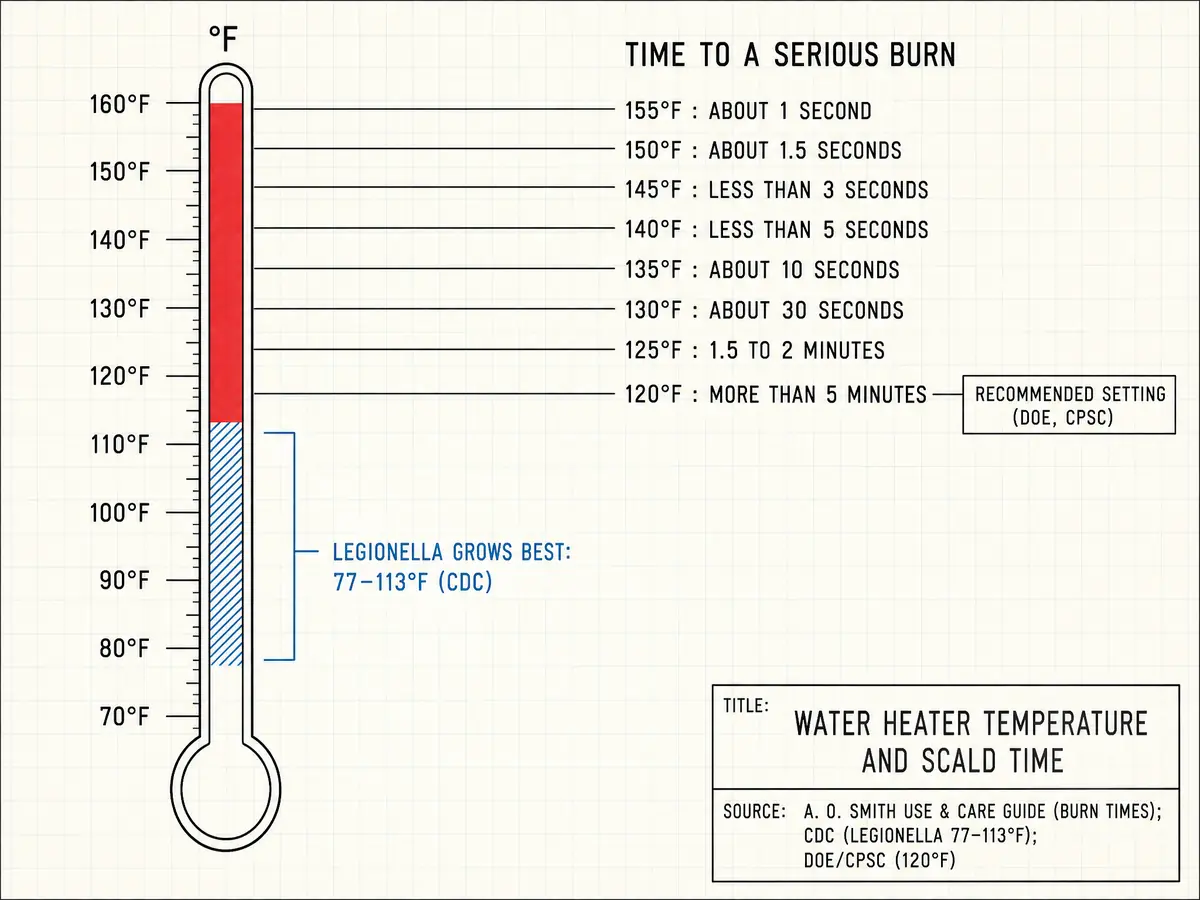
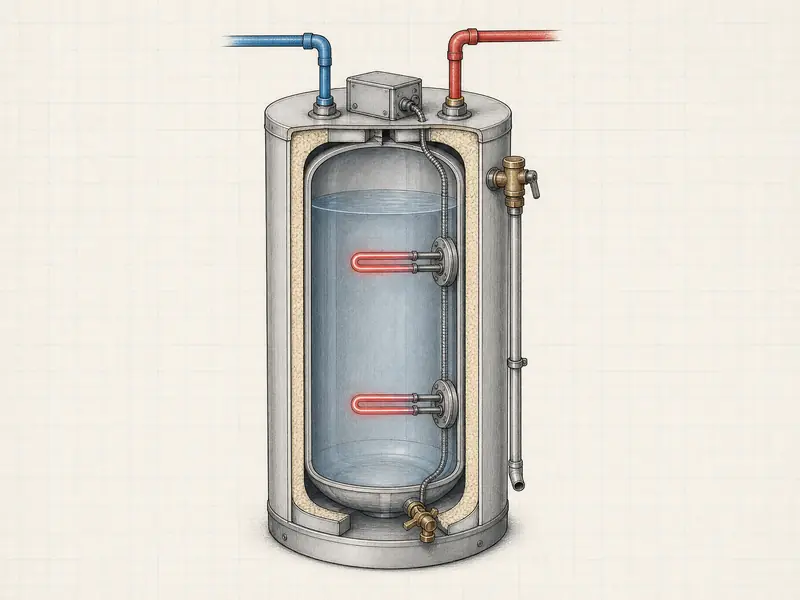
Hot water can scald in seconds above 130°F and in minutes at 120°F. CPSC says most adults suffer third-degree burns from 150°F water in two seconds, from 140°F in six seconds, from 130°F in thirty seconds, and from 120°F in about five minutes. A. O. Smith's table below gives slightly different times (about 1½ seconds at 150°F, under 5 seconds at 140°F), and the drawing on this page uses A. O. Smith's figures.
| Water temperature | Time to a serious burn |
|---|---|
| 155°F | About 1 second |
| 150°F | About 1½ seconds |
| 140°F | Less than 5 seconds |
| 135°F | About 10 seconds |
| 130°F | About 30 seconds |
| 125°F | 1½ to 2 minutes |
| 120°F | More than 5 minutes |
The curve is steep: each 5°F step above 120°F cuts the margin sharply. CPSC notes that most tap-water scald injuries and deaths involve older adults and children under five, who react slowly or can't get out of the water. Even at 120°F, A. O. Smith's gas guide warns hot water can still scald, so test bath water by hand.
Electric tanks can briefly run hotter than the dial. A. O. Smith's electric instructions describe "stacking," where many short draws of 3 gallons or less make the elements cycle and push outlet temperature up, and recommend an anti-scald device on the hot line.
Does a lower water heater temperature save money?
Yes, a lower water heater temperature saves money, mostly on tanks. DOE's archived guidance puts the standby heat lost at a 140°F setting at $36 to $61 yearly, and it lists savings of 4% to 22% a year from turning the setting down.
The reason is standby loss: a tank holds water hot all day and loses heat through its walls and, on gas models, up the flue. Hotter water loses heat faster. DOE also counts savings from using less heat at the tap, which it says may amount to more than $400. A tankless unit has no standby loss, so the dial matters less for cost there, though it still matters for scald risk.
For bigger cuts, efficiency is set at purchase, not on the thermostat. The efficiency and energy cost guide compares UEF ratings and yearly costs. Leaving home for a week or more? A. O. Smith's gas models have a vacation (VAC) mode near 55°F; its electric instructions say to turn the thermostat to its lowest setting.
What about Legionella at 120°F?
At 120°F, the Legionella risk is small for most households, according to DOE, but it is not zero. The CDC's building guidance says Legionella grows best between 77°F and 113°F and flags hot water that falls below 120°F as a growth risk.
DOE's archived page puts it this way: 120°F carries a very slight risk of promoting the bacteria but is still considered safe for most people. It suggests that anyone with a suppressed immune system or chronic respiratory disease may consider 140°F, with mixing valves to prevent scalds.
The CDC's Legionnaires' prevention sheet for rental homes gives the same balance. It says to set the heater at or above 120°F, notes that 130–140°F kills many germs but raises scald risk, and calls for thermostatic mixing valves above 120°F. It also advises routine flushing per the maker; the flushing guide has the steps.
When does a 140°F setting make sense?
A 140°F setting makes sense when someone in the home is at higher risk from Legionella, when an older dishwasher needs hotter water, or when a small tank has to stretch further, and only with mixing valves at the taps.
DOE notes that a dishwasher without a booster heater may need 130°F to 140°F for best cleaning. A. O. Smith's gas guide adds that some owners raise the setting for laundry or to get more usable hot water from the tank. Raising the dial to make up for an undersized heater has limits, though; the water heater sizing guide shows how to match first-hour rating to demand.
Thermostatic mixing valves are what make a hot tank safe. They blend cold water into the hot line so the tap delivers a set temperature while the tank stays hotter. A. O. Smith recommends one at each point of use whenever the setting is above 120°F. A licensed plumber should fit them, and local rules may require a permit.
How do you check and change the setting?
Check the setting by measuring tap water, then change it at the heater's control. Run the hot tap closest to the heater for a few minutes and hold a kitchen thermometer in the stream; the reading shows what actually reaches the tap.
On a gas tank, turn the control knob; on A. O. Smith models, "HOT" is about 120°F. On an electric tank, A. O. Smith's steps are: switch off power at the breaker, remove the access covers, fold back the insulation, set each thermostat with a screwdriver, cover the thermostats, replace the panels and restore power. Set upper and lower thermostats to the same temperature. Never touch the terminals with power on; the 240 V circuit can kill.
Tankless units and most heat pump models have a digital display with the setpoint. Wait a few hours after a change, then measure again. After a vacation of two weeks or more, A. O. Smith warns that hydrogen gas can collect in the hot water system; run a hot faucet for several minutes before using appliances nearby. For type-by-type routines, see the maintenance hub.
Sources and scope
Sources: CPSC Publication 5098, DOE Energy Saver's archived page on lowering water heating temperature, CDC's building water monitoring guidance and rental-home Legionnaires' sheet (12/2024), A. O. Smith's gas Use & Care Guide (June 2023) and electric installation instructions, Rinnai's SENSEI RX manual and American Water Heater's tankless guide, all opened in October 2026. Medical advice beyond what CDC and DOE publish, product rankings and forum anecdotes were left out.
Frequently asked
Is 125°F a safe water heater setting?
It is warmer than the 120°F CPSC and DOE recommend. A. O. Smith's table puts the time to a serious burn at 125°F at 1½ to 2 minutes, versus more than 5 minutes at 120°F.
Why does my hot water feel lukewarm at 120°F?
Water cools in long pipe runs, and the reading at the tap may be below the dial. Measure at the tap first; a heater too small for the household's peak hour can also run short.
Should the setting change in winter?
Colder inlet water takes more energy to heat, so a tank may recover more slowly. Many people leave the setting alone; check sizing before turning the dial up.
Does 120°F kill bacteria in a water heater?
It limits growth rather than killing everything. CDC says hotter water of 130–140°F kills more germs, but needs mixing valves to control scald risk.
What is the vacation setting on a water heater?
On A. O. Smith gas models, VAC holds the tank near 55°F to save energy and prevent freezing while hot water isn't used.
Can a tankless water heater be set higher than 120°F?
Usually yes. American Water Heater's tankless guide lists a 100–140°F range in 5°F steps with 120°F as the default.
Related reading
Start over at every water heater type, side by side · more in Care