
Section · Heat pump
Heat Pump Water Heaters: Pros, Cons and Fit
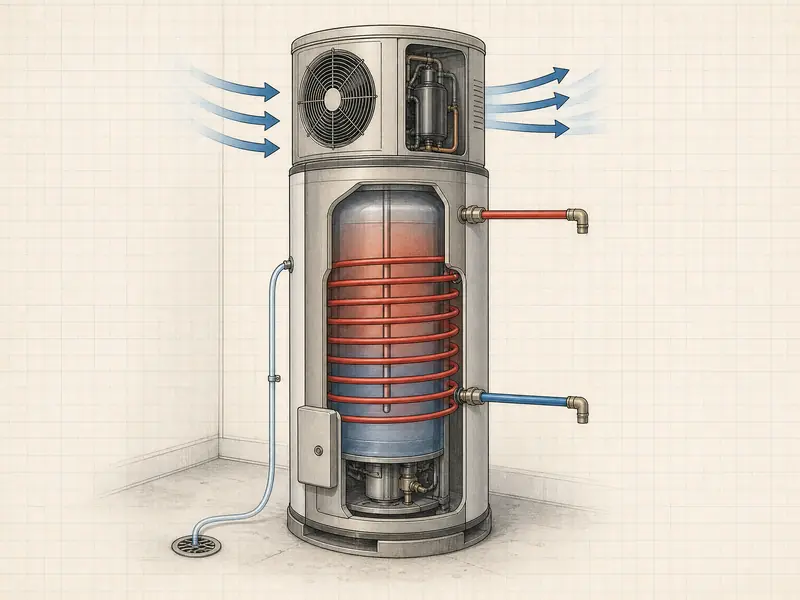
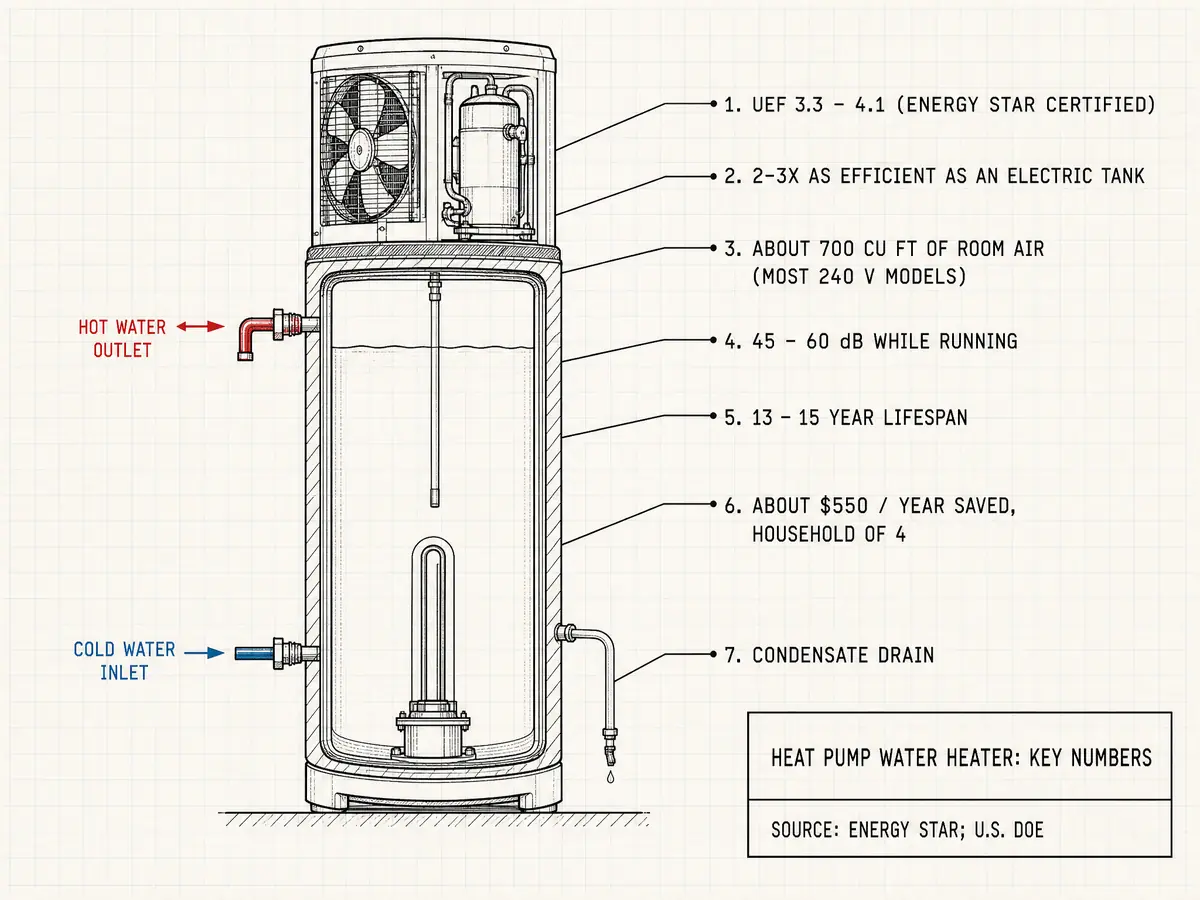
A heat pump water heater moves heat from room air into a storage tank, which makes it two to three times as efficient as a standard electric tank, in exchange for space, noise and a higher price.
Compiled by the Tank & Tankless desk · Revised
At a glance
- DOE rates heat pump units as two to three times as efficient as a conventional electric resistance tank.
- ENERGY STAR certified models carry a Uniform Energy Factor (UEF) of 3.3 to 4.1, against about 0.93 for a standard electric tank.
- ENERGY STAR's savings table puts the bill cut near $550 a year for four people, at $0.146 per kWh.
- Most 240 V models want about 700 cubic feet of room air; smaller rooms need louvers or ducting.
- The federal 25C credit (up to $2,000) ended for units placed in service after December 31, 2025, per the IRS.
- From May 6, 2029, most new electric tanks of 20 to 120 gallons must reach heat-pump-level efficiency under DOE's 2024 rule.
- 3.3–4.1UEF range of ENERGY STAR heat pump water heatersENERGY STAR
- $550/yrEstimated savings, household of four, at $0.146/kWhENERGY STAR
- 13–15 yrsTypical cited lifespan of a heat pump water heaterENERGY STAR
- 45–60 dBRunning sound of most new modelsENERGY STAR
How does a heat pump water heater work?
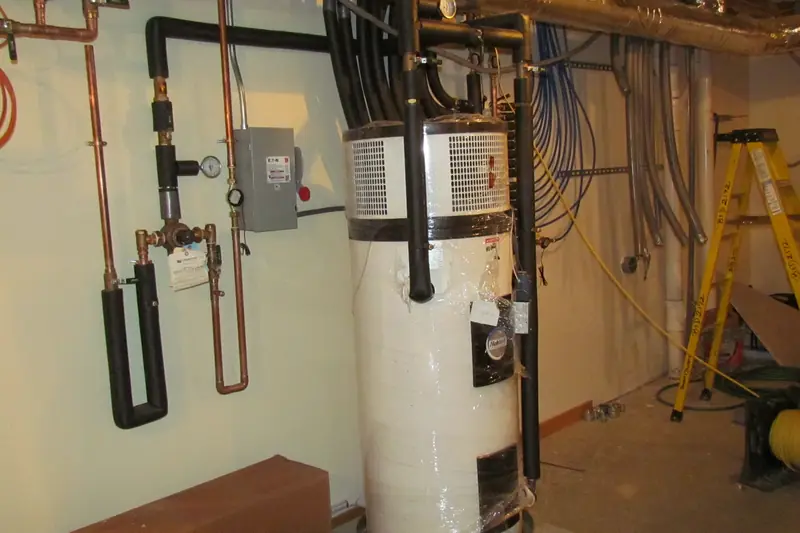
A heat pump water heater uses a compressor and refrigerant to pull heat out of the surrounding air and push it into the water, instead of making heat with a burner or element. Moving heat costs less electricity than making it, which is the whole efficiency story (DOE Energy Saver (archived)). Home models are integrated: a storage tank with the heat pump on top and backup resistance elements inside.
Those elements explain the "hybrid" label. During heavy demand the unit switches to resistance heat on its own, and most models offer efficiency (heat pump only), hybrid and electric modes (ENERGY STAR). Hybrid is the usual default.

What are the pros of a heat pump water heater?
The main advantage is a lower electric bill: a rated UEF of 3.3 to 4.1 means three to four units of heat per unit of electricity on the federal test. ENERGY STAR's table estimates yearly savings of $270 for two people, $410 for three and $550 for four, with a 2.7-year payback in the four-person case on a $1,503 price premium. That table assumes 14.6¢ per kWh; the August 2026 US average was 18.16¢ (EIA), so dollar savings at today's rates run higher.
The smaller gains are real too. The unit cools and dehumidifies its room, which suits a damp basement in summer. It needs no flue, since nothing burns. And ENERGY STAR cites a life of 13 to 15 years, against 10 to 15 for a standard tank (DOE).
What are the cons of a heat pump water heater?
The drawbacks of a heat pump water heater are air, warmth, sound and price. It needs a big volume of air at a workable temperature, it drains a little condensate, and it hums at 45 to 60 dB. It also chills its room slightly: a 2022 study of 81 households cited by ENERGY STAR measured an average basement drop of 2.3°F, gone within about four hours.
Recovery on the compressor alone is slow, so a family that drains the tank often leans on the elements and gives up some savings. Swapping out a gas unit usually means going one size larger. The side-by-side with a plain resistance tank is in heat pump vs electric tank.
| Type | Typical rated UEF | Cited lifespan | Site needs |
|---|---|---|---|
| Heat pump, 240 V integrated | 3.3–4.1 (ENERGY STAR certified) | 13–15 years | Room air, condensate drain, 30 A circuit |
| Standard electric tank | about 0.93 | 10–15 years | 240 V circuit |
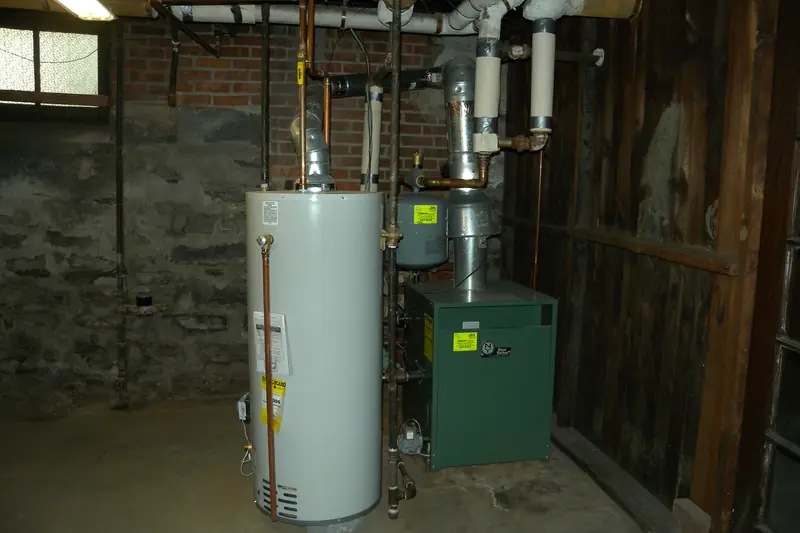
| Gas storage tank | 0.81–0.86 for ENERGY STAR models | 10–15 years | Gas line and flue |
| Gas tankless | 0.95 or higher for ENERGY STAR models | about 20 years | Gas line sized to input, sealed vent |
What does a heat pump water heater cost?
ENERGY STAR puts the unit price of a heat pump water heater at $1,500 to $3,000, and an informal contractor survey it reports added $1,000 to $3,000 in labor and materials on top. In its 2024 rulemaking DOE assumed $1,855 installed for an electric storage unit at the adopted heat-pump level, versus $1,578 for a gas tank. Wiring, drain and space work swing the total more than the tank itself.
Incentives shifted in 2026. The 30% federal credit under 25C, capped at $2,000, does not apply to units placed in service after 2025. What is left is state-run: HEEHR rebates cap a heat pump water heater at $1,750 for income-qualified homes in states that have launched the program (DOE Home Energy Rebates), and utilities often pay $300 to $1,000. The line items are broken out in the installation guide.
Where can a heat pump water heater go?
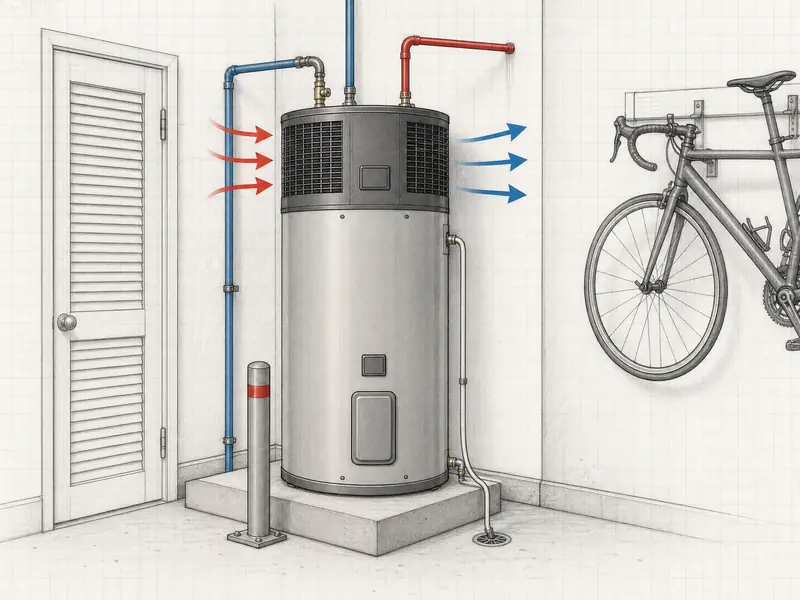
A heat pump water heater fits any room that holds enough air, stays mostly above the high 30s °F and has a drain close by. ENERGY STAR's 2024 installer guide gives a floor of 700 cubic feet for most 240 V units (450 for a few) and allows a closet of 84 cubic feet or more with a fully louvered door (ENERGY STAR install guide). DOE's older advice of 1,000 cubic feet at 40 to 90°F is the conservative end.
Basements and garages that rarely freeze are the usual homes for one. Below the model's rated cutoff the unit runs on its elements, so that number matters more than the box label. Where no 240 V circuit exists, a plug-in 120V model is the other route.
Does the 2029 DOE rule push buyers toward heat pumps?
For electric tanks, yes: under DOE's May 2024 final rule, most new electric storage units of 20 to 120 gallons built from May 6, 2029, need a UEF of 2.30 (up to 55 gallons) or 2.50 (above 55), which only heat pump designs reach (Federal Register). Small electric tanks of 20 to 35 gallons with a first-hour rating under 51 are excluded. Installed water heaters are not affected, and as of October 2026 no delay or repeal had been published. More on the 2029 rule page.
Sources and scope
Built from the archived DOE Energy Saver heat pump page (June 2026 snapshot), ENERGY STAR's product, savings, cost and 2024 installer pages, the 2024 DOE final rule, the IRS notice on 25C, DOE's Home Energy Rebates page and EIA price tables, each checked in October 2026. Not used: installer quotes, brand rankings or forum posts.
Frequently asked
Is a heat pump water heater worth it with no federal tax credit?
Often, on the numbers. ENERGY STAR's table assumes a $1,503 premium and a 2.7-year payback for four people at 14.6¢ per kWh, before any rebate. Higher local rates shorten that; a small household or cheap gas lengthens it.
Does a heat pump water heater still make hot water in winter?
Yes, as long as its room stays warm enough. Most units heat with the compressor down to the high 30s °F, then hand over to the resistance elements, which still deliver hot water at standard electric efficiency.
Is a heat pump a sensible swap for a gas tank?
It can be, with planning. It needs an electric circuit in place of the gas line and flue, plus a condensate drain, and ENERGY STAR suggests stepping up one tank size.
How quickly does a heat pump tank reheat?
More slowly than a resistance or gas tank when the compressor works alone. Spec sheets list recovery in gallons per hour at a stated rise; compare that number, not tank size, if the household takes back-to-back showers.
Do heat pump water heaters need extra maintenance?
A little. On top of normal tank care (flushing, anode checks, T&P valve tests), ENERGY STAR notes the air filter may need cleaning, typically once a year.
Are heat pump water heaters noisy?
They run at about 45 to 60 dB per ENERGY STAR, near refrigerator level at the low end. A spot away from bedrooms, or a rigid foam pad under the unit, helps.

Start over at every water heater type, side by side