
Buying
How Long Do Water Heaters Last?
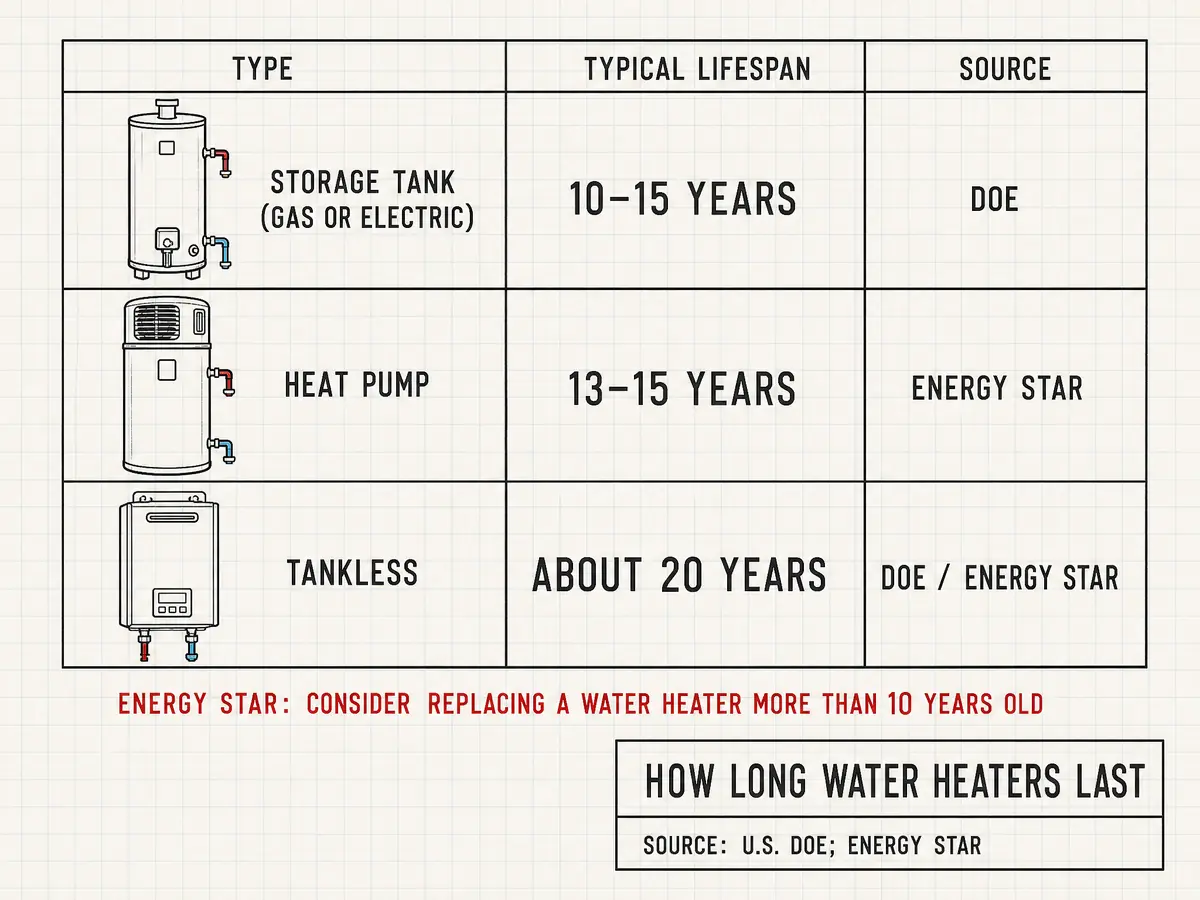
How long do water heaters last? Gas and electric tanks typically last 10–15 years, heat pump models 13–15 years and tankless units about 20 years, with hard water and skipped maintenance cutting that short.
Compiled by the Tank & Tankless desk · Revised
On this page
At a glance
- Storage tanks last 10–15 years, according to DOE Energy Saver (archived); DOE's 2024 rulemaking uses about 15 years.
- Tankless units last about 20 years and have "easily replaceable parts," per DOE and ENERGY STAR.
- Heat pump water heaters are "typically cited as lasting between 13-15 years," per ENERGY STAR.
- ENERGY STAR advises considering a replacement once a water heater is more than 10 years old, before it fails.
- DOE's rulemaking estimates average installed costs of $1,578 for a gas tank and $1,855 for an electric tank under the 2029 standard.
- The federal 25C tax credit ended for equipment placed in service after December 31, 2025 (IRS).
How long do water heaters last by type?
Water heaters last about 10 to 20 years depending on type: tanks at the low end, tankless units at the high end. The figures below are the ones federal sources publish; actual life depends on water quality, installation and care.
| Type | Typical lifespan | Source |
|---|---|---|
| Gas or electric storage tank | 10–15 years | DOE Energy Saver (archived) |
| Storage tank, rulemaking average | About 15 years | DOE, 89 FR 37778 |
| Heat pump (hybrid) tank | 13–15 years | ENERGY STAR |
| Gas tankless | About 20 years | DOE; ENERGY STAR |
ENERGY STAR's own figure for traditional tanks is shorter, 10 to 12 years, so plan on the lower end of DOE's range if the water is hard. Warranties hint at what makers expect: one heat pump line carries a 10-year tank and parts warranty (Rheem spec sheet), and one tankless line warrants its heat exchanger for 15 years in homes (Navien). No federal source gives a lifespan for solar water heaters.
- 10–15 yrsTypical storage tank lifespanDOE Energy Saver (archived)
- About 20 yrsTankless water heater life expectancyENERGY STAR
- 13–15 yrsHeat pump water heater lifespanENERGY STAR
- $1,578DOE estimate: gas tank bought and installedFederal Register, 89 FR 37778
What shortens a water heater's life?
Hard water, sediment, a worn-out anode and pressure from thermal expansion shorten a water heater's life most. The USGS says heating hard water forms calcium carbonate scale that "can reduce the life of equipment." A. O. Smith's manual adds that draining sediment "extends the life of the tank and drain valves."
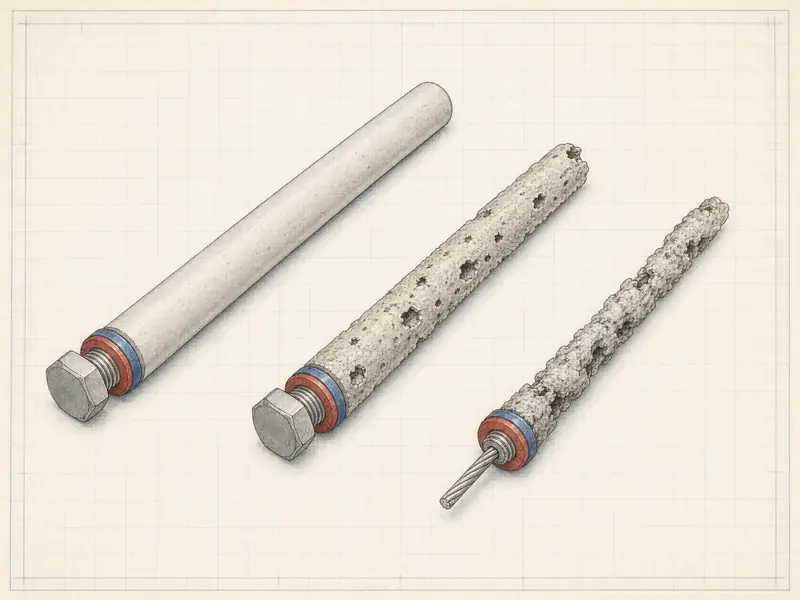
Tanks carry an anode rod, usually magnesium, that corrodes so the steel tank does not. Once it is used up, the tank itself starts to corrode, which is why makers say a tank must never run without one. A. O. Smith's electric instructions call artificially softened water "exceedingly corrosive" and say a softener "may decrease the life of the water heater tank"; the anode rod page covers inspection.
When a home's plumbing is closed off from the main (by a check valve, for example), A. O. Smith says thermal expansion "can cause premature tank failure (leakage)." For tankless units, Rinnai's manual states that skipping flushing damages the heat exchanger and that lime and scale damage "is not covered by the water heater's warranty." The hard water page explains the scale classes.
What are the signs a water heater is failing?
The clearest signs a water heater is failing are rust-colored hot water, leaks, rumbling noises and shrinking hot water supply. ENERGY STAR lists them:
- Corrosion: visible corrosion "is a sign that the water heater is breaking down."
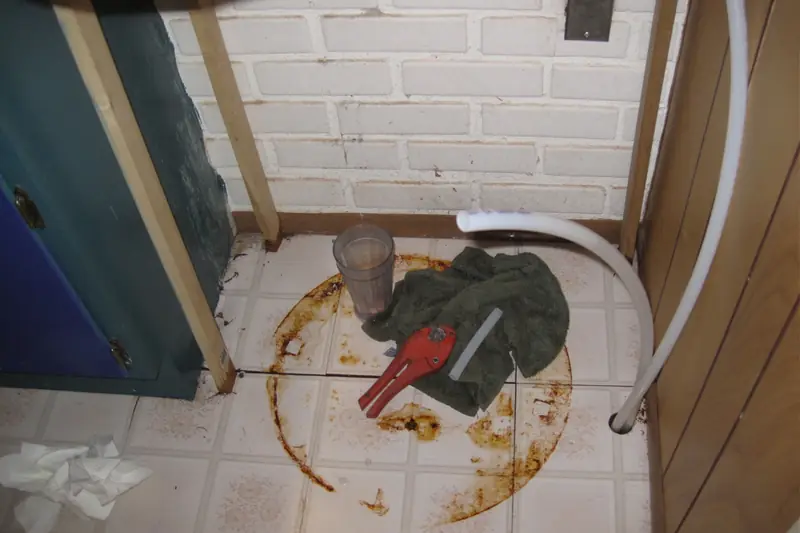
- Rusty water: rust in the hot water "is usually a sign that the interior of the water heating system is corroding."
- Leaks: water at joints, seals or seams usually indicates a problem; the leaking page separates fitting leaks from tank leaks.
- Less hot water: sediment build-up can reduce usable capacity.
- Noise: rumbling or vibration means the unit is "likely straining to operate correctly"; see the noises page.
ENERGY STAR also warns that a water heater can seem fine "and then fail without warning." To find its age, read the brand and serial number on the tank label; some labels print the manufacture date directly, and makers publish serial-number guides.
Should you repair or replace a water heater?
Repair a water heater when a replaceable part has failed on a unit with years of life left; replace it when the tank is corroding or the unit is near the end of its expected life. Thermostats, elements, igniters, anode rods and T&P valves are replaceable parts. A corroding or leaking tank body is the failure ENERGY STAR describes as the unit breaking down.
Age is the tie-breaker. A tank past 10 years is close to the end of DOE's range, and ENERGY STAR notes that waiting for a breakdown can force an emergency replacement that "can be more expensive." Check the warranty first: tank and heat exchanger coverage often outlasts parts coverage, and some makers exclude hard-water damage or void coverage if the anode is removed.
What does water heater replacement cost?
Water heater replacement cost depends mostly on the type and on how much the installation changes. In its 2024 rulemaking, DOE estimated $1,578 on average to buy and install a gas tank and $1,855 for an electric tank under the 2029 standard, which assumes many electric buyers move to heat pumps.
For heat pump models, ENERGY STAR quotes unit prices of $1,500 to $3,000 before incentives, and an informal contractor survey of $1,000 to $3,000 more for labor and materials. Switching fuel or type usually adds work, such as a new 240 V circuit, a condensate drain, a gas line upgrade or new venting.
Incentives have changed. The federal 25C credit (30%, up to $2,000 for a heat pump water heater) is gone for installs after 2025. The state-run HEEHR program can cover up to $1,750 for a heat pump water heater for qualifying incomes where a state has launched it (42 U.S.C. 18795a), and ENERGY STAR says many utilities offer $300 to $1,000. The 2029 rule page explains why replacing early is not required.
How do you make a water heater last longer?
Make a water heater last longer by following the maker's maintenance schedule, mainly flushing, anode checks and valve tests. A. O. Smith's gas manual asks for the tank to be drained and flushed six months after installation and then at least annually, with the anode inspected at the same visits; see the flushing page.
Other steps from manuals and DOE:
- Temperature: DOE notes that 120°F slows mineral buildup and corrosion compared with 140°F.
- T&P valve: operate the lever at least once a year (DOE suggests every six months), and have it professionally inspected per the valve label.
- Expansion tank: on closed systems, a properly sized one, pressurized to match the home's water pressure.
- Tankless: descale at least once a year, more often with hard water, per the descaling page.
- Heat pump: clean the air filter; ENERGY STAR says these units may need annual maintenance.
Sources and scope
Compiled from archived 2026 snapshots of DOE's Energy Saver tankless and storage pages, DOE's 2024 final rule (89 FR 37778), ENERGY STAR articles on replacement timing and heat pump costs, A. O. Smith and Rinnai installation manuals, USGS hardness guidance, maker warranty pages, IRS guidance on 25C and the HEEHR statute (all checked October 2026). Left out: survey-site cost averages, "repair if under 50% of the price" rules of thumb with no primary source, and any solar lifespan figure, since none was found in DOE or ENERGY STAR text.
Frequently asked
How long does a gas water heater last compared with an electric one?
DOE gives the same 10–15 year range for gas and electric storage tanks. Water quality and maintenance matter more than fuel.
How long does a tankless water heater last with hard water?
Makers do not publish a reduced lifespan, but they tie warranties to water quality: Noritz excludes damage from hardness above 12 grains per gallon, and Rinnai excludes scale damage. Yearly descaling and treatment for very hard water protect the heat exchanger.
Can a 20-year-old tank water heater keep running?
It can, but it is well past DOE's 10–15 year range. ENERGY STAR suggests planning a replacement for any unit over 10 years old rather than waiting for a leak.
How can the age of a water heater be found?
Read the serial number on the rating label. Some labels print the manufacture date; otherwise each maker's serial-number guide decodes the month and year.
Does replacing the anode rod extend tank life?
It can, because the anode corrodes instead of the steel tank. A. O. Smith's electric manual calls for an inspection within three years and yearly after that, or yearly from the start with softened water.
Is a federal tax credit available for a replacement in 2026?
No. Under the 2025 tax law, 25C stopped at the end of 2025, so a heater installed in 2026 does not qualify. State HEEHR rebates and utility incentives may still apply.
Does a heat pump water heater last as long as a tank?
Roughly. ENERGY STAR's 13–15 year figure for heat pump units sits inside DOE's tank range, and its savings model assumes 13 years.
Related reading
Start over at types of water heaters compared · more in Buying