
Compare
Tankless vs Tank Water Heater
Tankless vs tank water heater, in one line: tankless uses 24–34% less energy in homes drawing 41 gallons a day or less and lasts about 20 years, while a tank costs less to install and feeds several taps at once.
Compiled by the Tank & Tankless desk · Revised
On this page
- How does a tankless water heater differ from a tank?
- Is tankless more efficient than a tank water heater?
- Which gives more hot water at once?
- What does each cost to buy and install?
- How long does tankless last compared with a tank?
- When is a tank the better choice?
- How does hard water affect tankless vs tank?
- Frequently asked
At a glance
- DOE rates tankless units 24–34% more efficient than storage tanks in homes using 41 gallons a day or less, and 8–14% at about 86 gallons a day (DOE Energy Saver, archived).
- ENERGY STAR puts the saving of a certified gas tankless unit at $95 a year for a family of four, compared with a standard gas tank.
- A storage tank keeps 20 to 80 gallons hot; a tankless unit typically delivers 2–5 gallons per minute, and gas models sit at the top of that range.
- DOE gives storage tanks 10–15 years and tankless units about 20 years.
- DOE's rulemaking models put the average installed cost at $1,578 for a gas tank and $2,087 for a baseline gas tankless unit.
- Rinnai and Noritz tie their tankless warranties to water hardness; about 12 grains per gallon (200 mg/L) is a common maker ceiling.
- 24–34%Tankless efficiency gain over a tank in homes using 41 gal/day or lessDOE Energy Saver (archived)
- $95/yrSaving of an ENERGY STAR gas tankless unit vs a standard gas tank, family of fourENERGY STAR
- 10–15 yrsTypical storage tank lifespanDOE Energy Saver (archived)
- about 20 yrsTypical tankless lifespanENERGY STAR
How does a tankless water heater differ from a tank?
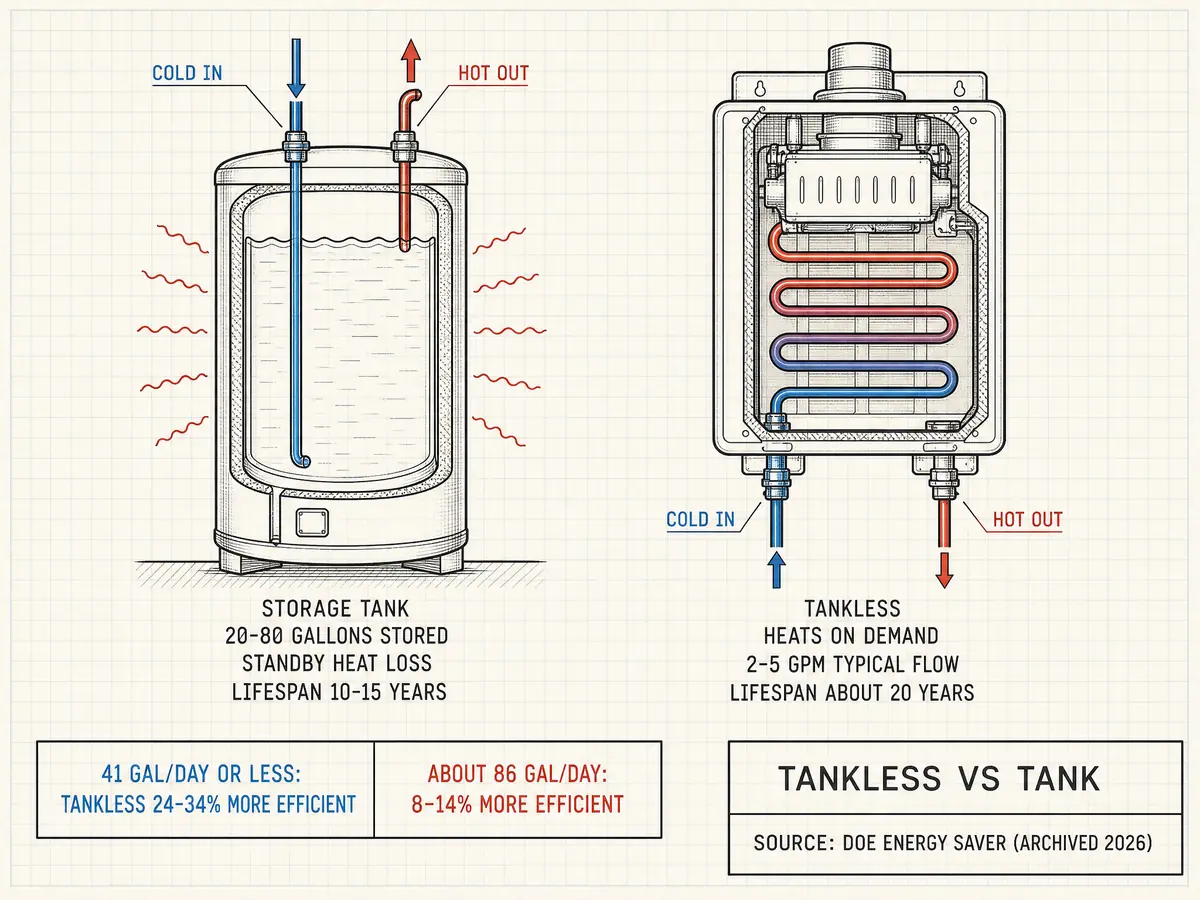
A tank stores hot water and keeps it hot; a tankless unit heats water only while a tap is open. In a storage heater, hot water leaves from the top and cold water enters the bottom through a dip tube, so the tank is always full and always holding heat. DOE's storage water heater page (Energy Saver, archived) puts single-family tanks at 20 to 80 gallons.
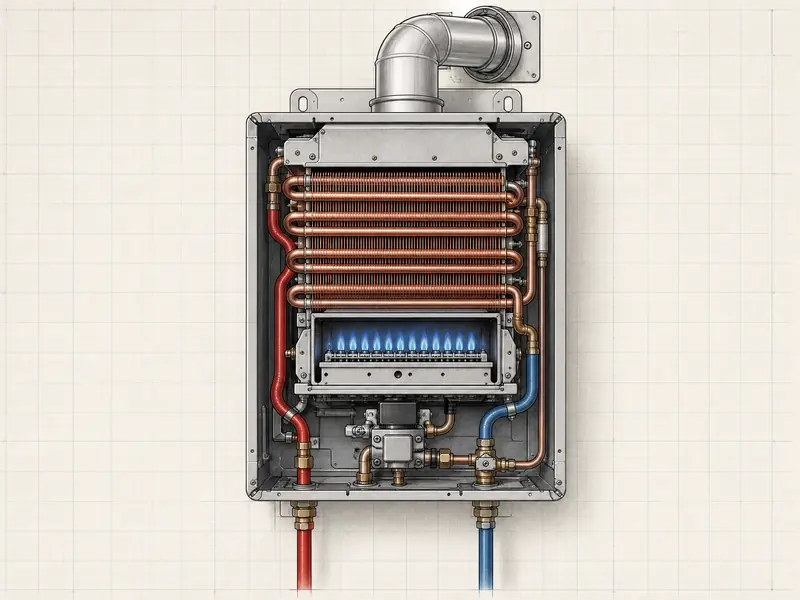
A tankless, demand or instantaneous unit has no reservoir. When flow starts, cold water passes through a heat exchanger and a gas burner or electric element heats it on the way through. A flow sensor lights the burner in gas models, and combustion gases leave through a sealed vent.
That one design choice drives every other difference on this page. A tank is rated by how many gallons it can deliver in its first hour. A tankless unit is rated by how many gallons per minute it can heat through a given temperature rise. The tank section and the tankless section cover each type in depth.
Is tankless more efficient than a tank water heater?
Yes, and the margin shrinks as hot water use rises. DOE's figures are 24–34% better efficiency for households using 41 gallons a day or less and 8–14% for heavy users near 86 gallons a day. The gain comes from avoiding standby loss: a tank loses heat to the room around it all day, and only tankless designs skip that loss entirely.
Rated numbers tell the same story. A tank's federal minimum depends on its volume; for a 50-gallon, medium-draw gas tank it works out to about 0.56 UEF today, while gas tankless units face a 0.81 minimum under 10 CFR 430.32. ENERGY STAR asks for 0.81 or more from a medium-draw gas tank of 55 gallons or less and 0.95 or more from a gas tankless unit.
UEF compares heaters only within the same usage bin, and DOE warns that a higher rating does not always mean a lower bill across fuels. The efficiency and energy cost guide explains the label in full.
Which gives more hot water at once?
A tank gives more at once; a tankless unit gives more over a long stretch. A tank can empty a large share of its stored volume in a few minutes, so two showers and a washer can run together until the reserve runs low. ENERGY STAR's example is a 40-gallon tank with a strong element that can deliver 80 gallons in its first hour.
A tankless unit never runs out, but it caps the flow. DOE says typical units supply 2–5 GPM and that a shower plus a dishwasher can stretch one to its limit. At a 70°F rise, DOE expects about 5 GPM from gas units and about 2 GPM from electric ones. ENERGY STAR lists a shower at 2.5 GPM, a sink at 2.2 and a clothes washer at 3.3, so two fixtures already need 4.7 GPM.
To size either type, start with the household sizing worksheet for tanks or the GPM and temperature-rise method for tankless units.
What does each cost to buy and install?
A tank usually costs less to install. DOE's 2024 rulemaking put the average installed cost of a gas storage tank at $1,578 at the adopted standard level. DOE's separate analysis for gas tankless units put a baseline non-condensing model at $2,087 installed, in 2023 dollars (89 FR 105188). The two models used different years and assumptions, so treat the gap as a rough guide.
Switching from a tank to tankless can add work that a like-for-like swap does not need. ENERGY STAR tells buyers to have the installer check whether the existing gas line is big enough, whether power is near the heater for fan-driven venting, and how exhaust will be vented. A 199,000 Btu/h unit is common, and the venting and gas line guide shows why pipe size and run length matter.
The federal 25C tax credit does not help with a 2026 install. The IRS says the credit is not allowed for property placed in service after December 31, 2025.
| Spec | Storage tank (gas) | Tankless (gas) |
|---|---|---|
| Stored hot water | 20–80 gallons | None |
| Rated by | First-hour rating (gallons) | GPM at a temperature rise |
| Standby heat loss | Yes | No |
| Federal minimum UEF | About 0.56 (50-gal medium draw, derived) | 0.81 |
| ENERGY STAR UEF | 0.81+ (55 gal or less, medium draw) | 0.95+ |
| Typical lifespan | 10–15 years | About 20 years |
| DOE average installed cost | $1,578 | $2,087 (2023 dollars) |
How long does tankless last compared with a tank?
Tankless units last longer. DOE says most tankless heaters have a life expectancy of more than 20 years and have replaceable parts, while storage tanks last 10–15 years. ENERGY STAR uses 20 years for tankless units.
A tank's life ends when the steel shell corrodes through, which is why the anode rod and yearly draining matter. A tankless heat exchanger fails from scale and wear instead, which is why descaling matters. Warranty terms reflect the difference: Noritz, for one, offers 12 years on the heat exchanger of a model used in a single-family home. The lifespan and replacement cost guide covers the warning signs for both.
When is a tank the better choice?
A tank fits best where several fixtures run at the same moment, where the budget is tight, or where the gas line and vent would need a rebuild. Heavy users gain only 8–14% from going tankless, so the higher install cost takes longer to pay back. A large family with back-to-back showers may also outrun a single tankless unit's flow.
Electric homes face a different choice. A whole-house electric tankless unit delivers about 2 GPM at a 70°F rise, which is one shower in cold-inlet regions. From May 6, 2029, most new electric tanks of 20–120 gallons must reach heat pump efficiency, so the realistic electric alternatives become a heat pump water heater or a small exempt tank.
How does hard water affect tankless vs tank?
Hard water hurts both, but tankless warranties are stricter about it. USGS says heated hard water forms calcium carbonate scale that shortens equipment life and raises heating costs. In a tank, scale settles as sediment, and A. O. Smith's manual calls for draining and flushing at least once a year after a first flush at six months.
In a tankless unit, scale coats the narrow heat-exchanger passages. Rinnai's manual sets a hardness limit of 200 mg/L, says damage from lime or scale is not covered by the warranty, and calls for flushing at least once a year. Noritz excludes damage from water above 12 grains per gallon. The hard water and tankless guide covers testing and treatment, and the descaling guide shows the yearly flush.
Sources and scope
This comparison draws on DOE Energy Saver pages (archived copies from 2026, since the live pages were taken down), ENERGY STAR product and savings pages, 10 CFR 430.32, the Federal Register rules of May and December 2024, the IRS 25C guidance, USGS and the Rinnai, Noritz and A. O. Smith manuals, all checked in October 2026. Left out: contractor price quotes, forum anecdotes and brand rankings.
Frequently asked
Can a 40-gallon tank be replaced with a tankless water heater?
Yes, if the tankless unit is sized for flow and the fuel supply can feed it. Add up the GPM of fixtures that run together and size for the temperature rise from your coldest inlet water. A gas model near 5 GPM at a 70°F rise covers a shower and a sink; a roughly 2 GPM electric model does not.
Does a tankless water heater ever run out of hot water?
It does not run out, but it cannot exceed its rated flow. Open more fixtures than it can heat and the outlet temperature drops. A tank behaves the other way: full flow until the stored hot water is used up.
Is tankless worth it for a family of four?
ENERGY STAR estimates $95 a year in gas savings for a certified tankless unit against a standard gas tank. Using DOE's average installed costs, the extra roughly $500 would take about five years to recover, a rough derived figure since the two DOE models differ.
Does a tankless water heater need a bigger gas line?
Often. The NFPA 54 table reproduced in Rinnai's manual shows 3/4-inch Schedule 40 pipe carrying about 199 cubic feet per hour at 30 feet, and less over longer runs. A gas fitter sizes the line for the whole house load.
Is there a minimum flow before a tankless heater turns on?
Yes. One maker's guide lists 0.5 GPM to start firing and 0.4 GPM to keep firing. A very low trickle at a bathroom sink may stay cold.
Which costs less to run, a gas tank or gas tankless?
The FTC EnergyGuide ranges suggest tankless. Medium-capacity gas tanks show $179–235 a year on the label, while medium-capacity gas tankless units show $144–170.
Is there a federal tax credit for a tankless heater installed in 2026?
No. The IRS says the 25C credit is not allowed for property placed in service after December 31, 2025. State or utility rebates may still apply.
Related reading
Start over at the water heater type index · more in Compare