
Tank
Electric Water Heater Guide
An electric water heater heats a stored tank with one or two resistance elements on a 240-volt circuit; it rates about 0.92 UEF today, and most new ones must reach heat pump efficiency from May 6, 2029.
Compiled by the Tank & Tankless desk · Revised
On this page
At a glance
- A double-element electric tank has an upper and a lower element, each with its own thermostat, and A. O. Smith's electric manual says both thermostats must be set to the same temperature.
- That manual's circuit table pairs a 4,500-watt element at 240 V with 25-amp protection and 10 AWG copper; ENERGY STAR calls a 30-amp breaker and 10-gauge wire typical.
- For a 50-gallon medium-draw resistance tank, the federal minimum works out to about 0.92 UEF today (derived from 10 CFR 430.32).
- From May 6, 2029, new electric tanks of 20–55 gallons need a UEF of 2.30 and those over 55 up to 120 gallons 2.50; small 20–35 gallon tanks with an FHR under 51 are excluded.
- The FTC's EnergyGuide range for a medium-FHR electric tank runs $121–$494 a year; heat pump models sit at the low end.
- U.S. homes paid an average of 18.16¢ per kWh in August 2026, per EIA.
- 0.92Approximate federal minimum UEF today, 50-gal medium-draw electric tank (derived)eCFR, 10 CFR 430.32
- 2.302029 minimum UEF for most 20–55 gal electric tanksFederal Register
- 18.16¢U.S. average residential price per kWh, August 2026EIA
- $1,855DOE's average installed cost for an electric storage heater under the 2029 standardFederal Register
How does an electric water heater work?
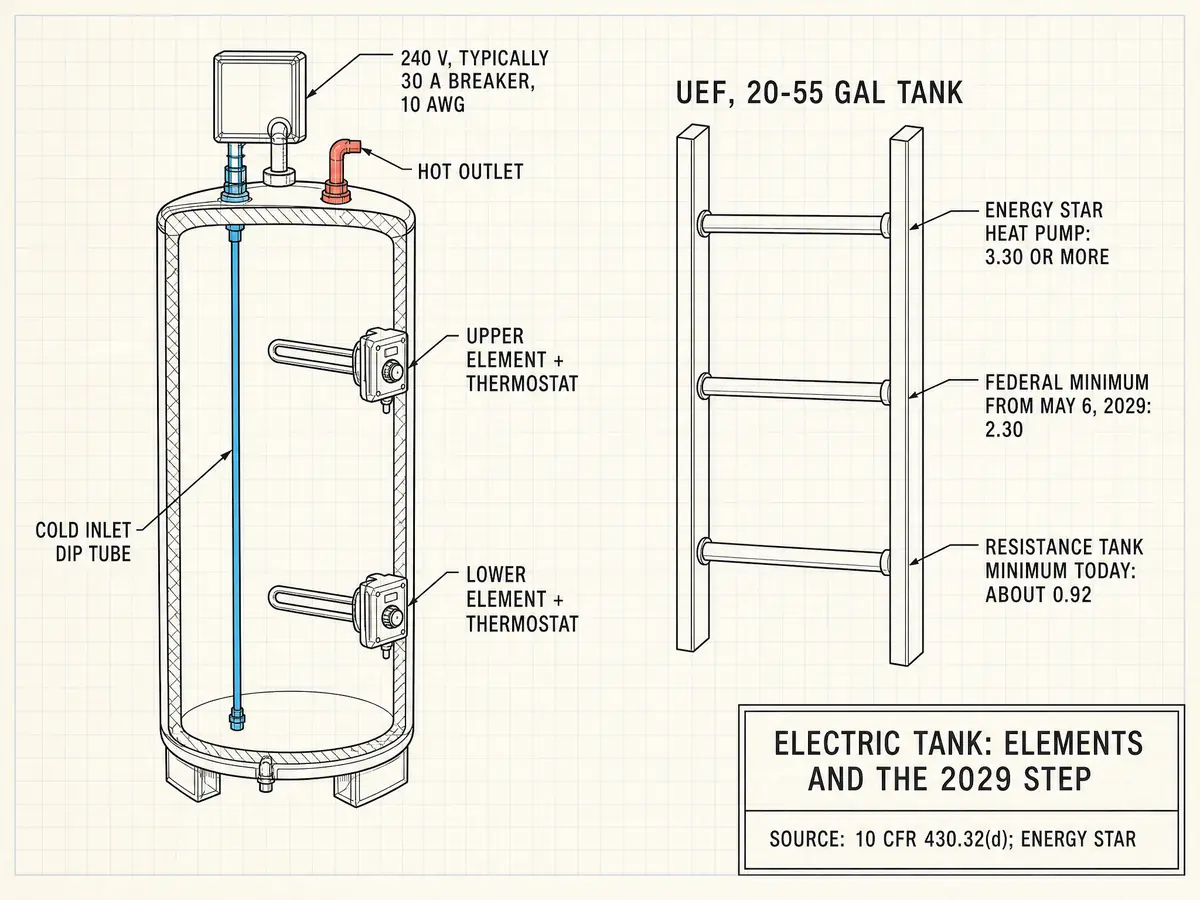
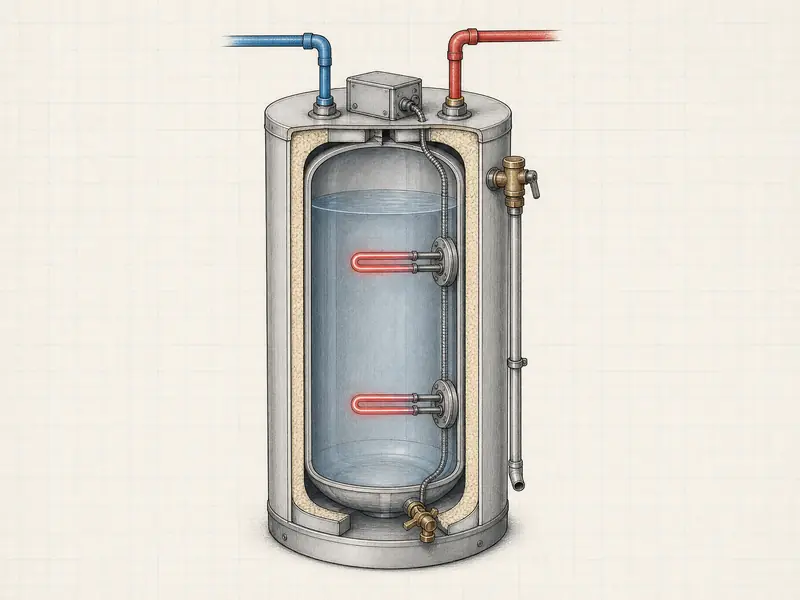
An electric water heater warms a stored tank of water with resistance elements that screw through the tank wall, and each element is switched by its own thermostat. Cold water enters through a dip tube that carries it to the bottom, and hot water leaves from the top, as in any storage tank. A double-element tank has an upper element near the top and a lower element near the bottom.
The wiring decides whether both can heat at once. A. O. Smith's electric manual shows "interlocking" (non-simultaneous) wiring, where only one element heats at a time, and simultaneous wiring as a separate option. In both cases the upper element serves the top of the tank, where hot water is drawn off, which is why the manual's troubleshooting chart links "no hot water" to the upper element or thermostat and "insufficient hot water" to the lower element.
Each thermostat carries a high-limit switch. In that manual, it cuts power to the elements if the water passes 170°F and must be reset by hand with a red button. If the limit keeps tripping, the manual says to call a qualified person rather than keep resetting it.
What circuit does an electric water heater need?
Most whole-house electric tanks run on a dedicated 240-volt circuit, sized to the element wattage on the data plate. ENERGY STAR's heat pump installation guide says a 240 V heat pump model typically uses a 30-amp breaker and 10-gauge wire, "just like a standard electric storage water heater."
The circuit table in A. O. Smith's electric manual, based on the National Electrical Code, gives these pairings at 240 V:
| Element load | Overcurrent protection | Copper wire size |
|---|---|---|
| 3,500 W | 20 A | 12 AWG |
| 4,500 W | 25 A | 10 AWG |
| 5,500 W | 30 A | 10 AWG |
| 6,000 W | 30 A | 8 AWG |
Voltage matters too. Rheem's spec sheet for its 240 V heat pump model notes that a 4,500-watt backup element puts out 25% less, 3,375 watts, on a 208-volt supply. Wiring a water heater is electrician's work: the manual calls for proper breaker protection, grounding and code-sized copper, and warns that powering an element before the tank is full of water destroys it.
What size electric water heater do you need?
Choose an electric tank by its first-hour rating (FHR), the gallons it can deliver in an hour starting full and hot, and match that to your busiest hour of use. DOE's archived sizing worksheet counts 20 gallons per shower and 25 per top-loading wash. ENERGY STAR's example shows why gallons alone mislead: a 40-gallon tank with a very high-powered element might deliver 80 gallons in its first hour.
DOE says the FHR depends on tank capacity, the heat source and the element size, so the label figure is the one to compare. The household sizing guide walks through the full peak-hour count. If you are weighing a heat pump replacement, note that ENERGY STAR suggests sizing up one step when you move from gas to a heat pump, and the 120-volt heat pump guide covers the plug-in models.
How much does an electric water heater cost to run?
A standard electric tank costs roughly $121 to $494 a year to run on the federal EnergyGuide label for a medium-FHR model, and actual bills depend on use and your power price. Those ranges come from 16 CFR Part 305; the low end reflects heat pump models, which use far less power for the same hot water. Low-FHR tanks span $90 to $357 a year and high-FHR tanks $173 to $747.
Power prices have risen. EIA puts the August 2026 U.S. residential average at 18.16¢ per kWh, up from 17.57¢ a year earlier. ENERGY STAR's savings table, which uses 14.6¢, credits a certified heat pump with about $550 a year for a household of four, or 3,760 kWh. At August 2026 prices those same kilowatt-hours would be worth about $683 (derived).
Two cheap steps cut standby loss. DOE puts the standby loss of a tank kept at 140°F at $36 to $61 yearly, and a 120°F setting trims part of that, and an insulating blanket on an electric tank can cut standby loss by 25–45%. If you add a blanket, DOE warns not to set the thermostat above 130°F, because the wiring may overheat; buying an R-24 or better tank avoids the need. The efficiency and energy cost guide compares fuels.
What changes for electric water heaters in 2029?
From May 6, 2029, most new electric tanks must reach heat-pump-level efficiency, under DOE's May 2024 standard (89 FR 37778). The minimum becomes 2.30 UEF for 20–55 gallons and 2.50 for over 55 up to 120 gallons. Tanks above 120 gallons keep the resistance-level formula.
"Small" electric tanks are excluded: those with 20–35 gallons of effective volume and an FHR under 51 gallons stay at today's level. DOE expected heat pumps to go from about 3% of electric tank sales in 2023 to about 61% in 2030, and left room for 120-volt and split-system heat pump designs.
The rule covers new heaters made from that date; a tank already in a home can stay and be repaired. DOE estimated average lifetime savings of $859 for buyers of 20–55 gallon models, while noting a net cost for 35% of them. As of October 2026, no delay or repeal had been published. The 2029 rules page and the heat pump vs electric tank comparison go further.
Tax credits have changed as well. The IRS says the 25C credit is not allowed for property placed in service after December 31, 2025, so a 2026 heat pump install does not qualify. State-run HEEHR rebates, up to $1,750 for a heat pump water heater depending on income, exist only where a state has launched them.
How do you maintain an electric water heater?
Flush sediment, test the T&P valve and check the anode on the maker's schedule, and always switch off the breaker before opening an access panel. A. O. Smith's electric manual recommends draining and flushing every six months, operating the T&P lever at least once a year, and inspecting the anode within three years at most and yearly after that (its gas guide asks for the first check at six months). With softened water, the anode needs a yearly check from the start, because softened water is more corrosive to the tank. DOE's older advice of an anode check every three to four years is looser than the maker's.
The manual lists two signs of a spent anode: most of the rod is thinner than 3/8 inch, or about a third or more of its core wire shows. A replacement element must match the original's voltage and wattage, which are stamped on its flange or on the data plate.
One safety note from the same manual: if the hot water has not been used for two weeks or more, hydrogen gas can collect in the pipes. Run a kitchen hot tap for several minutes, with no flame or smoking nearby, before using appliances on the hot line. The flushing guide and the anode rod guide cover both jobs step by step.
Sources and scope
Built from A. O. Smith's residential electric installation and use and care manual, Rheem's 240 V heat pump spec sheet, ENERGY STAR's 2024 heat pump installation guide and savings table, DOE Energy Saver pages (archived May–July 2026), the May 2024 federal rule, 10 CFR 430.32, 16 CFR Part 305, IRS guidance and EIA price data, all checked October 2026. The $683 figure and the 0.92 UEF floor are calculations from quoted source values. Left out: brand rankings, store prices, contractor quotes and anecdotes.
Frequently asked
Can an electric water heater run on a 20-amp breaker?
Only if its elements are small. A. O. Smith's NEC-based table pairs 3,500 watts at 240 V with 20-amp protection, while a 4,500-watt element calls for 25 amps; match the breaker to the data plate, not to habit.
Why do both thermostats on an electric tank need the same setting?
A. O. Smith's manual says the upper and lower thermostats must be adjusted to the same temperature. Mismatched settings make one zone of the tank hotter or cooler than the dial suggests.
Why does my electric water heater run out of hot water fast?
The manual's chart links "insufficient hot water" to a failed lower element or thermostat, settings that are too low, sediment in the tank or a heater too small for the load. A failed upper element usually means no hot water at all.
What is "stacking" in an electric tank?
Many short draws of 3 gallons or less make the elements cycle often, which can push outlet temperature above the setting. A. O. Smith recommends an anti-scald device on the hot line for that reason.
Will a new electric tank be legal to buy after 2029?
Yes, but most 20–120 gallon models sold new will be heat pump designs. Small 20–35 gallon tanks with an FHR under 51 gallons can stay resistance-only.
Is a 120-volt electric tank enough for a house?
A. O. Smith's NEC table caps 120 V elements at 3,000 watts, so 120 V resistance tanks suit small, low-demand uses. For whole-house loads on 120 V, look at plug-in heat pump models instead.
Related reading
Start over at the water heater type index · more in Tank