
Compare
Heat Pump Water Heater vs Tankless
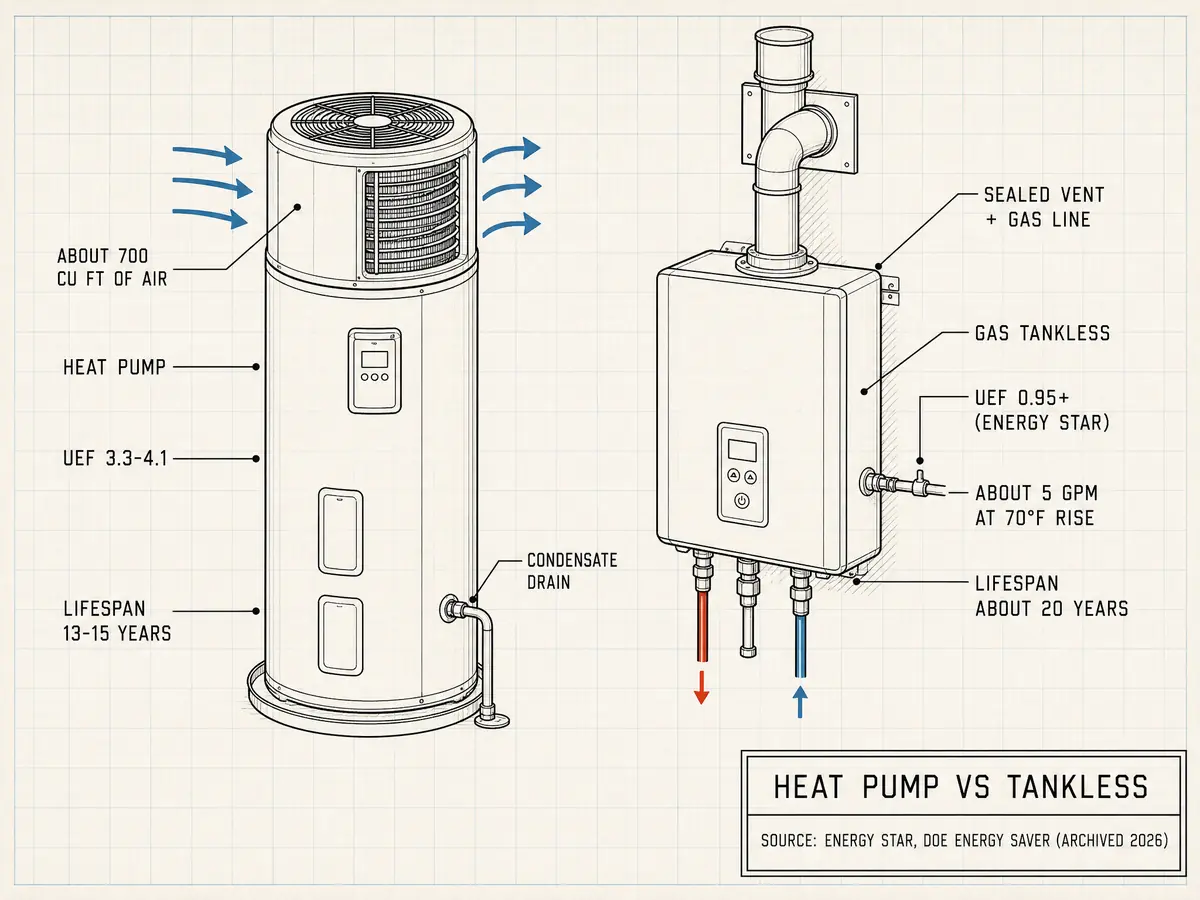
Heat pump water heater vs tankless comes down to fuel and space: a heat pump rates UEF 3.3–4.1 but needs about 700 cubic feet of air, while gas tankless rates 0.81–0.95 and hangs on a wall.
Compiled by the Tank & Tankless desk · Revised
On this page
- How do heat pump and tankless water heaters work differently?
- Which uses less energy, a heat pump or tankless unit?
- Which costs less to run?
- What space and hookups does each need?
- How do climate and groundwater temperature affect each?
- Heat pump vs tankless: which lasts longer?
- Which one fits your home?
- Frequently asked
At a glance
- ENERGY STAR certified heat pump water heaters typically rate UEF 3.3 to 4.1; a gas tankless unit must reach 0.81 federally and 0.95 for ENERGY STAR.
- ENERGY STAR estimates a heat pump model saves a household of four about $550 a year against a standard electric tank, at $0.146/kWh.
- Most 240 V heat pump models want about 700 cubic feet of air around them (ENERGY STAR install guide, 2024); a tankless unit mounts on a wall.
- A gas tankless unit delivers about 5 GPM at a 70°F rise (DOE), and the colder the incoming water, the lower that flow gets.
- ENERGY STAR cites 13–15 years for heat pump models and about 20 years for tankless units.
- The 25C federal credit ended for equipment placed in service after December 31, 2025 (IRS); state HEEHR rebates of up to $1,750 apply only where launched.
- 3.3–4.1Rated UEF range, certified heat pump modelsENERGY STAR
- 0.95Minimum UEF for an ENERGY STAR gas tankless unitENERGY STAR
- 700 cu ftAir space most 240 V heat pump models needENERGY STAR install guide
- 45–60 dBRunning noise of most new heat pump modelsENERGY STAR
How do heat pump and tankless water heaters work differently?
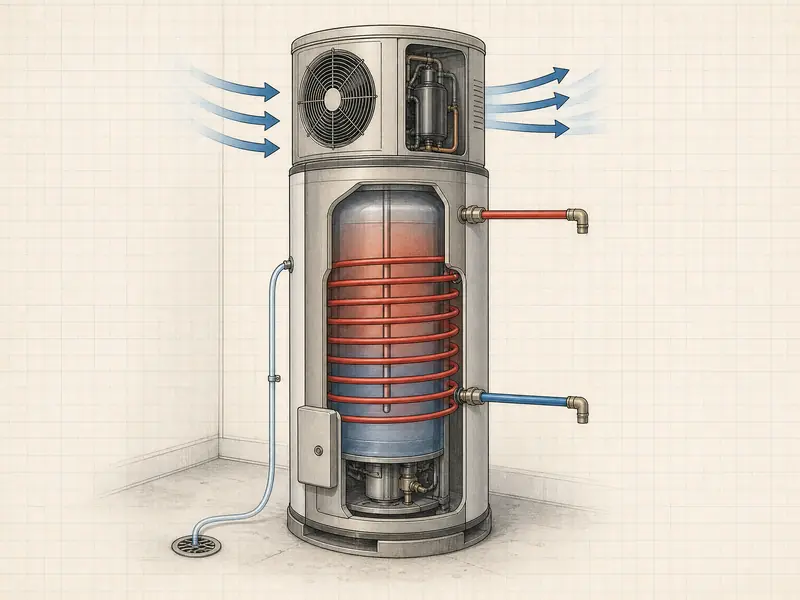
A heat pump water heater moves heat from the surrounding air into a storage tank; a tankless unit burns gas or runs an element to heat water as it flows. DOE describes the heat pump as using electricity to move heat rather than generate it, which is why it can be two to three times as efficient as an electric resistance tank (DOE Energy Saver, archived).
Most heat pump models are integrated units: a compressor and fan on top of a 40- to 80-gallon tank, with backup resistance elements. When demand runs high, they switch to those elements automatically, which is why ENERGY STAR notes they are also called hybrid water heaters. A tankless unit has no tank at all, so it is rated in gallons per minute at a temperature rise.
The practical split is simple. A heat pump stores hot water and recovers slowly. A tankless unit never stores hot water and never runs out, but caps the flow. The heat pump section and the tankless section cover each in depth.
Which uses less energy, a heat pump or tankless unit?
The heat pump uses less energy on paper, by a wide margin. Certified heat pump models rate 3.3 to 4.1 UEF, meaning they deliver more than three units of heat for every unit of electricity. The best gas tankless units rate about 0.95, and ENERGY STAR says a certified condensing model uses 9 percent less energy than a conventional gas tankless unit.
UEF does not settle the question alone, because the fuels cost different amounts. DOE cautions that higher efficiency ratings do not always mean lower annual costs when fuel sources differ, and the efficiency guide explains how to compare across fuels. An electric tankless unit is the weakest of the three on energy use: its federal minimum is 0.91 UEF, about a quarter of what a good heat pump reaches.
Which costs less to run?
At average US prices, a heat pump and a condensing gas tankless unit land close together. EIA puts residential electricity at 18.16¢/kWh for August 2026 and natural gas at about $1.48 per therm for 2025. Divided by rated efficiency, that is roughly $16 per million Btu of hot water for a 3.3 UEF heat pump and roughly $16 for a 0.95 UEF gas tankless unit (derived from EIA electricity data and EIA gas prices).
Local rates decide the winner. Where electricity runs well below average, the heat pump pulls ahead; where gas is cheap and power expensive, tankless does. DOE notes a heat pump can cost less to run than a conventional gas tank even where gas is cheaper per unit of energy.
The savings figures each program publishes compare against a different baseline. ENERGY STAR's heat pump savings table shows about $550 a year for a household of four against an electric tank. Its gas tankless figure is $95 a year against a gas tank.
Up front, ENERGY STAR cites $1,500 to $3,000 for a heat pump unit, plus $1,000 to $3,000 for labor and materials from an informal contractor survey. DOE's 2024 tankless analysis put a baseline gas tankless unit at $2,087 installed and a 0.91 UEF condensing level at $2,318, in 2023 dollars.
| Spec | Heat pump (240 V, integrated) | Gas tankless |
|---|---|---|
| Rated efficiency | UEF 3.3–4.1 (ENERGY STAR certified) | UEF 0.81 minimum; 0.95+ for ENERGY STAR |
| Hot water supply | Stored; e.g. 50-gal model with 67-gal first-hour rating | About 5 GPM at a 70°F rise |
| Space | About 700 cu ft of air, or louvers or ducting | Wall-mounted |
| Hookups | 240 V circuit (often 30 A), condensate drain | Gas line, sealed vent, power for the fan |
| Lifespan | 13–15 years | About 20 years |
| Installed cost, DOE model average | $1,855 (heat-pump-level electric tank) | $2,087 (2023 dollars) |
What space and hookups does each need?
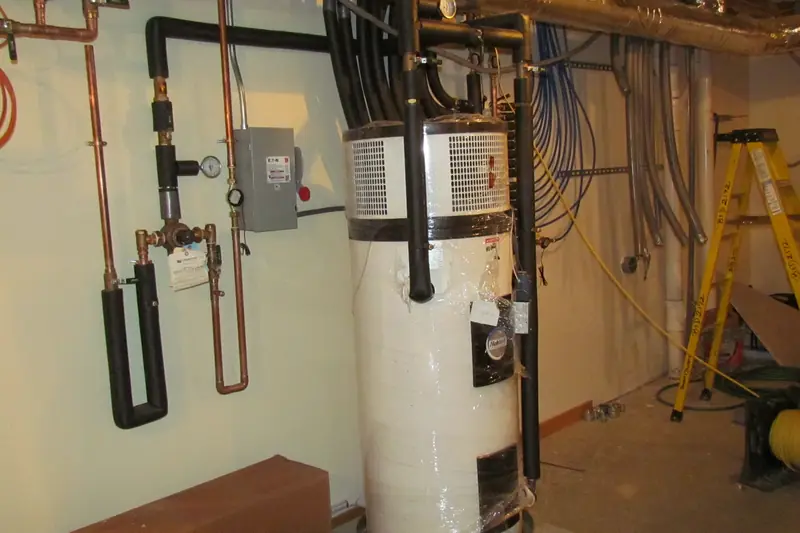
A heat pump needs floor space, air and a drain; a tankless unit needs a wall, a vent and an adequate gas line. ENERGY STAR's installation guide says most 240 V models need at least 700 cubic feet of air space, some as little as 450, and that a closet of at least 84 cubic feet can work with a fully louvered door. DOE's older guidance asked for 1,000 cubic feet.
Heat pump models also produce condensate that must run to a drain or pump, and they hum at 45 to 60 decibels. Many use the same 30-amp, 240 V circuit as a standard electric tank, and 120 V plug-in models exist for gas replacements; see the 120-volt guide.
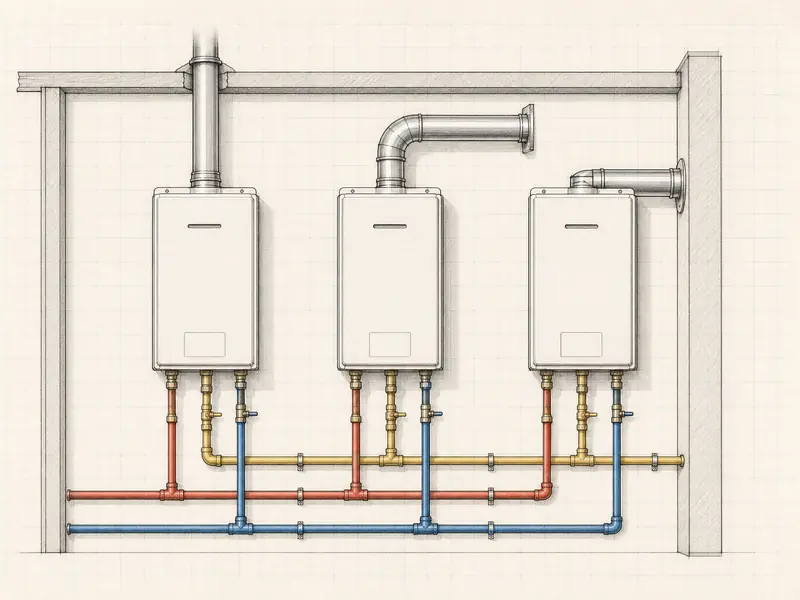
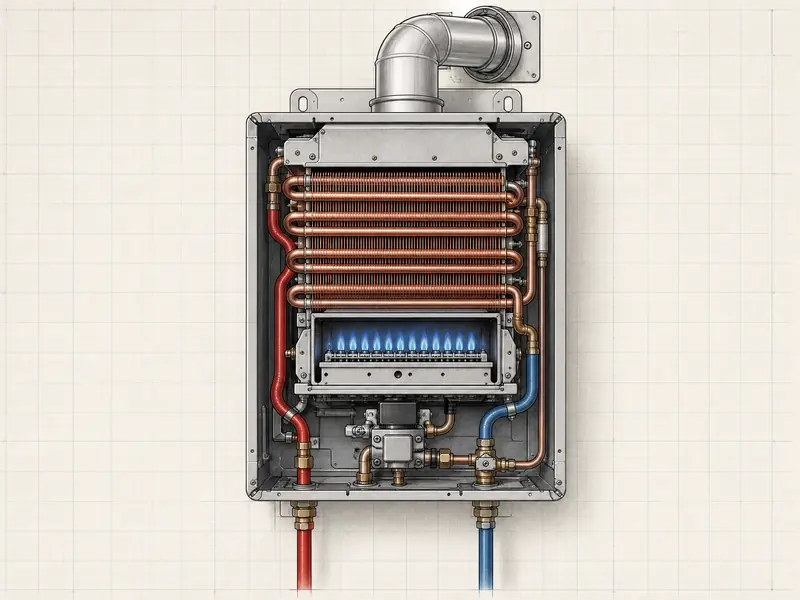
A gas tankless unit needs a vent through the wall or roof and a gas supply sized for its burner, often 199,000 Btu/h. ENERGY STAR tells buyers to have the installer confirm the gas line, nearby power and the vent route. The venting and gas line guide covers the details.
How do climate and groundwater temperature affect each?
Cold air limits the heat pump; cold water limits the tankless unit. Heat pump models run best in spaces that stay above the high 30s °F, and ENERGY STAR notes they switch to resistance heat below about 35°F, which cuts efficiency. The space and climate guide covers garages and basements. Split systems with an outdoor unit are rated to work as low as -25°F.
A tankless unit's output depends on how many degrees it must add. American Water Heater's guide maps groundwater at 37–51°F in the northern zone and 62–77°F in the southern zone. One 199,000 Btu/h model in that guide delivers 5.5 GPM at a 70°F rise but 8.5 GPM at a 40°F rise. A heat pump also cools and dehumidifies the room it sits in, which helps in a humid southern basement and costs heat in a cold northern one.
Heat pump vs tankless: which lasts longer?
Tankless units last longer. ENERGY STAR cites about 20 years for tankless water heaters and 13–15 years for heat pump models. A heat pump still has a steel tank with an anode rod, plus a compressor, fan and filter to maintain.
Warranties point the same way. Rheem's 240 V heat pump spec sheet lists a 10-year limited tank and parts warranty, while Navien lists 15 years on the heat exchanger of one residential tankless series. Both warranties depend on yearly care: filter cleaning for the heat pump, descaling for the tankless unit.
Which one fits your home?
A heat pump fits an electric home with a basement, garage or utility room that stays mild; gas tankless fits a gas home short on floor space. Under the DOE rule, electric tanks built from May 6, 2029 must mostly reach heat pump efficiency, so electric households are moving that way regardless. The gas tankless minimum stays at 0.81 UEF, because Congress disapproved the stricter rule in May 2025.
Heavy, simultaneous use favors gas tankless or a large heat pump tank in hybrid mode. Light use in a small home favors the heat pump's low running cost. Compare both against a plain tank on the heat pump vs electric tank page and the tankless vs tank page.
Sources and scope
This page draws on ENERGY STAR product, savings and installation pages, archived DOE Energy Saver pages, the Federal Register tankless rule of December 2024 and its May 2025 withdrawal, EIA energy prices, the IRS 25C guidance and Rheem, Navien and American Water Heater spec sheets, all checked in October 2026. The per-million-Btu running costs are derived from those figures. Not used: installer quotes, owner stories from forums, or any ranking of brands.
Frequently asked
Can a heat pump water heater go in a closet?
Sometimes. ENERGY STAR's guide says a closet of at least 84 cubic feet can work with a fully louvered door, and some models allow ducting. The model's manual sets the minimum.
Does a heat pump water heater work in a cold garage?
Yes, but below its rated cutoff it heats with resistance elements instead of the compressor. ENERGY STAR requires makers to report the ambient temperature below which the compressor stops, so check that figure before buying.
Can a heat pump water heater replace a wall-mounted tankless unit in the same spot?
Rarely. A heat pump needs floor space for a tank, the air volume around it and a condensate drain, while the tankless unit only needed wall space, a vent and a gas line.
Is an electric tankless unit a good alternative to a heat pump?
On energy, no. An electric tankless unit rates around 0.91 UEF and manages roughly 2 GPM through a 70°F rise, while a certified heat pump rates 3.3 or more.
Which recovers faster after everyone showers?
The tankless unit has nothing to recover. A heat pump refills slowly in heat pump mode; one Rheem 240 V model lists 27 gallons per hour of recovery at a 90°F rise, and hybrid mode adds the elements when demand spikes.
Are there rebates for a heat pump water heater in 2026?
Possibly. The federal HEEHR program funds income-based rebates of up to $1,750 through participating states, and ENERGY STAR says utilities often offer $300 to $1,000. The 25C tax credit has ended.
Related reading
Start over at the water heater type index · more in Compare