
Compare
Gas vs Electric Water Heater
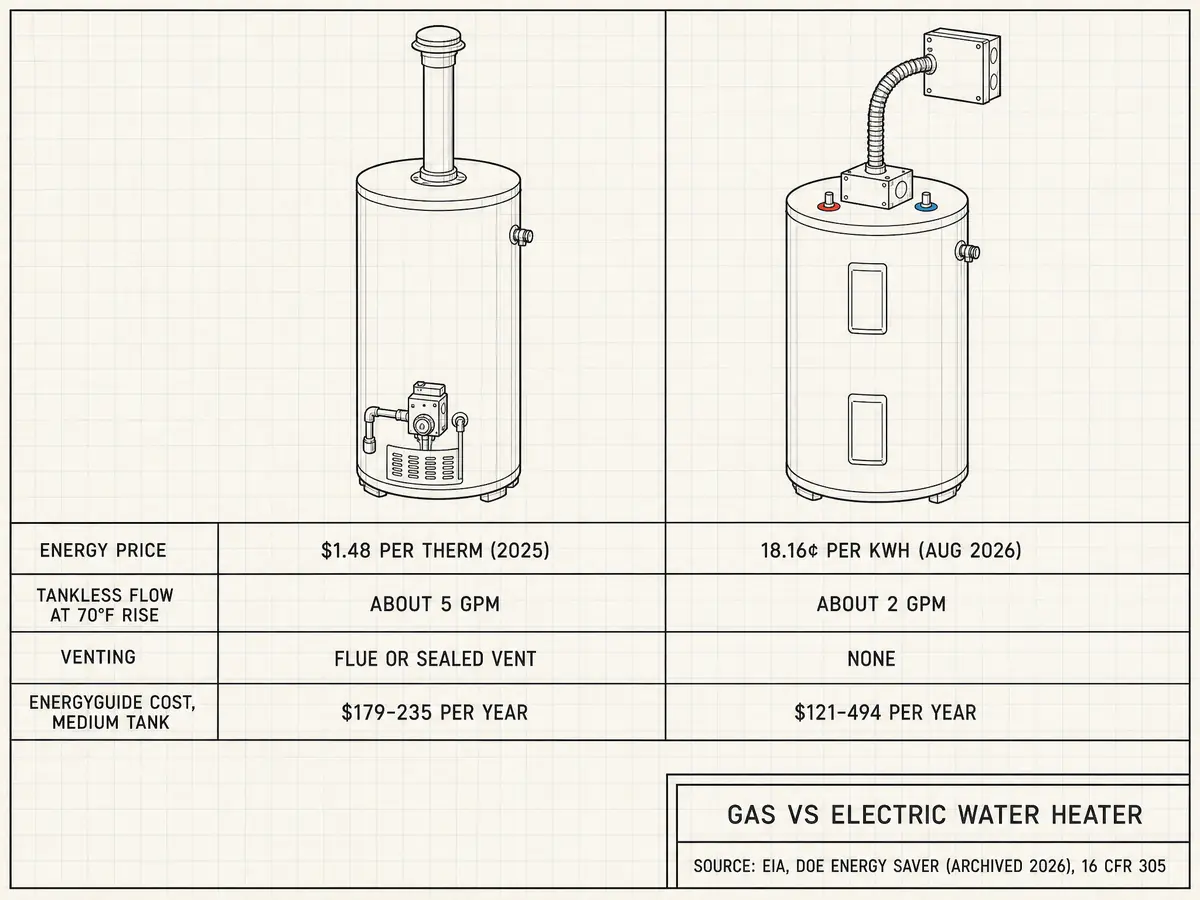
Gas vs electric water heater: at 2025–2026 average US prices, gas heats water for about a third to half the fuel cost of a standard electric tank, though an electric heat pump model closes that gap.
Compiled by the Tank & Tankless desk · Revised
On this page
At a glance
- Per ENERGY STAR, over 80 percent of the water heaters in US homes are one of two kinds: a standard electric resistance tank or a natural gas tank.
- EIA put US residential electricity at 18.16¢/kWh in August 2026; natural gas averaged about $1.48 per therm in 2025 (derived from $15.34 per thousand cubic feet).
- Per million Btu of hot water, that works out to roughly $57 for a standard electric tank and $18–26 for a gas tank (derived).
- DOE expects about 5 GPM at a 70°F rise from gas tankless units, against roughly 2 GPM for electric models.
- Gas units need a vent and a properly sized gas line; standard electric tanks typically need a 240 V, 30-amp circuit.
- There is no federal gas water heater ban: the 2029 rule raises gas tank minimums modestly, and the stricter gas tankless rule was withdrawn in May 2025.
- 18.16¢US residential electricity price per kWh, August 2026EIA
- $15.34US residential natural gas price per thousand cubic feet, 2025 averageEIA
- $179–235EnergyGuide annual cost range, medium gas tank16 CFR 305
- $121–494EnergyGuide annual cost range, medium electric tank (low end = heat pump models)16 CFR 305
Gas vs electric water heater: what is the core difference?
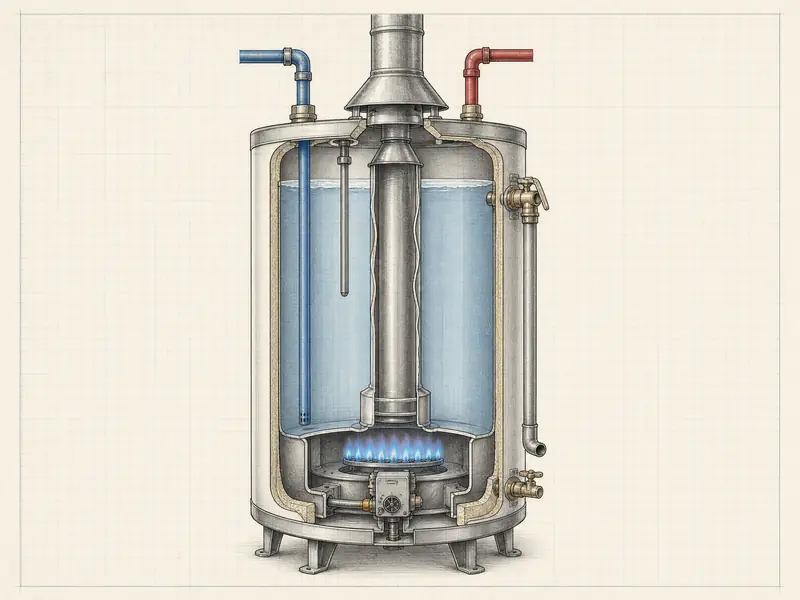
The core difference is the heat source: a gas burner under the tank or in a heat exchanger, or electric elements in the water. A gas tank has a burner at the bottom and a flue running up through the middle, which is why a 3–4 inch round vent on top is the quickest way to spot one, per ENERGY STAR. An electric tank has one or two resistance elements behind access panels and no vent.
DOE's storage water heater page (Energy Saver, archived) lists natural gas, propane, fuel oil and electricity as tank fuels. Gas and oil units also lose heat up the vent, a loss electric tanks do not have. Electric resistance tanks rate higher on paper, about 0.93 UEF, because nearly all of the element's energy ends up in the water.
The same split applies to tankless units and adds a third electric option, the heat pump. The gas tank guide and electric tank guide cover each type in detail.
Is a gas or electric water heater cheaper to run?
Gas is usually cheaper to run than a standard electric tank, and an electric heat pump model is roughly even with good gas equipment. Electricity at 18.16¢/kWh costs about $53 per million Btu; gas at $1.48 per therm costs about $15 (derived from EIA electricity prices and EIA's therm conversion). Dividing by each heater's rated efficiency gives the cost of the heat that reaches the water.
DOE's caution applies here: a higher UEF does not mean a lower bill when fuels differ. DOE also notes that an electric heat pump model can cost less to run than a conventional gas tank even where gas is cheaper per unit of energy. Local rates swing the result, and summer gas prices run far above the annual average.
The EnergyGuide label offers a second yardstick. Medium-capacity gas tanks show $179–235 a year, the same size on propane $361–476, and medium electric tanks $121–494, with heat pump models at the low end. The efficiency and energy cost guide walks through the math with your own rates.
| Heater | UEF used | Approx. cost per million Btu delivered |
|---|---|---|
| Electric tank (standard) | 0.93 | $57 |
| Electric tankless | 0.91 (federal minimum) | $58 |
| Gas tank, 50-gal federal minimum | 0.56 | $26 |
| Gas tank, ENERGY STAR | 0.81 | $18 |
| Gas tankless, ENERGY STAR | 0.95 | $16 |
| Heat pump (electric) | 3.3 | $16 |
Which heats water faster, gas or electric?
Gas heats faster in both tanks and tankless units, because a burner puts more heat into the water per hour than a household element. DOE says gas-fired tankless units produce higher flow rates than electric ones and puts the typical figures at about 5 GPM and 2 GPM at a 70°F rise. A common electric element is 4,500 W, which Rheem's spec sheet notes drops 25% on a 208 V supply.
For tanks, the number to compare is the first-hour rating on the EnergyGuide label. DOE explains that tank volume, fuel and burner or element output all shape it. ENERGY STAR requires a first-hour rating of at least 51 gallons for a certified gas tank and 45 gallons for a heat pump model. Size from your household's peak hour with the sizing worksheet.
What does installation need for each?
A gas heater needs a gas line sized for its input and a vent sized for the appliance; a standard electric tank needs a dedicated 240 V circuit. Atmospheric gas tanks vent through Type B metal pipe, while non-condensing tankless units need Category III vent and condensing ones Category IV, per DOE's 2024 final rule. A gas fitter sizes the gas pipe under NFPA 54.
Placement rules also differ. The San Diego water heater bulletin, which cites the California Plumbing Code, bars gas units from bathrooms, bedrooms and clothes closets unless they are direct-vent, and requires any heater that can ignite vapors in a garage to sit 18 inches up. Rules are local, and a permit is commonly required.
On the electric side, ENERGY STAR says a typical 240 V heat pump model uses the same 30-amp breaker and 10-gauge wire as a standard electric tank. Whole-house electric tankless units draw far more current, which is covered in the electric tankless guide. The installation and code guide covers the parts both fuels share: relief valve piping, expansion tanks and drain pans.
Are gas water heaters being banned?
No. DOE's May 2024 rule gives gas storage tanks a moderate efficiency increase from May 6, 2029, a level DOE expects to be met with flue dampers rather than condensing technology. For a medium-draw tank holding 50 gallons, the gas minimum rises from about 0.56 to about 0.62 UEF (derived from 10 CFR 430.32).
The separate rule that would have pushed gas tankless units to condensing efficiency never took effect. Congress disapproved it, the joint resolution was signed May 9, 2025, and DOE withdrew the rule on May 20, 2025. Gas tankless units stay at the 0.81 minimum.
The bigger change lands on electric tanks: most 20–120 gallon models made from May 6, 2029 must reach heat pump efficiency. Existing heaters are not affected. The 2029 rules guide has the full detail.
Which is safer and easier to maintain?
Electric tanks are simpler to maintain because there is no burner, flue or gas line, but both fuels carry real hazards. Gas units burn fuel indoors and rely on the vent to carry combustion gases out, so vent, gas and burner work belongs to a licensed gas fitter or plumber. Electric tanks run on 240 V, and DOE warns that wiring can overheat if an insulated electric tank is set above 130°F under a blanket.
Both fuels share the scald and pressure risks. CPSC urges a 120°F setting and notes 140°F water can cause third-degree burns in six seconds; the temperature guide covers the trade-off with Legionella. The A. O. Smith gas manual asks owners to drain and flush at least once a year, operating the relief valve yearly and checking the anode. Both fuels give tanks the same 10–15 year life, per DOE.
Sources and scope
Built from EIA electricity and natural gas prices (released October and September 2026), the EIA therm conversion, the FTC EnergyGuide ranges in 16 CFR 305, 10 CFR 430.32, DOE's 2024 final rule and May 2025 withdrawal notice, archived DOE Energy Saver pages, ENERGY STAR, CPSC, the San Diego bulletin and maker manuals, all checked October 2026. The per-million-Btu costs are derived. Omitted: utility-specific rates, installer quotes and brand picks.
Frequently asked
Is propane cheaper than electricity for a water heater?
It depends on local prices. The EnergyGuide label for a medium propane tank shows $361–476 a year, well above the $179–235 for the same tank on natural gas, and above the low end of the electric range set by heat pump models.
Can a gas water heater be replaced with an electric one?
Yes. The plumber caps the gas line, and an electrician adds a 240 V circuit unless a 120 V plug-in heat pump model is chosen. ENERGY STAR notes those 120 V units are typically sized up, for example from a 40-gallon gas tank to a 65-gallon heat pump model.
Does a gas tankless water heater need electricity too?
Yes. On ENERGY STAR's checklist, one installer task is making sure a fan-vented model has power close by, and the controls run on it as well. Check the manual for what the unit does during an outage.
Do electric water heaters last longer than gas ones?
DOE gives storage tanks 10–15 years regardless of fuel. Care matters more than fuel: yearly flushing and anode checks extend either tank's life.
Does an insulating blanket help a gas water heater?
No. DOE says most heat loss in a gas tank goes up the flue, so a blanket does little. On electric tanks it can save about 7–16% on water heating.
Which is cheaper to install, gas or electric?
A like-for-like swap is usually cheapest. DOE's 2024 rulemaking modeled the average installed gas tank at $1,578, while an electric tank built to the 2029 heat pump level averaged $1,855.
Related reading
Start over at the water heater type index · more in Compare