
Section · Other types
Other Water Heater Types
Other water heater types fill gaps that tanks and tankless units leave: solar cuts the fuel bill, point-of-use heaters shorten the wait at a distant tap, and combi or indirect systems borrow heat from a boiler.
Compiled by the Tank & Tankless desk · Revised
At a glance
- ENERGY STAR says a certified solar water heater "can cut your annual hot water costs in half" and is generally paired with a gas or electric backup.
- The federal 25D credit that covered solar water heating ended for expenditures after December 31, 2025, per the IRS.
- ENERGY STAR suggests point-of-use heaters for low use, "less than 20 gallons per day," and remote bathrooms.
- One maker's 120 V mini-tankless unit draws 25 amps and gives a 41°F rise at 0.5 gallons per minute.
- DOE rates combination water and space heating systems by combined appliance efficiency (CAE), which runs from 0.59 to 0.90.
- DOE calls an indirect tank on a high-efficiency boiler possibly "the least expensive means of providing hot water."
- 1/2Share of annual hot water cost an ENERGY STAR solar system can cutENERGY STAR
- Under 20 gal/dayUse level ENERGY STAR links to point-of-use savingsENERGY STAR
- 0.59–0.90Combined appliance efficiency range of combination systemsDOE Energy Saver (archived)
Which other water heater types are there?
Besides gas and electric tanks, tankless units and heat pumps, US homes use three other water heater types: solar systems, point-of-use heaters and boiler-fed systems (combi boilers, indirect tanks and tankless coils). Each solves a narrower problem than a whole-house tank. Solar lowers the fuel bill but needs a backup; point-of-use units serve one or two fixtures; boiler-fed systems make sense mainly where a hydronic boiler already heats the house.
The main types are compared side by side on the home page and in the compare section. This hub covers the rest.
When does a solar water heater make sense?
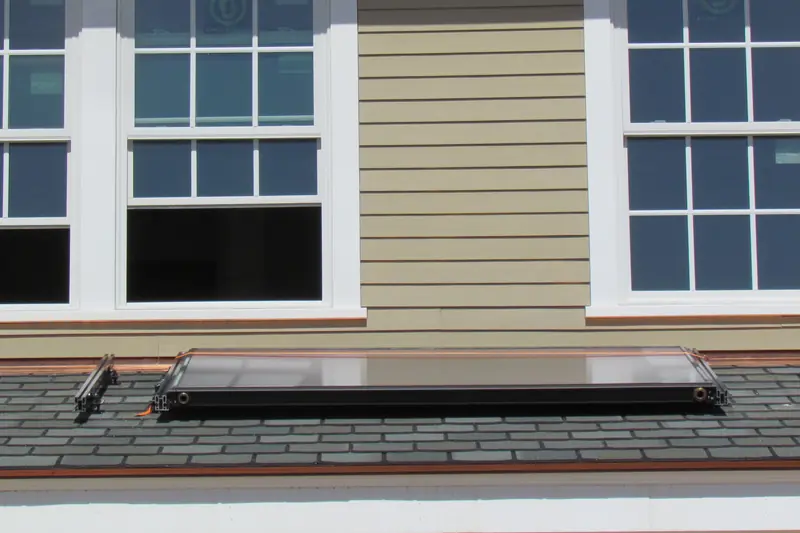
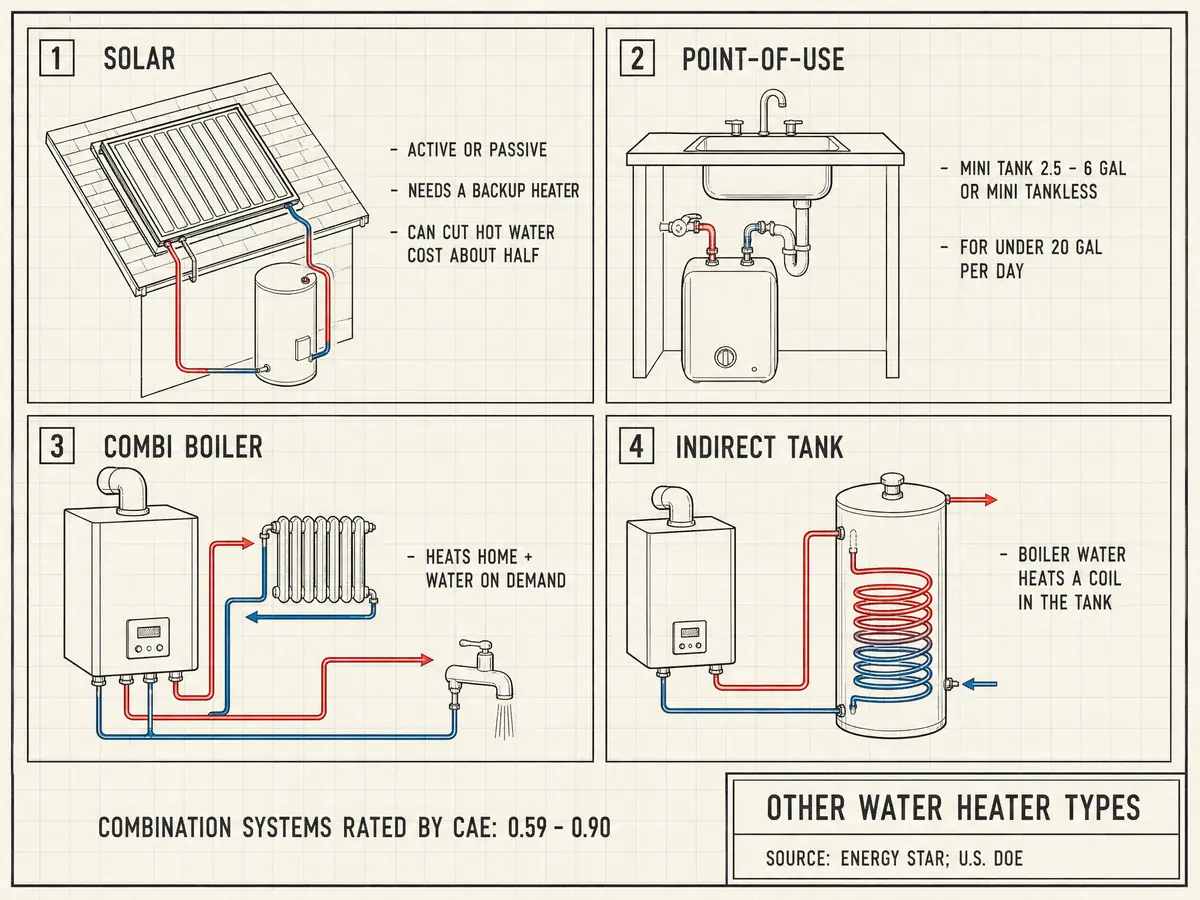
A solar water heater makes sense on a roof or yard with clear sun from 10 a.m. to 4 p.m. year-round, facing within 30° of true south, in a home that will keep its backup heater (ENERGY STAR). Systems are active (pumps and controls) or passive (no pumps); DOE notes passive ones cost less and may last longer but are usually less efficient. "Solar water heating systems almost always require a backup system," per DOE Energy Saver (archived).
The economics changed in 2026. The 25D residential clean energy credit, which covered solar water heating, ended for expenditures after December 31, 2025, and an installation finished after that date counts as a 2026 expenditure, per the IRS. Freeze protection and collector sizing are in the solar guide.
Where do point-of-use heaters fit?
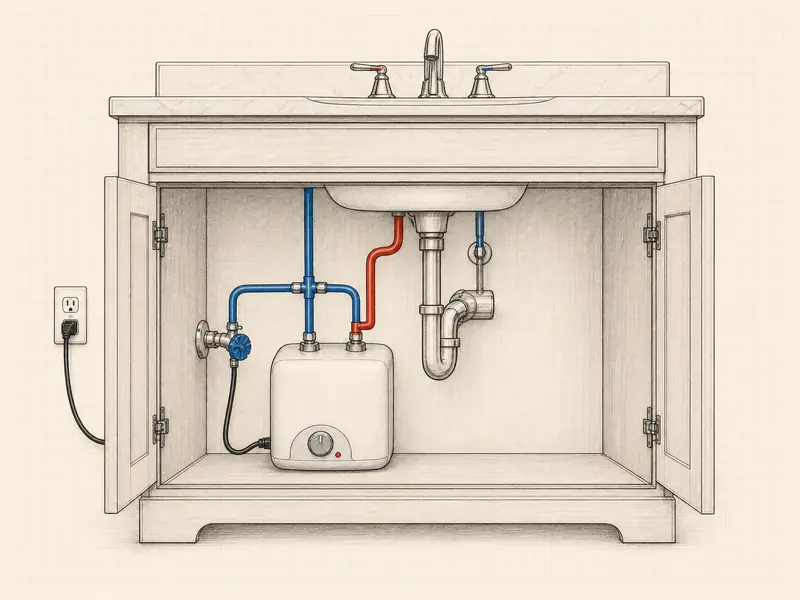
Point-of-use heaters fit at a single sink, a remote bathroom or an addition, where the main heater is far away and the wait for hot water is long. ENERGY STAR places them right beside the fixture they serve and says they suit low use or spread-out fixtures best (ENERGY STAR). They come as mini tanks of about 2.5 to 6 gallons or as small electric tankless units.
They are not a whole-house answer. ENERGY STAR says they are "not suitable back-ups for solar water heaters or geothermal heat pumps," because they cannot carry a household's full demand. A. O. Smith describes its mini tanks as meant for sinks, not showers.
How do combi and indirect water heaters work?
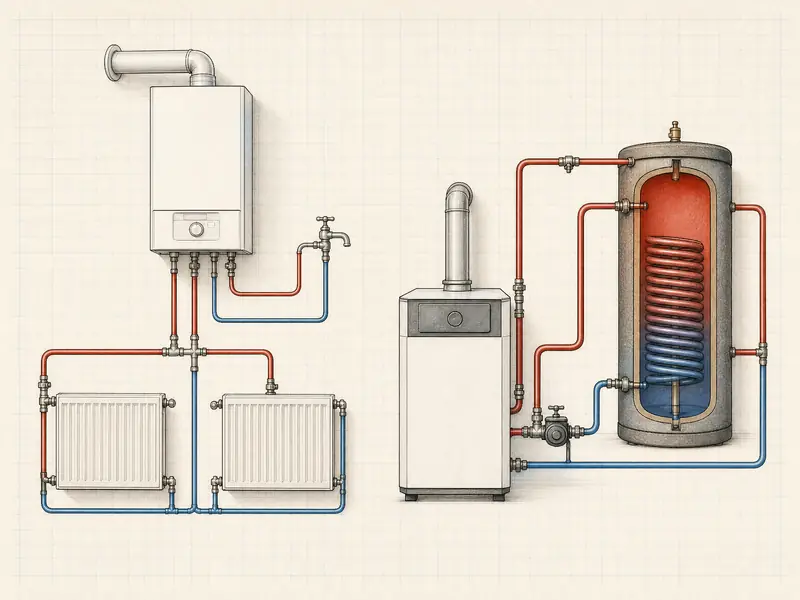
Combi and indirect water heaters both take their heat from a boiler. An indirect water heater is a storage tank with a coil inside; boiler water flows through the coil and heats the domestic water around it (DOE Energy Saver (archived)). A combi boiler heats the house and, on demand, heats domestic water through a built-in heat exchanger, much like a tankless unit.
A tankless coil is the older cousin: a coil inside the boiler that heats water as it flows. DOE calls it efficient in cold months and "an inefficient choice for many homes, especially for those in warmer climates." Sizing any combination system "is best left to a qualified plumbing and heating contractor," DOE adds.
How do other water heater types compare on efficiency?
The other water heater types are rated on different scales, so they cannot be ranked by one number. Solar systems carry a solar uniform energy factor (SUEF): ENERGY STAR requires at least 3.00 with electric backup and 1.80 with gas backup. Small electric tankless units post UEFs in the mid 0.90s, and combination systems use CAE, spanning 0.59 to 0.90 per DOE. Boilers themselves are rated by AFUE for space heating.
The table lists what each scale means and where each type fits best. For the main metrics behind it, see water heater efficiency and energy costs.
| Type | Efficiency rating used | Published figure | Best fit |
|---|---|---|---|
| Solar with electric backup | SUEF | 3.00 or more for ENERGY STAR | Sunny, south-facing roof |
| Solar with gas backup | SUEF | 1.80 or more for ENERGY STAR | Same, gas home |
| Electric mini-tankless (one maker) | UEF | 0.94–0.97 | Single sink, short wait |
| Mini tank, 2.5–6 gal (one maker) | Not rated (N/A on sheet) | 1,440 W element | Sink in an addition or garage |
| Combi or indirect from a boiler | CAE | 0.59–0.90 range | Homes with a hydronic boiler |
What happened to federal help for these types?
Federal tax credits for these types ended with 2025. The 25D credit, which covered solar water heating, does not apply to expenditures after December 31, 2025, and the 25C credit (up to $600 for a qualifying gas water heater, $2,000 for heat pump units) ended for property placed in service after that date (IRS credit page; IRS). State and utility programs vary; DOE points buyers to the State Energy Office for its rebate programs.
Sources and scope
This hub draws on ENERGY STAR's solar, point-of-use and key-criteria pages, archived DOE Energy Saver pages on solar and on tankless coil and indirect heaters (June 2026 snapshots), the IRS notice on 25C and 25D, a Stiebel Eltron DHC spec sheet and A. O. Smith's point-of-use pages, all checked October 2026. Left out: installer quotes, solar lifespan claims without a primary source, and brand rankings.
Frequently asked
What is the cheapest other water heater type to buy?
A point-of-use mini tank or mini-tankless unit costs the least up front because it is small, but it serves only a fixture or two. Price per gallon of household demand is a different question.
Is a combi boiler the same as a tankless water heater?
No. A combi boiler is also the home's space heater, feeding radiators or radiant floors; its hot water side works much like a tankless unit, heating water as it flows.
Can a point-of-use heater back up a solar system?
ENERGY STAR says no: point-of-use heaters cannot meet a household's full demand when the solar side is not producing.
Does a solar water heater work on cloudy days?
Partly. DOE says solar systems almost always need a backup for cloudy days and heavy demand, usually a gas or electric tank downstream.
What is a tankless coil water heater?
A coil inside a boiler that heats domestic water as it flows. DOE says it works best in cold months when the boiler runs anyway and is a poor fit in warm climates.
Which of these types work without electricity?
Passive solar systems have no pumps, but their backup heater usually needs power or gas controls. Combi boilers, indirect tanks and point-of-use units all need electricity.
Start over at every water heater type, side by side