
Other types
Point-of-Use Water Heaters
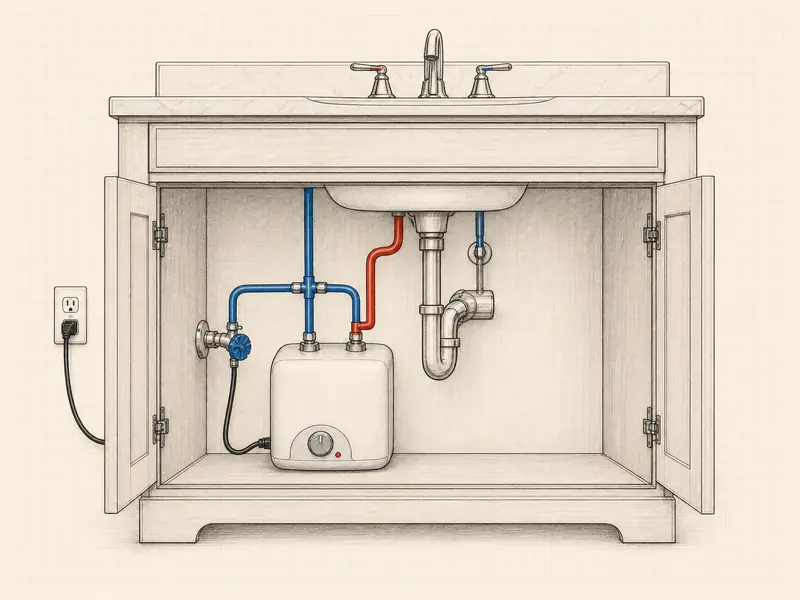
A point-of-use water heater is a small tank or tankless unit mounted at one sink or bathroom, so hot water arrives in seconds instead of traveling from a distant main heater.
Compiled by the Tank & Tankless desk · Revised
On this page
At a glance
- ENERGY STAR defines point-of-use heaters as heating water "very near the sink, shower or bath," and suggests them where use is under 20 gallons per day.
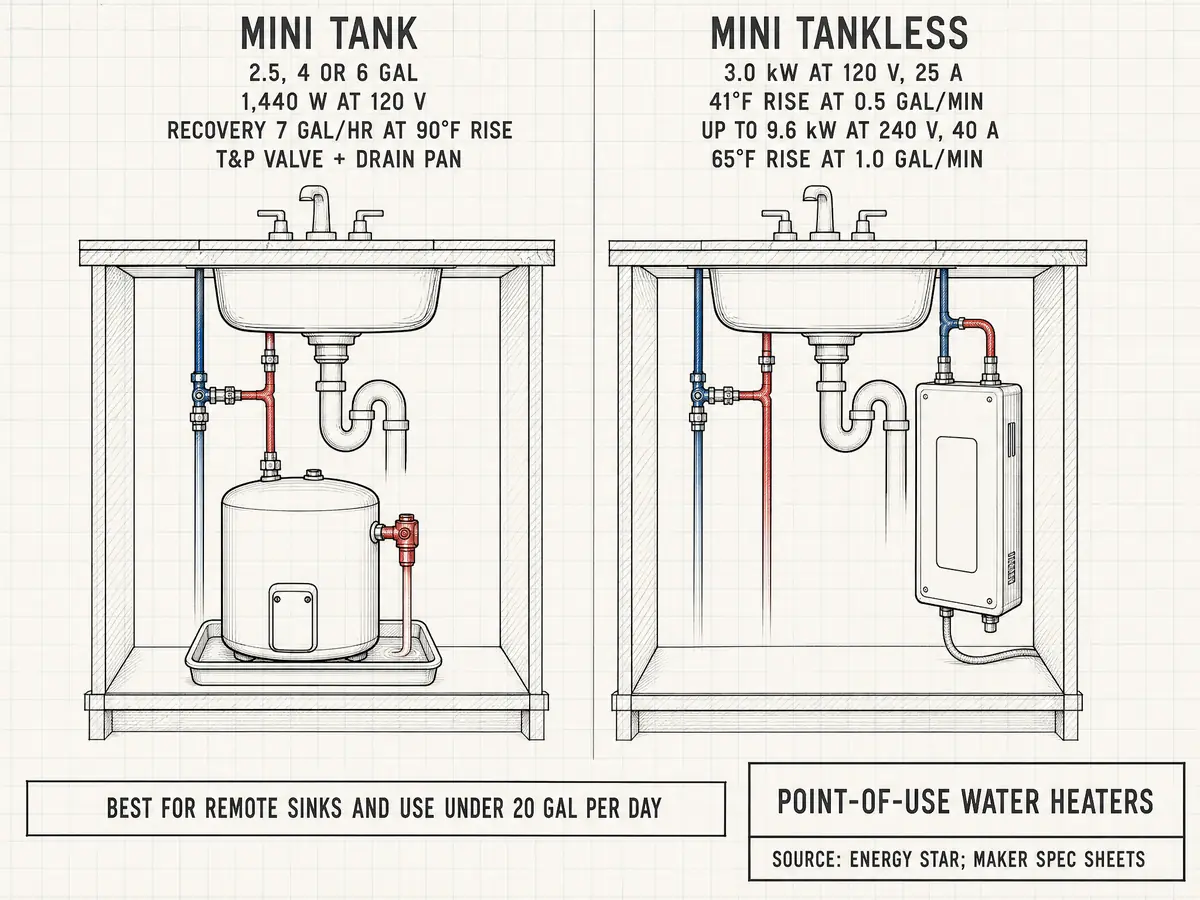
- A. O. Smith's ProLine mini tanks come in 2.5, 4 and 6 gallon (nominal) sizes, each with one 1,440-watt element at 120 V; each recovers 7 gph at a 90°F rise.
- The 2.5 and 4 gallon A. O. Smith models plug into an outlet; the 6 gallon model is hardwired.
- Stiebel Eltron's 120 V DHC 3-1 mini-tankless unit draws 3.0 kW and 25 amps and gives a 41°F rise at 0.5 gallons per minute.
- Its largest sibling, the 240 V DHC 10-2 at 9.6 kW and 40 amps, gives a 65°F rise at 1.0 gallon per minute.
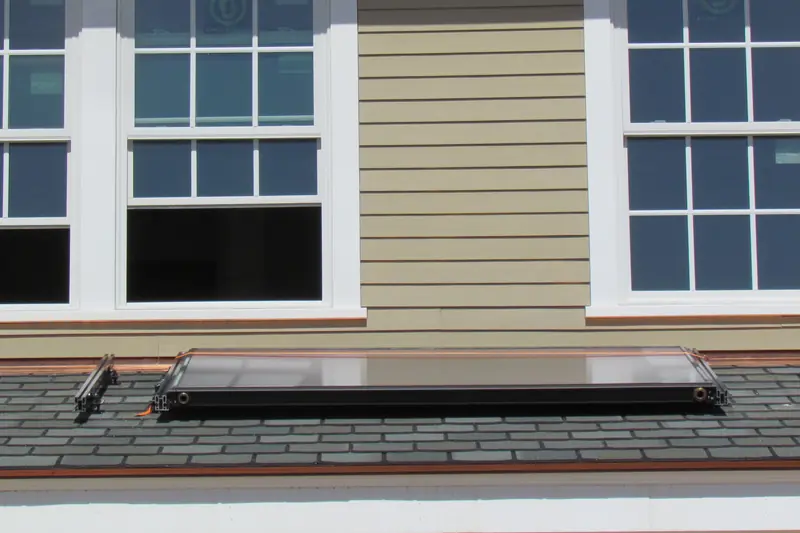
- ENERGY STAR says point-of-use heaters are not suitable backups for solar water heaters or geothermal heat pumps.
- Under 20 gal/dayDaily hot water use where point-of-use heaters fit bestENERGY STAR
- 1,440 WElement in A. O. Smith 2.5, 4 and 6 gallon mini tanksA. O. Smith
- 41°F at 0.5 gpmTemperature rise of a 120 V, 3.0 kW mini-tankless unitStiebel Eltron
- 40 ABreaker for a 9.6 kW, 240 V mini-tankless unitStiebel Eltron
What is a point-of-use water heater?
A point-of-use water heater is a small heater installed at or near one fixture, usually under a sink, instead of at a central location. ENERGY STAR says the name applies "because water is heated very near the sink, shower or bath where the water is used," and that these units are often used "to boost the temperature of water at a fixture that is a long way from a central water heater" (ENERGY STAR).
The benefit is shorter waits and less heat lost in long pipe runs. ENERGY STAR adds that a heater at the fixture "may be the best option in terms of system-wide energy efficiency," especially compared with turning up a storage tank's thermostat to push hotter water down a long line. DOE's archived tankless page makes a related point: putting a demand heater at each outlet can save more energy in some cases (DOE Energy Saver (archived)).
Mini tank or tankless point-of-use water heater?
A mini tank stores a few gallons of hot water and runs on a small element; a mini tankless unit heats water only while it flows and needs far more power. A. O. Smith's ProLine point-of-use tanks hold 2.5, 4 or 6 gallons nominal (2.6, 3.8 and 5.9 rated), use one 1,440-watt element at 120 V and recover 7 gallons per hour at a 90°F rise (A. O. Smith spec sheet). They deliver a full-temperature burst, then run out and reheat.
Stiebel Eltron's DHC Classic tankless line runs from a 3.0 kW, 120 V model to a 9.6 kW, 240 V model, with a nominal water volume of 0.13 gallons (Stiebel Eltron spec sheet). It never runs out, but the temperature rise falls as flow rises: the sheet gives the rule gpm = kW × 6.83 ÷ temperature rise. The smallest models ship with a 0.5 gallon-per-minute aerator that must be installed.
| Model | Type | Power | Circuit | Output |
|---|---|---|---|---|
| A. O. Smith EPU-2.5 | 2.5 gal tank, cord | 1,440 W at 120 V | Outlet | 7 gph at 90°F rise |
| A. O. Smith EPU-6 | 6 gal tank, hardwired | 1,440 W at 120 V | Hardwired 120 V | 7 gph at 90°F rise |
| Stiebel Eltron DHC 3-1 | Tankless | 3.0 kW at 120 V | 25 A, 10/2 AWG | 41°F rise at 0.5 gpm |
| Stiebel Eltron DHC 6-2 | Tankless | 6.0 kW at 240 V | 25 A, 10/2 AWG | 41°F rise at 1.0 gpm |
| Stiebel Eltron DHC 10-2 | Tankless | 9.6 kW at 240 V | 40 A, 8/2 AWG | 65°F at 1.0 gpm; 33°F at 2.0 gpm |
Where does a point-of-use water heater make sense?
A point-of-use water heater makes sense where one fixture sits far from the main heater, where an addition or garage needs a little hot water, or where daily use is low. ENERGY STAR lists three conditions that favor them: "Some fixtures distant from other fixtures," "Low daily hot water use, for example less than 20 gallons per day," and "Remote bathrooms or hot tubs." For additions, it suggests a point-of-use heater with only cold water plumbing run to the new space.
A. O. Smith describes its mini tanks for "under sinks, in small apartments, and in room additions and garages," and for "a single, low-flow shower or one to two sink/faucet installations"; elsewhere on the same page it says they "are designed for sinks, not showers" (A. O. Smith). The safe reading is sinks first. For a whole bathroom with a shower, a larger electric tankless or a whole-house tankless unit is the usual comparison.
What power does a point-of-use water heater need?
A point-of-use water heater needs anything from an ordinary 120 V outlet for a small tank to a dedicated 240 V, 40-amp circuit for the largest mini tankless. The A. O. Smith 2.5 and 4 gallon tanks come with a power cord, while its manual says "6 Gallon models are hard wired and do not have a cord." Their 1,440-watt element draws about 12 amps at 120 V (calculated).
Tankless models need much more. Stiebel Eltron's 120 V DHC 3-1 lists 3.0 kW, 25 amps, a 25-amp breaker and 10/2 AWG copper; the 240 V DHC 10-2 lists 9.6 kW, 40 amps and 8/2 AWG. The maker wants copper conductors sized for under 3% voltage drop. Any new circuit is a job for a licensed electrician, and the electric tankless guide covers whole-house units with even higher draws.
Flow is the other limit. ENERGY STAR lists a typical kitchen or bathroom sink at 2.2 gallons per minute; a mini-tankless unit delivers its rated rise only at the lower flows on its chart. With 50°F inlet water, the DHC 3-1's 41°F rise at 0.5 gpm yields about 91°F at the tap (calculated), warm enough for hand washing.
Can a point-of-use water heater replace a whole-house unit?
A point-of-use water heater cannot replace a whole-house unit in a typical home. ENERGY STAR says these heaters "will not be able to support the full hot water demand of a household," which is why it rules them out as backups for solar or geothermal systems. A 6-gallon tank holds about one-third of the 20 gallons DOE's sizing worksheet assigns to a single shower (DOE Energy Saver (archived)).
What they can do is take one fixture off the main system. Several units across a house is a decentralized design that ENERGY STAR says needs its costs and benefits "carefully assessed." For whole-home sizing, start with the first-hour rating worksheet.
How do you install and maintain one?
A mini tank installs like a small storage water heater: cold supply, hot outlet, a T&P relief valve, a drain pan and, for the hardwired size, an electrical connection. A. O. Smith's manual calls for the T&P discharge to end no more than 6 inches above a floor drain, not in the drain pan, and for the tank to be completely full before power goes on to avoid burning out the element (A. O. Smith manual). Its thermostat is set at the factory to about 105°F.
Maintenance follows the same manual: drain and flush, and inspect the anode, after the first six months and at least yearly, and operate the T&P lever annually. Mini tankless units have no tank to flush or anode to check; the DHC sheet says they need no T&P valve (check local code) and accept only cold inlet water up to 86°F. In hard water, follow the maker's descaling advice; see hard water and tankless heaters.
Sources and scope
Sources: ENERGY STAR's point-of-use page, A. O. Smith's ProLine Specialty spec sheet (AOSRE50603, April 2021), its point-of-use product pages and mini tank manual (100288209), Stiebel Eltron's DHC Classic specification and technical sheets (rev. 6.2025), and archived DOE Energy Saver pages, all checked October 2026. Two makers are used as examples because their sheets list power, circuit and output; other brands differ. Not used: retailer listings, reviews and price quotes.
Frequently asked
How long does a mini tank point-of-use heater take to reheat?
A. O. Smith rates its 2.5 to 6 gallon models at 7 gallons per hour at a 90°F rise, so a fully drained 2.5-gallon tank takes roughly 20 to 25 minutes to recover (calculated).
Can a point-of-use water heater serve a shower?
A small one struggles. A. O. Smith says its mini tanks are designed for sinks, and a 0.5 gpm mini-tankless unit is far below the 2.5 gpm ENERGY STAR lists for a shower. A larger electric tankless unit sized for the flow is the usual answer.
Does a point-of-use water heater need a T&P valve?
Mini tanks do; A. O. Smith ships them with a factory-installed T&P valve. Stiebel Eltron says its DHC tankless units need none, subject to local code.
Can a point-of-use heater be fed with hot water from the main heater?
Stiebel Eltron's DHC units accept cold water only, with a maximum inlet of 86°F. Mini tanks are normally fed from the cold line too, per A. O. Smith's manual.
Do point-of-use heaters waste less energy than a central tank?
Sometimes. ENERGY STAR says a heater at a distant fixture may be the best option system-wide, and DOE says a demand heater at each outlet can save more in some cases, but both say to weigh costs and benefits first.
Is a point-of-use heater good for a hot tub?
ENERGY STAR lists hot tubs heated with electricity as one case to consider. The tub maker's instructions decide what may be connected.
Related reading

Start over at types of water heaters compared · more in Other types