
Buying
What Size Water Heater Do I Need?
What size water heater do you need? For a tank, pick a first-hour rating at least equal to your busiest hour of hot water use; for tankless, match flow in GPM at your temperature rise.
Compiled by the Tank & Tankless desk · Revised
On this page
At a glance
- DOE sizes tanks by first-hour rating (FHR), not tank volume: choose a model whose FHR at least matches your peak-hour demand (DOE Energy Saver (archived)).
- DOE's worksheet counts 20 gallons per shower, 7 per dishwasher load, 25 per top-load wash and 15 per front-load wash.
- A 40-gallon tank with a strong element "might produce 80 gallons" in the first hour, per ENERGY STAR.
- Tankless units are sized by GPM at a temperature rise; with 50°F inlet water and a 120°F target, the rise is 70°F.
- At a 70°F rise, DOE says gas tankless units typically deliver about 5 GPM and electric ones about 2 GPM.
- Swapping gas for a 120 V heat pump usually means sizing up two tank sizes, e.g. 40-gallon gas to 65-gallon, per ENERGY STAR.
How do you size a water heater?
You size a tank water heater by its first-hour rating and a tankless one by its flow rate at your temperature rise. DOE's sizing guidance (archived) applies the first rule to gas, electric and heat pump tanks alike. Tank volume alone is a weak guide, because two 50-gallon tanks with different burners or elements can deliver very different amounts of hot water in an hour.
Oversizing costs money too. DOE notes that an oversized tank "carries a higher purchase price and increased energy costs due to higher standby energy losses." The goal is the smallest unit whose rating covers the busiest hour, with a little margin.
- 20 galHot water per shower in DOE's peak-hour worksheetDOE Energy Saver (archived)
- 125°FOutlet temperature used to measure first-hour ratingENERGY STAR
- 5 GPMTypical gas tankless flow at a 70°F rise (electric: about 2)DOE Energy Saver (archived)
- 2.5 GPMShower flow used for tankless sizingENERGY STAR
What is a first-hour rating?
A first-hour rating is the number of gallons of hot water a storage heater can deliver in one hour, starting with a full tank of hot water. DOE says it depends on tank capacity, the heat source and the size of the burner or element. ENERGY STAR adds that it is measured at a 125°F outlet temperature.
The number is printed on the yellow EnergyGuide label as "Capacity (first hour rating)" in the top left corner, and makers list it on spec sheets. The FTC labels group tanks by FHR: 18–50.9 gallons is the low bin, 51–74.9 medium and 75 or more high (16 CFR 305). The efficiency page explains how those bins tie to UEF.
How do you work out peak-hour demand?
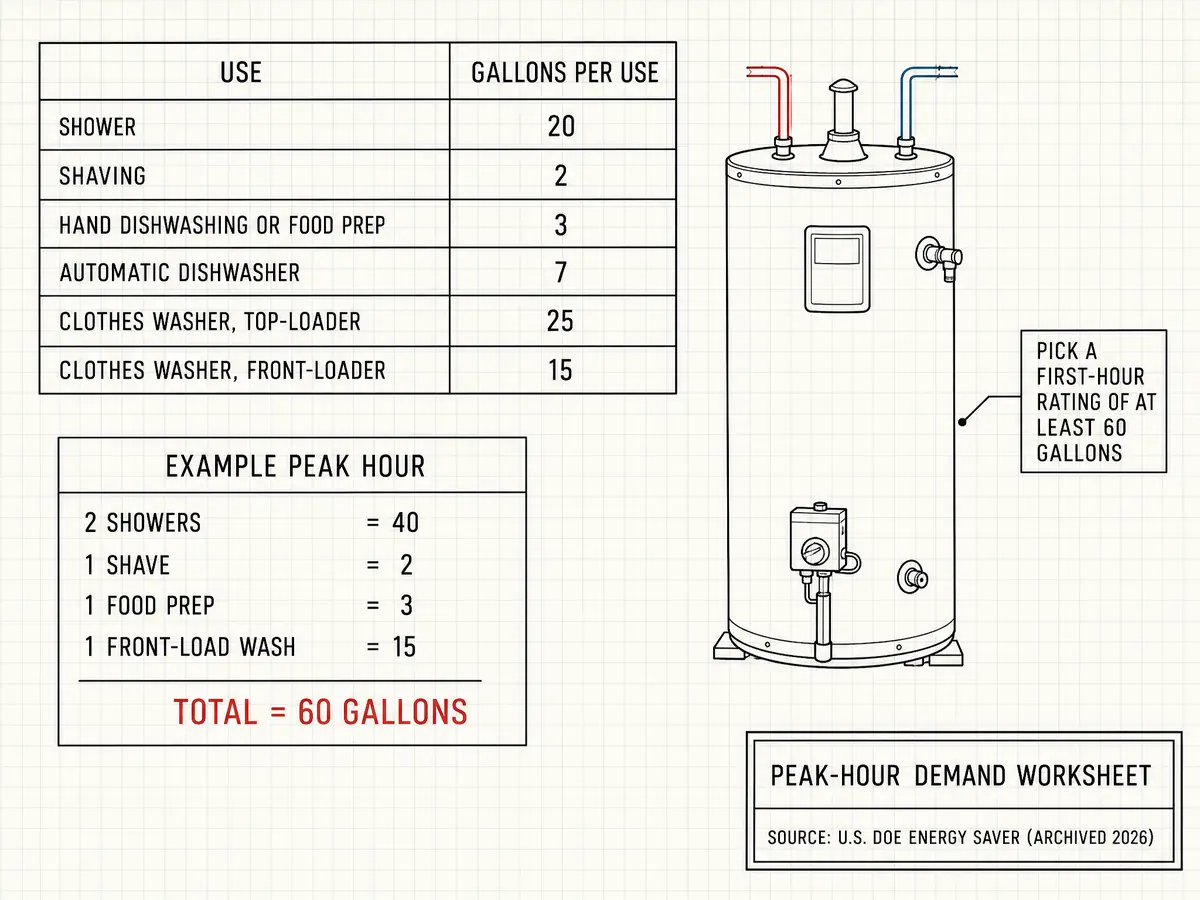
Peak-hour demand is the hot water your home uses in its single busiest hour, usually a weekday morning or evening. DOE's worksheet multiplies the number of times each task happens in that hour by its typical gallons, then adds the results. The worksheet does not estimate daily use, only the peak hour.
| Use | Gallons per use |
|---|---|
| Shower | 20 |
| Shaving (0.05 gal per minute) | 2 |
| Hand dishwashing or food prep (2 gal per minute) | 3 |
| Automatic dishwasher | 7 |
| Clothes washer, top-loader | 25 |
| Clothes washer, front-loader (H-axis) | 15 |
DOE's own example lists three showers (60 gallons), one shave (2) and one hand dishwashing (3), and prints a total of 66 gallons; the rows add up to 65. Either way, that home needs an FHR in the mid-60s or higher. The worksheet values are averages, so a household with long showers or high-flow heads should round up.
Is a 40-gallon water heater enough?
A 40-gallon water heater is enough when its first-hour rating covers your peak hour. Using DOE's numbers, two showers back to back plus food prep is 43 gallons, which many 40-gallon tanks can meet. Three showers in the same hour is 60 gallons, which needs a tank rated in the medium FHR bin or above.
These worked examples use the DOE worksheet; they are illustrations, not DOE household rules:
- Two people: 2 showers + 1 shave + food prep = 45 gallons.
- Four people: 3 showers + 1 shave + dishwasher = 69 gallons.
- Six people: 4 showers + food prep + front-load wash = 98 gallons.
If showers are spread across the morning, the peak hour is smaller. If laundry or a dishwasher runs during showers, it is larger.
40 vs 50 gallon water heater: which size?
Choose between a 40 and a 50 gallon water heater by comparing first-hour ratings, not tank size. ENERGY STAR notes that a 40-gallon tank with a very high-powered heating element might deliver 80 gallons in its first hour, more than a slow-recovering 50-gallon tank. DOE ties FHR to the burner or element size as well as volume, so a 40-gallon model with a large burner can match a bigger tank with a small one.
Heat pump tanks recover slowly on the heat pump alone, which is why they are usually bought a size larger. On one maker's spec sheet, a 240 V 50-gallon heat pump model lists an FHR of 67 gallons and the 80-gallon version 87 (Rheem). Check the label of the exact model; the tank hub compares gas and electric models.
How do you size tankless or heat pump models?
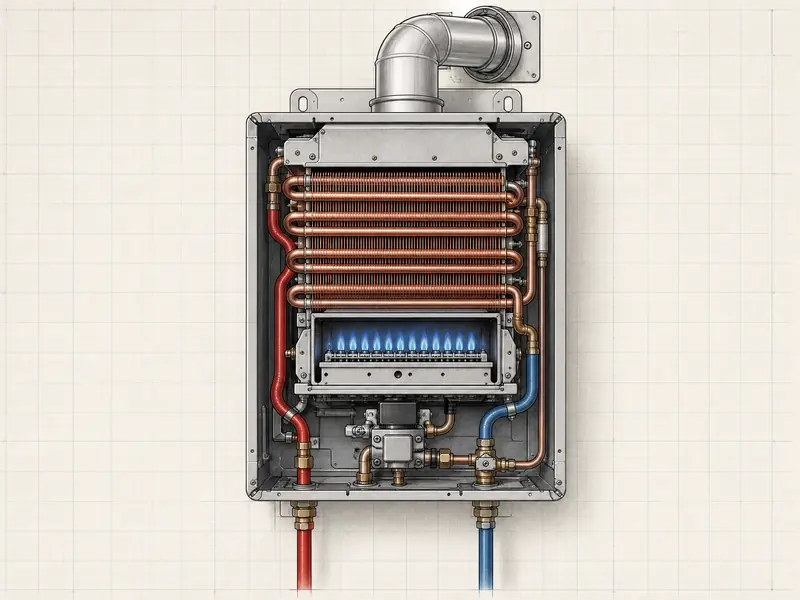
Tankless units are sized by adding the flow of every fixture that may run at once and finding a model that delivers that flow at your temperature rise. DOE's example pairs a 0.75 GPM faucet with a 2.5 GPM shower, so the unit must supply at least 3.25 GPM. For fixture flows, ENERGY STAR uses 2.5 GPM for a shower or tub, 2.2 for a sink, 3.3 for a clothes washer and 1.3 for a dishwasher.
Temperature rise is the target temperature minus the incoming water temperature. DOE says to assume 50°F unless you know otherwise; a 120°F target then needs a 70°F rise. Two showers and a sink at once total 7.2 GPM, well beyond the roughly 5 GPM a typical gas unit gives at that rise, so a household that overlaps showers may need a larger unit or two units installed in parallel, since units in series add temperature rise, not flow. The tankless sizing page walks through inlet temperatures by region.
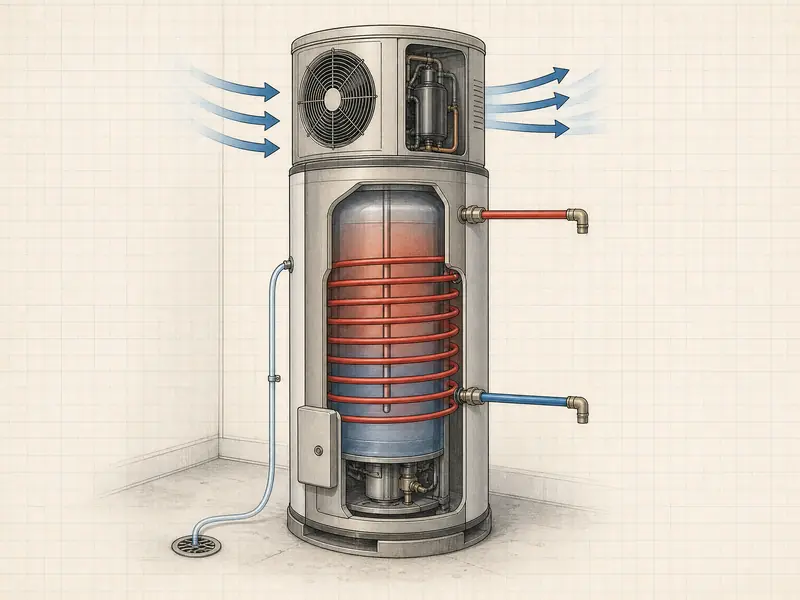
Heat pump tanks are sized like other tanks, by FHR, with two adjustments from ENERGY STAR: when replacing gas, size up one step (40 to 50 gallons, or 50 to 65), and for 120 V plug-in models, typically two steps (40-gallon gas to 65-gallon). The 120-volt page covers why.
Sources and scope
This page is based on DOE's archived Energy Saver sizing page (snapshot July 2, 2026), ENERGY STAR's key product criteria and fixture flow rates, ENERGY STAR articles on UEF and heat pump installation, the FTC EnergyGuide bins in 16 CFR 305, and one maker spec sheet for heat pump first-hour ratings (all checked October 2026). The household examples are worked from DOE's worksheet values and are illustrations. Left out: "gallons per person" rules of thumb and square-footage charts, which no primary source here supports, and brand rankings.
Frequently asked
Does a bigger tank always mean more hot water?
Not always. First-hour rating depends on the burner or element as well as volume, so a smaller tank with fast recovery can out-deliver a larger slow one. Compare FHR on the label.
How long can a 40-gallon water heater run a shower?
DOE's worksheet assumes 20 gallons of hot water per shower, so a 40-gallon tank covers about two average showers before recovery matters. Longer showers or higher-flow heads use more.
Where is the first-hour rating on a water heater?
On the EnergyGuide label, top left, as "Capacity (first hour rating)," and on the maker's spec sheet. It is not the same as the gallon size on the tank.
Is first-hour rating tested the same way for gas and electric tanks?
Yes. Both are rated with the same DOE test at a 125°F outlet temperature, so FHR figures can be compared across fuels. The results differ with the burner or element size, which is why the label number matters more than the fuel.
What inlet temperature should be used in northern states?
DOE's default is 50°F, but groundwater is colder in northern areas in winter. One maker's map puts northern groundwater at 37–51°F, so measure cold water in the coldest season if possible.
Should a tank be sized for the worst day of the year?
Size for a normal busy hour with some margin. Sizing for rare peaks, like holiday guests, adds standby losses every other day; DOE warns that oversizing raises energy costs.
Do heat pump water heaters need a bigger tank?
Usually. ENERGY STAR suggests one size up when replacing gas with a 240 V heat pump, and typically two sizes up for a 120 V plug-in model.
Related reading
Start over at types of water heaters compared · more in Buying