
Buying
Water Heater Efficiency and Running Costs
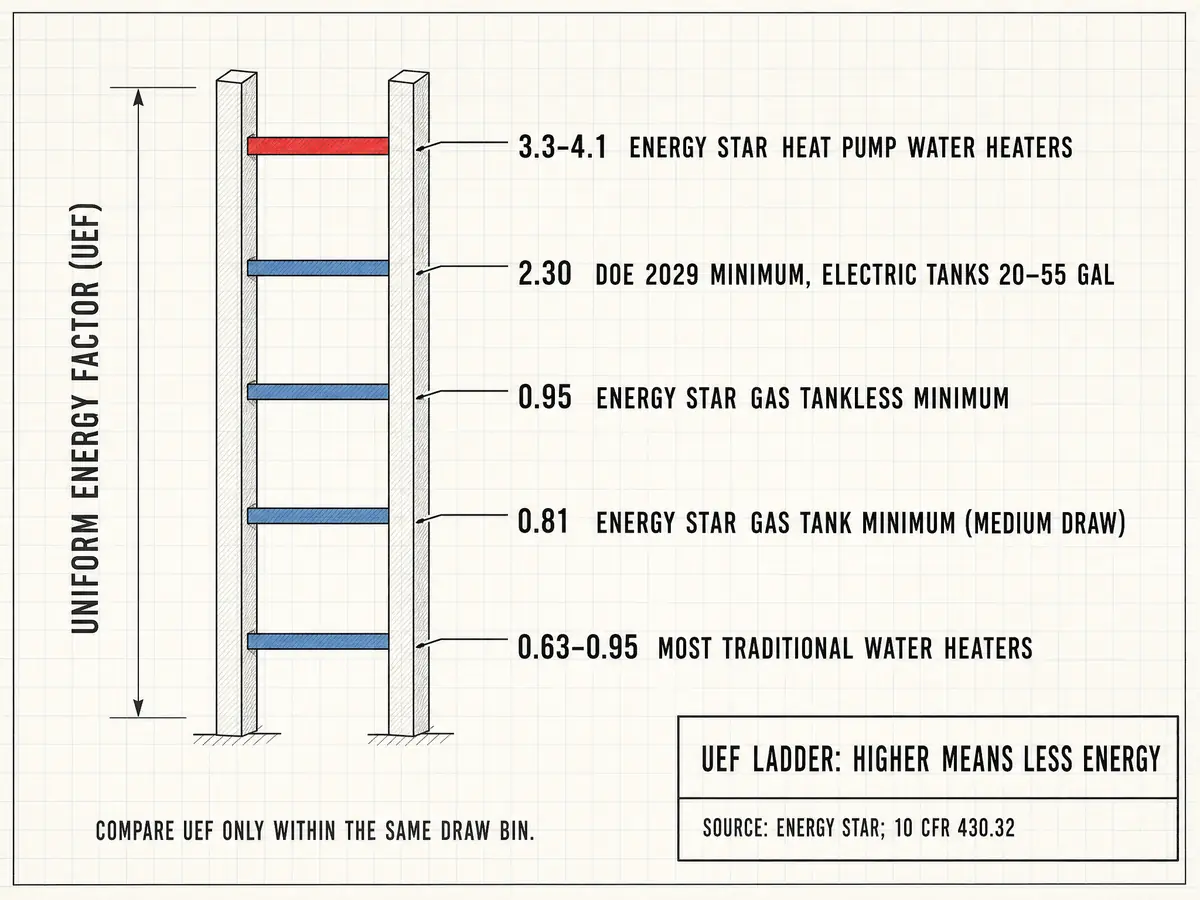
Water heater efficiency is rated as UEF, the share of energy that ends up as delivered hot water; most gas and electric tanks rate 0.63–0.95, while heat pump models rate 3.3–4.1.
Compiled by the Tank & Tankless desk · Revised
On this page
At a glance
- Water heating uses about 18% of a home's energy, typically its second largest energy expense (DOE Energy Saver (archived)).
- UEF replaced the older Energy Factor in 2017; a higher UEF means less energy for the same hot water, per ENERGY STAR.
- UEF can only be compared between models in the same draw bin, which is set by first-hour rating or GPM.
- ENERGY STAR Version 5.0 (effective April 18, 2023) requires UEF ≥3.30 for integrated heat pump tanks and ≥0.95 for gas tankless.
- ENERGY STAR estimates a heat pump tank saves a household of four about $550 a year at $0.146/kWh.
- U.S. homes paid an average 18.16¢/kWh in August 2026 (EIA) and about $1.48 per therm of gas in 2025 (derived from EIA).
What does water heater efficiency mean?
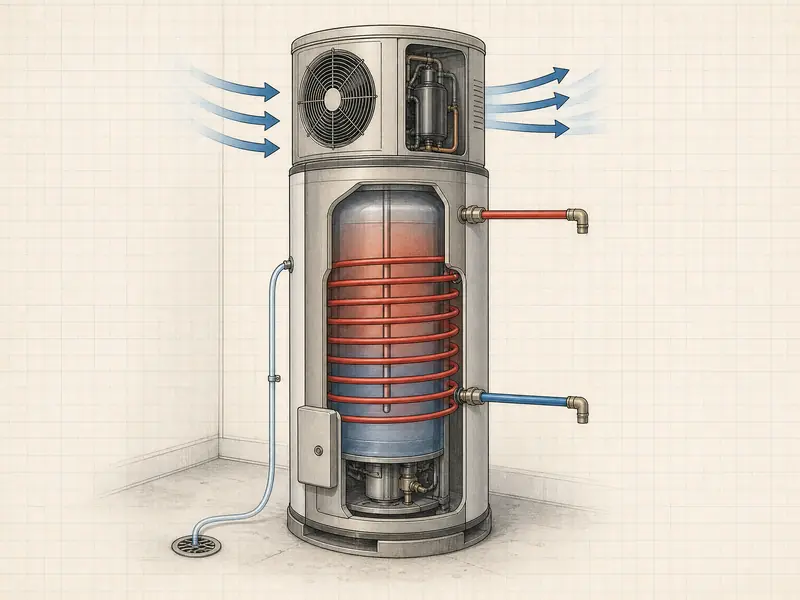
Water heater efficiency is how much of the energy a heater uses ends up as hot water at the tap over a day of typical use. A tank loses heat through its walls while it waits (standby loss), and gas units also lose heat up the vent; tankless units avoid standby loss, according to DOE (archived). Heat pump models can rate above 1.0 because they move heat from the surrounding air instead of making it.
Efficiency is not the same as running cost. DOE notes that "higher energy factor values don't always mean lower annual operating costs, especially when you compare fuel sources," because a kilowatt-hour and a therm are priced differently. Compare UEF within a fuel, then compare yearly cost across fuels; the gas vs electric page does that comparison by type.
- 18%Share of home energy use that goes to water heatingDOE Energy Saver (archived)
- 3.3–4.1Rated UEF range for certified heat pump tanksENERGY STAR
- $550/yrHeat pump tank savings, household of four, at $0.146/kWhENERGY STAR
- 18.16¢U.S. residential electricity price per kWh, August 2026EIA
How do you read a UEF rating?
Read a UEF rating as a ratio: the higher the number, the less energy the heater uses for the same daily hot water. DOE's test first measures how much hot water the unit can deliver, then simulates 24 hours of use. ENERGY STAR says most conventional heaters rate between 0.63 and 0.95, with a gas tankless or standard electric tank around 0.93.
The catch is the bin. DOE assigns each model to one of four draw patterns, very small, low, medium or high, based on its first-hour rating (tanks) or flow rate (tankless), and states that "a water heater's UEF can only be compared with water heaters within the same bin." A 0.65 medium-draw gas tank and a 0.65 high-draw gas tank are rated against different usage. To find a model's bin, check its FHR, which the sizing page explains.
What does the EnergyGuide label tell you?
The EnergyGuide label shows a water heater's estimated yearly energy cost, its first-hour rating and a cost range for similar models. DOE says the first-hour rating sits in the top left corner as "Capacity (first hour rating)." The range bar lets you see where one model falls among others of the same fuel and size bin.
The ranges come from 16 CFR 305, the FTC labeling rule, last set in January 2023. They are comparison figures for similar models, not a forecast of any one household's bill.
| Type and bin | Label cost range per year |
|---|---|
| Gas tank, medium (FHR 51–74.9 gal) | $179–$235 |
| Gas tank, high (FHR 75+ gal) | $227–$336 |
| Electric tank, low (FHR 18–50.9 gal) | $90–$357 |
| Electric tank, medium | $121–$494 |
| Electric tank, high | $173–$747 |
| Gas tankless, medium (2.8–3.9 GPM) | $144–$170 |
| Gas tankless, high (4.0+ GPM) | $210–$253 |
The wide electric ranges are the useful clue: the low end reflects heat pump models and the high end standard resistance tanks. Propane versions of gas units carry roughly double the cost ranges of natural gas.
What does ENERGY STAR require?
ENERGY STAR requires efficiency well above the federal minimum, plus minimum warranties. The current Version 5.0 criteria apply to units made from April 18, 2023. Key levels:
- Heat pump, integrated: UEF ≥3.30, FHR ≥45 gallons, sealed-system warranty ≥6 years.
- Heat pump, 120 V/15 A or split system: UEF ≥2.20.
- Gas tank, over 20 to 55 gallons: UEF ≥0.81 (medium draw) or ≥0.86 (high draw); FHR ≥51 gallons.
- Gas tankless: UEF ≥0.95, at least 2.8 GPM over a 67°F rise, heat exchanger warranty ≥6 years.
- Solar: solar UEF ≥3.00 with electric backup or ≥1.80 with gas backup.
For comparison, gas tankless units must legally reach only 0.81, and a 50-gallon medium-draw gas tank's floor is about 0.56 (derived from 10 CFR 430.32). Those floors rise for tanks built from May 6, 2029; see the 2029 rule page.
How much does a water heater cost to run each year?
A water heater typically costs a few hundred dollars a year to run, and an electric resistance tank in a busy household can cost more than $700, judging by the label ranges above. The cheapest option depends on local prices. EIA's August 2026 national average was 18.16¢ per kWh, up from 17.57¢ a year earlier, and its 2025 average residential gas price of $15.34 per thousand cubic feet works out to about $1.48 per therm (EIA conversion, derived).
ENERGY STAR's heat pump savings table assumes $0.146 per kWh: a household of four saves 3,760 kWh, or $550 a year, against a standard electric tank. At August 2026's 18.16¢, the same 3,760 kWh is worth about $683 a year (derived). For gas, ENERGY STAR estimates a certified gas tank saves a family of four $25 a year and a certified gas tankless unit $95 a year against a standard gas tank. The heat pump vs electric tank page runs these numbers by household size.
How can you cut water heating costs?
The cheapest savings come from the thermostat. DOE says a tank set at 140°F can waste $36 to $61 a year in standby losses and that lowering it to 120°F saves 4% to 22% a year (DOE (archived)). The temperature setting page covers the scald and Legionella trade-offs.
Other steps with sourced numbers:
- Insulating blanket (electric tanks only): DOE estimates 25–45% less standby loss and 7–16% lower water heating cost; do not set the thermostat above 130°F under a blanket. DOE says a blanket does little on gas tanks, where heat goes up the flue.
- Pipe insulation: PNNL's checklist calls for at least R-3 insulation on accessible hot water pipes.
- Maintenance: flushing sediment, covered on the flushing page, helps keep the tank working as rated.
Sources and scope
Sources for this page: archived DOE Energy Saver pages (snapshots from May to July 2026), ENERGY STAR's Version 5.0 key product criteria and savings pages, the FTC EnergyGuide ranges in 16 CFR 305 and DOE minimums in 10 CFR 430.32 (eCFR as of October 1, 2026), EIA price tables released in September and October 2026, and PNNL's heat pump water heater checklist. Dollar figures marked derived are simple recalculations of those sources. Left out: contractor cost estimates, savings claims from sellers, and any single "tankless saves X%" figure outside DOE's own ranges.
Frequently asked
Is a higher UEF always cheaper to run?
Only within the same fuel. A gas tank with a lower UEF can cost less to run than an electric resistance tank with a higher UEF because gas and electricity are priced differently; compare the yearly cost on the label.
What replaced the Energy Factor (EF) rating?
UEF replaced EF in 2017 when DOE adopted a revised test procedure. Old EF numbers and new UEF numbers should not be compared directly.
Why can a heat pump water heater have a UEF above 1?
It moves heat from the surrounding air into the water with a compressor, so it delivers more heat energy than the electricity it uses. Resistance tanks and gas units cannot exceed 1.0.
Do heat pump water heaters have an EnergyGuide label?
DOE's archived sizing page says the FTC requires the label on conventional storage heaters but not on heat pump models; check the spec sheet for FHR and UEF either way.
Does a tankless water heater have a first-hour rating?
No. Tankless units are rated by maximum flow (GPM) at a temperature rise; ENERGY STAR measures it over a 67°F rise.
How much does a pilot light matter?
DOE notes that tankless units can waste energy with a standing pilot light and suggests models with an intermittent ignition device instead.
Does an ENERGY STAR gas tank use much less energy?
About 8% less than a standard model, according to ENERGY STAR, which puts the saving for a family of four at $25 a year.
Related reading
Start over at every water heater type, side by side · more in Buying