
Care
Water Softeners, Conditioners and Water Heaters
A water softener and water heater work well together: softening removes the calcium and magnesium that form scale, but softened water wears a tank's anode rod faster, so test hardness first.
Compiled by the Tank & Tankless desk · Revised
Ownership note. Tank & Tankless has the same owners as SoftPro Water Systems and Quality Water Treatment, two water treatment stores. We link to them only on pages about hard water, scale and well-water odor, and only for products they sell. Figures come from DOE, ENERGY STAR, the Federal Register, IRS, USGS and maker manuals, checked October 2026. Store product descriptions are the store's own claims. Ownership and store links
On this page
- Does a water softener help a water heater?
- What is the downside of a water softener for a water heater?
- What does a salt-free conditioner do for scale?
- Water softener vs salt-free conditioner for a water heater
- What do water heater makers recommend?
- How do you choose a scale prevention option?
- Frequently asked
At a glance
- A softener removes hardness (calcium and magnesium) by ion exchange; USGS ties heated hard water to scale.
- Rinnai's manual names a water softener or Rinnai's own scale product as the treatment for hard water.
- Salt-free conditioners don't remove hardness; their scale-prevention claim is the seller's, not a water heater maker's.
- A. O. Smith's gas Use & Care Guide says a softener makes the anode rod deplete faster than normal.
- With softened water, A. O. Smith's electric instructions call for a yearly anode inspection from the start.
- Under 61 mg/L, USGS calls water soft, and Rinnai's table lists no treatment needed.
- 61 mg/LWhere USGS's moderately hard class beginsUSGS
- 61 mg/LStart of Rinnai's "slightly hard" band, where it recommends a softener or its scale productRinnai
- 1 yrAnode check interval with softened waterA. O. Smith
- 12 gpgHardness past which Noritz tankless coverage endsNoritz
Does a water softener help a water heater?
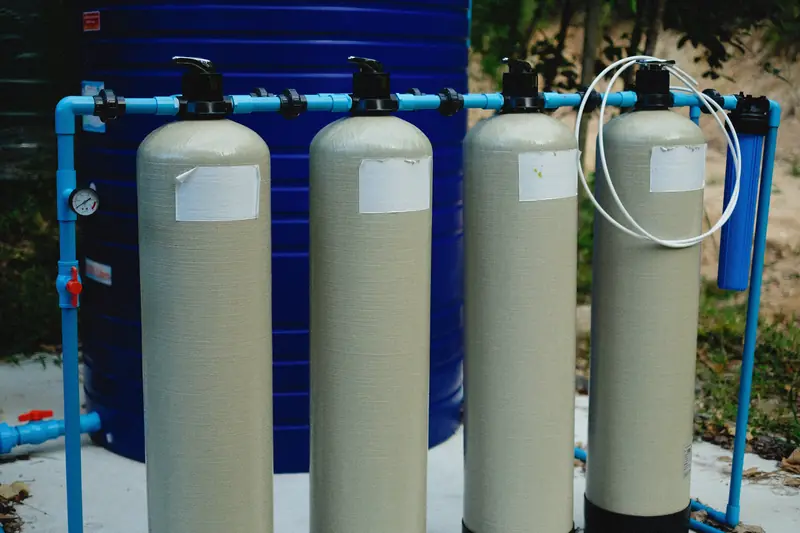
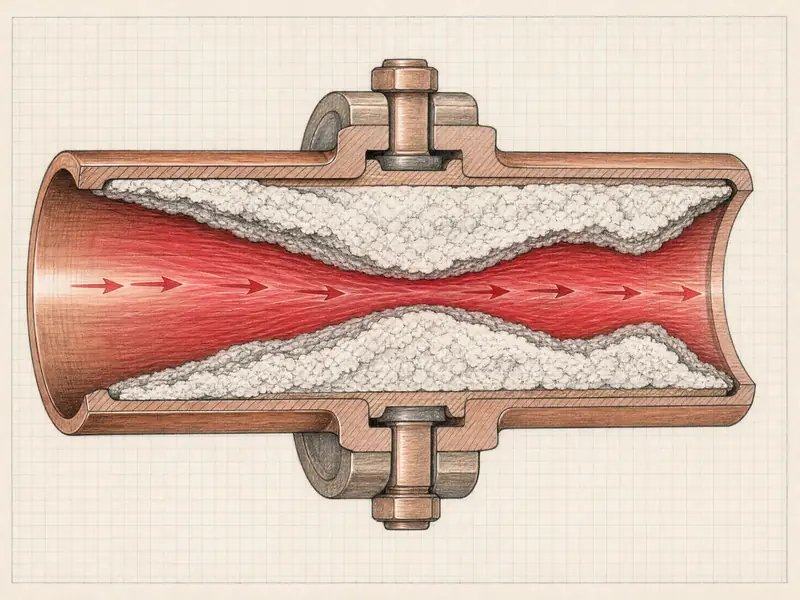
Yes, a water softener helps a water heater on hard water by taking out the minerals that turn into sediment and scale. USGS explains that heating hard water forms calcium carbonate deposits that can shorten equipment life and raise heating costs; a softener swaps those calcium and magnesium ions for sodium before the water reaches the heater.
Tankless makers ask for it in writing. Rinnai's SENSEI RX manual recommends a water softener or its own scale-prevention product from 61 mg/L (about 4 gpg in its table), strongly recommends one in its 9 to 12 grains-per-gallon band and requires one above 12 gpg. Noritz's warranty excludes damage caused by hardness above 12 gpg, and Navien's warranty excludes hard water deposits. For a tankless owner on hard water, a softener is the treatment that matches the manual.
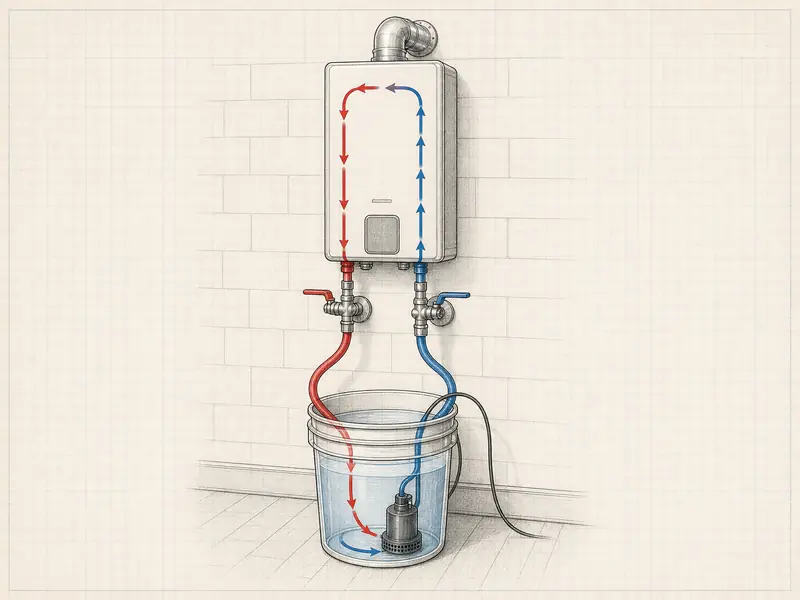
Tanks benefit too: less sediment on the bottom, quieter heating and less frequent heavy flushes. A softener doesn't replace maintenance, though. Tanks still need a yearly flush, and tankless units still need descaling at the interval the maker sets.
What is the downside of a water softener for a water heater?
The downside of a water softener for a water heater is faster anode wear in tanks. A. O. Smith's electric instructions call artificially softened water exceedingly corrosive because sodium replaces calcium and magnesium, and say a softener may decrease the life of the tank.
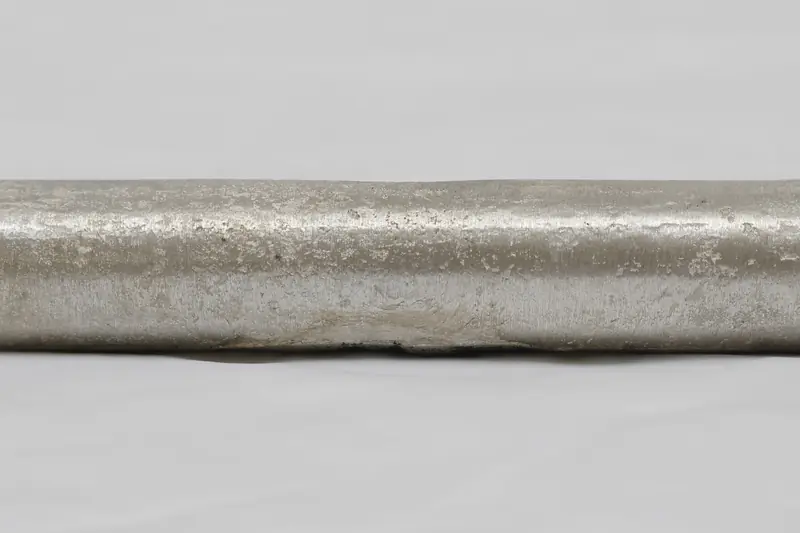
The remedy is inspection, not avoiding softening. A. O. Smith's gas guide tells softener owners to check the anode rod more often and replace it when depleted; its electric instructions make that check yearly. Anode rods are a consumable part that the gas guide says isn't covered by warranty, so budget for replacements. The anode rod guide shows what a spent rod looks like.
Two smaller points. Penn State Extension notes that in rare cases a softener can contribute to hydrogen sulfide odor in hot water; the rotten-egg smell guide covers that. And a softener needs salt, regeneration water and a drain, which a conditioner does not.
What does a salt-free conditioner do for scale?
A salt-free conditioner is sold to reduce scale without removing hardness. The calcium and magnesium stay in the water; the seller's claim is that they are less likely to stick as scale. That claim comes from the store, not from a water heater maker or a federal agency.
The store descriptions make the point. The SoftPro FORTRESS is described as managing mineral buildup without salt and offered as a scale-prevention option. The SoftPro Elite Salt Free Water Conditioner (sold by SoftPro Water Systems, same owners as this site) is described by its store as reducing scale buildup without salt for city water, and the listing calls it a softener in places, although it leaves hardness in the water.
What matters for a water heater owner is the warranty language. Rinnai names a water softener or its own scale product; a third-party conditioner isn't either of those. If you choose one, read your heater's warranty terms first and keep descaling or flushing on the manual's schedule. Conditioners don't add sodium, so they don't carry the softened-water anode warning.
Water softener vs salt-free conditioner for a water heater
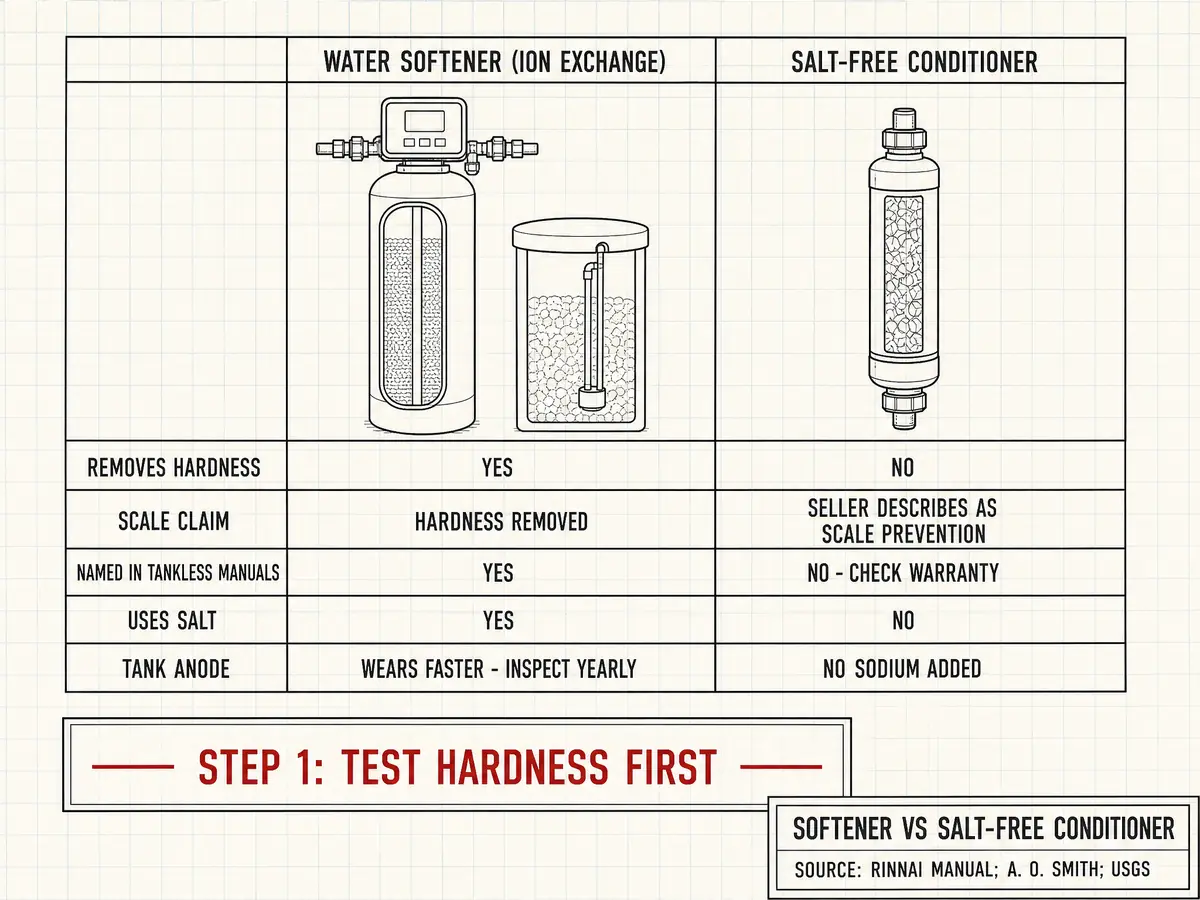
A water softener removes hardness and is the option tankless manuals name; a salt-free conditioner leaves hardness in place and relies on the seller's scale claim. The table sets out the differences that matter for a heater.
| Question | Water softener | Salt-free conditioner |
|---|---|---|
| Removes calcium and magnesium | Yes, by ion exchange | No |
| Scale claim | Hardness is removed | Seller describes it as scale prevention |
| Named in tankless manuals | Yes (Rinnai) | No; check warranty terms |
| Salt and drain needed | Yes | No |
| Effect on tank anode | Faster wear; inspect yearly | No sodium added |
What do water heater makers recommend?
Water heater makers recommend treated water above set hardness levels and name a softener or their own scale product. Rinnai's manual lists no treatment for soft water of 0 to 60 mg/L, recommends a softener or Rinnai scale product with yearly flushing for homes from 61 to 160 mg/L, strongly recommends one from 161 to 200 mg/L and requires one above 200 mg/L.
Noritz sets its line at 12 grains per gallon (200 mg/L): above it, the warranty doesn't apply. Navien excludes damage from hard water deposits and lime. Tank makers focus on the softened-water side: A. O. Smith's documents warn about anode depletion and call for yearly checks. The tankless hard water guide has each maker's terms in one place.
How do you choose a scale prevention option?
Choose a scale prevention option by testing hardness, reading your heater's manual, and matching the treatment to both. Start with the number: a utility report or test kit in mg/L or grains per gallon, compared with the USGS classes in the hard water guide.
- Soft water (0–60 mg/L): no treatment is needed for the heater; keep the normal maintenance schedule.
- Moderately hard to hard, tank heater: treatment is optional for the tank. Yearly flushing may be enough; a softener cuts sediment but means yearly anode checks.
- Hard water, tankless heater: follow the manual. Rinnai's manual names a softener or its Scale Cutter; Noritz's warranty excludes damage from hardness above 12 gpg.
- Salt-free conditioner: an option where salt or a drain is a problem, with the understanding that hardness stays and the scale claim is the store's.
For a softener, size it to the measured hardness and household use. The SoftPro ECO City Water Softener is sold for municipal water, and the Fleck 5600SXT (sold by Quality Water Treatment, same owners as this site) is a metered unit its store lists at up to 48,000 grains of capacity. Prices are each store's listed price in October 2026. A licensed plumber can install either and set the bypass so the heater gets treated water.
Sources and scope
Sources: the USGS Water Science School page on hardness, Rinnai's SENSEI RX manual, the Noritz N-0751M-DVC limited warranty, Navien's NPE-A warranty page, A. O. Smith's gas guide (June 2023) and electric installation instructions, and Penn State Extension's page on hydrogen sulfide, opened in October 2026. Product details are the stores' own descriptions and were not tested. Lab claims for salt-free media, magnetic or electronic devices, contractor pricing and online reviews were left out.
Frequently asked
Does softened water damage a water heater?
It doesn't harm the heater directly, but A. O. Smith says it speeds anode wear and may shorten tank life. Yearly anode checks address that.
Do tankless water heaters require soft water?
Not always. Rinnai lists no treatment for soft water and recommends a softener or its scale product from 61 mg/L; Noritz's warranty excludes damage from hardness above 12 gpg.
Is a salt-free conditioner as good as a softener for a water heater?
They do different things. A softener removes hardness; a conditioner doesn't, and its scale claim is the seller's. Tankless manuals name softeners, not third-party conditioners.
Should the water heater be on softened water or bypassed?
Water heaters are normally fed softened water, since that is where scale forms. Outdoor taps for irrigation are often left on hard water, which the installer sets when plumbing the bypass.
Does a softener mean you never flush the water heater?
No. Makers still set flushing and descaling intervals, and grit can enter from pipes or wells. Softened water often makes those jobs quicker.
How much salt does a water softener use?
It depends on hardness, household use and the unit's settings. A metered softener regenerates based on water used, which keeps salt use tied to demand.
Related reading
Start over at types of water heaters compared · more in Care