
Compare
Heat Pump vs Electric Water Heater
Heat pump vs electric water heater: a heat pump model is two to three times as efficient as a standard electric tank, saving a household of four about $550 a year, but it costs more and needs room to breathe.
Compiled by the Tank & Tankless desk · Revised
On this page
- How is a heat pump water heater different from an electric tank?
- How much less electricity does a heat pump use?
- What does each cost up front and over its life?
- Where can a heat pump water heater not go?
- Is the standard electric water heater going away in 2029?
- When does a plain electric tank still make sense?
- Frequently asked
At a glance
- DOE says a heat pump unit can be two to three times more efficient than conventional electric resistance tanks (DOE Energy Saver, archived).
- A standard electric tank rates about 0.93 UEF; ENERGY STAR certified heat pump units carry ratings of 3.3 to 4.1.
- ENERGY STAR's savings table shows about $550 a year saved for four people, $410 for three and $270 for two, at $0.146/kWh.
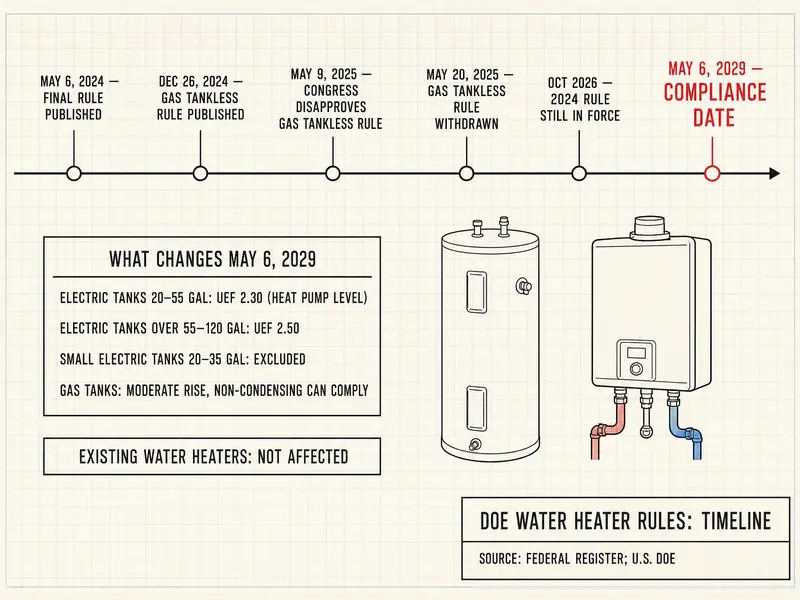
- Under the 2024 DOE rule, new electric tanks of 20–55 gallons must reach UEF 2.30 from May 6, 2029; small 20–35 gallon tanks are excluded.
- Most 240 V heat pump models need about 700 cubic feet of air, and most switch to resistance heat when the space falls into the mid-30s °F.
- ENERGY STAR cites 13–15 years for a heat pump model; DOE gives storage tanks 10–15 years.
- 2–3×Heat pump efficiency vs a standard electric tankDOE Energy Saver (archived)
- $550/yrENERGY STAR estimated saving for a household of fourENERGY STAR
- 2.30Minimum UEF for most new 20–55 gal electric tanks from May 6, 202910 CFR 430.32
- 61%DOE-projected heat pump portion of new electric tanks in 2030, up from 3%DOE final rule, May 2024
How is a heat pump water heater different from an electric tank?
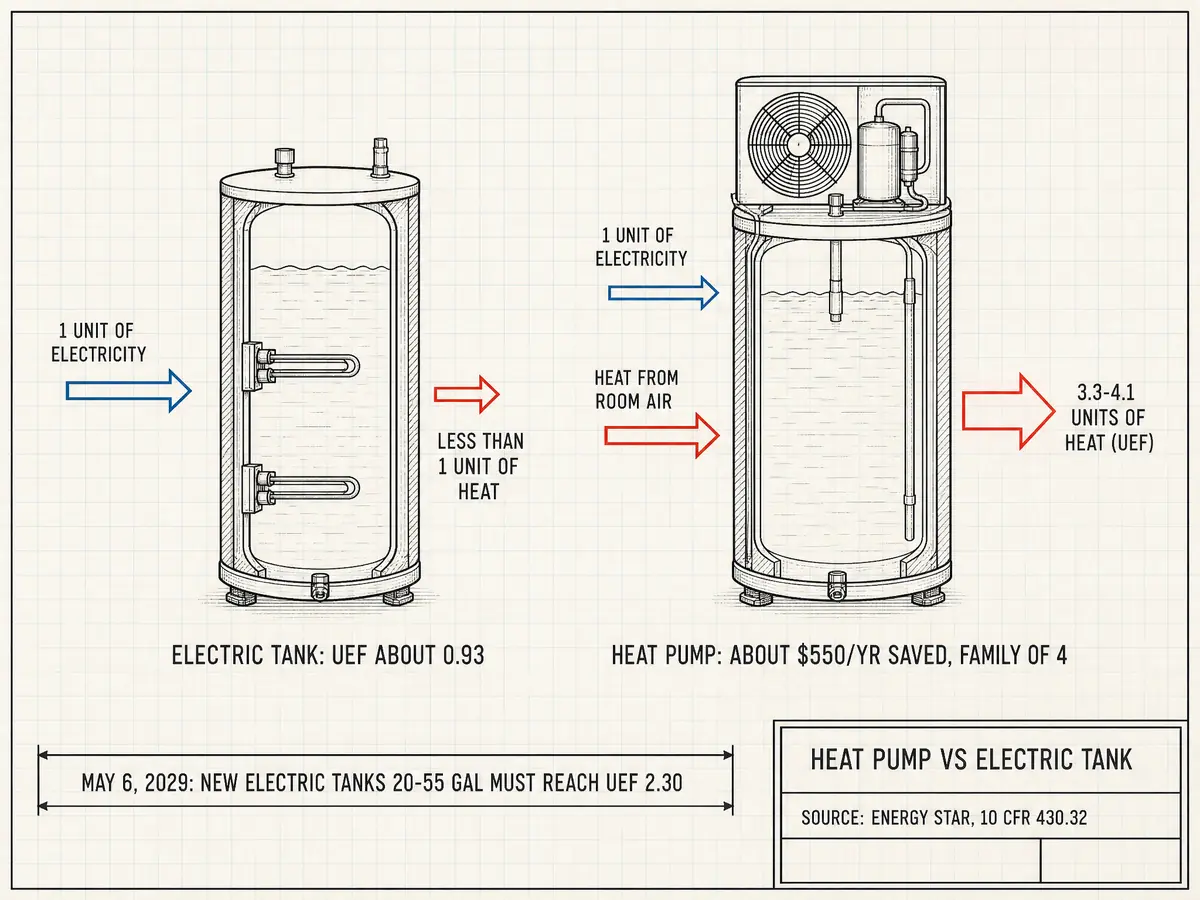
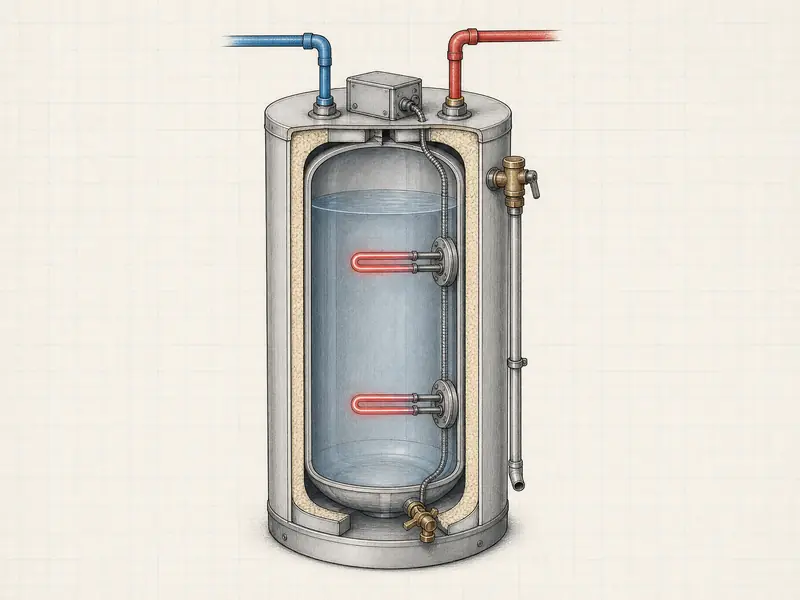
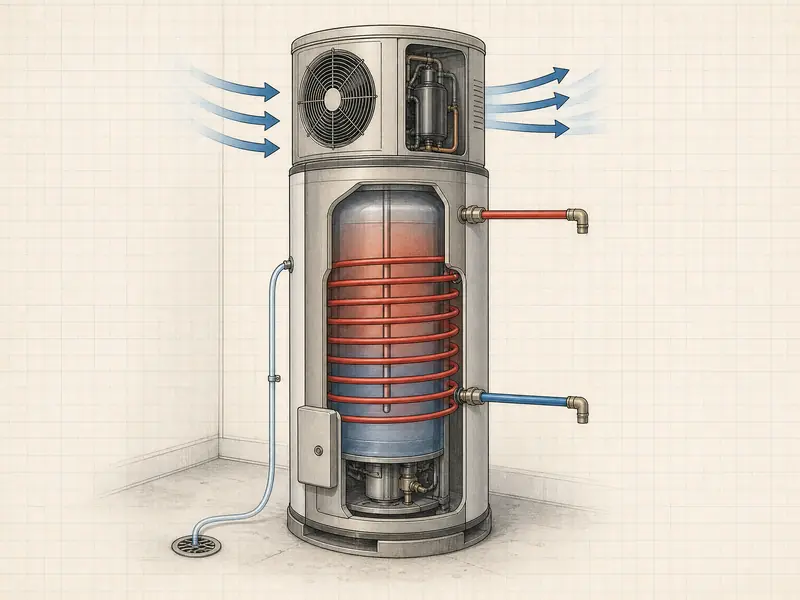
Both are electric storage tanks; the difference is how the heat gets into the water. A standard electric tank runs one or two resistance elements, turning each kilowatt-hour into roughly one kilowatt-hour of heat. A heat pump model puts a small compressor, fan and evaporator coil on top of the tank and pulls heat out of the surrounding air, the way a refrigerator works in reverse.
The heat pump unit keeps resistance elements as a backup. ENERGY STAR explains that when demand runs high, the unit switches to those elements automatically, which is why these heaters are often called hybrids. Most have an efficiency mode that uses only the heat pump, a hybrid mode that is usually the default, and an electric mode that is the least efficient.
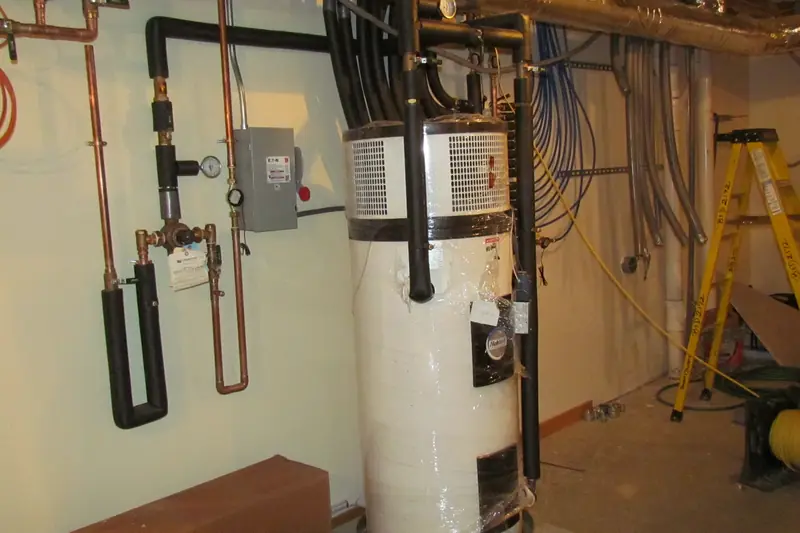
Outwardly they look alike, though the heat pump is taller and has an air intake, an exhaust grille and a condensate drain. The electric tank guide and the heat pump guide cover each design in depth.
How much less electricity does a heat pump use?
A heat pump model uses roughly a third to half the electricity of a standard tank for the same hot water. DOE's figure is two to three times the efficiency. On the rating label, ENERGY STAR notes a standard electric tank might rate 0.93 UEF, against a 3.3–4.1 band for certified heat pump units.
ENERGY STAR's savings table puts the cut at 3,760 kWh a year for a household of four, 2,820 kWh for three and 1,880 kWh for two. Real use falls short of the label when the unit runs in electric or hybrid mode during heavy draws, so the mode setting matters as much as the model.
The FTC EnergyGuide label shows the spread: medium-capacity electric tanks list annual costs from $121 to $494, and the low end of that range reflects heat pump models. The efficiency and energy cost guide explains how to read the label.
What does each cost up front and over its life?
The heat pump costs more to buy and less to run. ENERGY STAR cites $1,500 to $3,000 for the unit and $1,000 to $3,000 for labor and materials, a range it attributes to an informal survey of contractors. Its savings table assumes an extra $1,503 over a standard tank and a 13-year life.
On those assumptions, ENERGY STAR shows a 2.7-year payback and $5,610 in lifetime savings for four people, 3.7 years and $3,830 for three, and 5.5 years and $2,050 for two. The table uses $0.146/kWh. EIA's U.S. residential average was 18.16¢/kWh in August 2026, so at today's price four people would save about $680 a year (derived from EIA data).
DOE's 2024 rulemaking modeled the average installed cost of a heat-pump-level electric tank at $1,855 and found average lifetime savings of $859 for 20–55 gallon tanks. DOE also found that 35 percent of buyers in that size range would see a net cost over the heater's life.
| Spec | Standard electric tank | Heat pump water heater |
|---|---|---|
| Rated UEF | About 0.93 | 3.3–4.1 (ENERGY STAR certified) |
| Energy use, household of four | Baseline | About 3,760 kWh a year less |
| Up-front cost | Lower | $1,500–$3,000 unit, plus $1,000–$3,000 install (informal survey) |
| Space needed | Closet-sized | Roughly 700 cu ft of room air, less with louvers or ducts |
| Extra hookups | None | Condensate drain |
| Noise | Silent | 45–60 dB |
| Lifespan | 10–15 years | 13–15 years |
Where can a heat pump water heater not go?
A heat pump model cannot go in a small sealed closet, a space that drops near freezing, or anywhere without a drain path. ENERGY STAR's 2024 installation guide says most 240 V models need at least 700 cubic feet of air, some as little as 450, and a closet of 84 cubic feet or more can work with a fully louvered door. Older DOE guidance asked for 1,000 cubic feet and a space held between 40°F and 90°F year-round.
Cold matters because the heat pump draws its heat from the room. ENERGY STAR's myth-busting page says units switch to resistance heating below 35°F. The same page cites a 2022 study of 81 homes in which basements cooled by an average of 2.3°F, returning to normal within four hours. The space and climate guide covers garages and cold basements.
The wiring is usually not the obstacle. ENERGY STAR says a 240 V heat pump model typically uses the same 30-amp breaker and 10-gauge wire as a standard electric tank. For tight spaces or homes without a 240 V circuit, 120 V plug-in models exist, typically sized up; see the 120-volt guide.
Is the standard electric water heater going away in 2029?
Mostly, for new tanks of common sizes. DOE's May 2024 final rule requires electric storage heaters made on or after May 6, 2029 to meet UEF 2.30 for 20–55 gallons and 2.50 for over 55 up to 120 gallons, levels only heat pump designs reach. Small electric tanks of 20–35 gallons with first-hour ratings under 51 gallons are excluded and keep today's resistance-level minimum.
Heaters already installed are not affected, and stores can sell units made before the compliance date. As of October 2026, nothing delaying or repealing this rule had appeared in the Federal Register. DOE projects heat pump models growing from about 3 percent of electric tank sales in 2023 to about 61 percent in 2030. The 2029 rules guide has the full detail, including the moderate change for gas tanks.
When does a plain electric tank still make sense?
A plain tank still makes sense where a heat pump cannot breathe, where hot water use is light, or where a small exempt tank does the job. ENERGY STAR's own table shows a two-person home waiting 5.5 years for payback, and a single occupant waits longer. A closet with no room for louvers or ducting also rules the heat pump out.
For a tank that stays, two low-cost steps help. DOE says an insulating blanket on an electric tank can cut standby losses by 25–45% and save about 7–16% on water heating, but cautions against thermostat settings over 130°F on a blanketed tank, since the wiring may overheat. Setting the thermostat to 120°F also cuts waste and scald risk. A point-of-use heater can serve a remote bathroom where running a long hot line makes no sense.
Money can tip the decision. The federal 25C credit no longer covers a 2026 install. Income-based HEEHR rebates, capped at $1,750 for a heat pump unit, run only in states that have launched them, and ENERGY STAR reports typical utility incentives in the $300–$1,000 range.
Sources and scope
Sources for this comparison: the ENERGY STAR savings table, UEF explainer, 2024 installation guide and myth-busting page; archived DOE Energy Saver pages; the May 2024 final rule in the Federal Register and 10 CFR 430.32; EnergyGuide label cost ranges (16 CFR 305); and EIA's August 2026 electricity price, all checked October 2026. The $680 figure is derived. Excluded: contractor quotes, owner anecdotes and model rankings.
Frequently asked
How much does a heat pump water heater save per month?
About $46 a month for a household of four on ENERGY STAR's $550-a-year figure at $0.146/kWh. At August 2026 average rates, the same energy saving is worth closer to $57 a month (derived).
Will a heat pump water heater make my basement cold?
A little. A 2022 study cited by ENERGY STAR found an average drop of 2.3°F, which recovered within four hours. In summer, the cooling and dehumidifying can help.
Can a heat pump water heater use the existing electric tank's circuit?
Often. ENERGY STAR says 240 V models typically use the same 30-amp breaker and 10-gauge wire as a standard electric tank, and some run on 25- or 20-amp circuits. Check the model's installation manual.
Do heat pump water heaters need more maintenance than an electric tank?
Slightly more. Besides the usual tank care, ENERGY STAR notes heat pump models may need annual maintenance such as cleaning or changing the air filter, and the condensate line must stay clear.
Can a store still sell a standard 50-gallon electric tank after 2029?
Yes, if it left the factory before May 6, 2029; existing stock is not recalled. Units made on or after that date in the 20–55 gallon range must meet UEF 2.30 unless they qualify as small electric tanks.
Is a bigger heat pump tank needed to match an electric tank's output?
Sometimes. A heat pump recovers more slowly in efficiency mode, so a larger tank or hybrid mode covers heavy mornings. Size it from the first-hour rating, not the gallon number alone.
Related reading
Start over at types of water heaters compared · more in Compare