
Heat pump
Heat Pump Water Heater Installation
Heat pump water heater installation adds three jobs to a normal tank swap: enough room air, a condensate drain and the right circuit, usually 240 V on a 30-amp breaker.
Compiled by the Tank & Tankless desk · Revised
On this page
- What does a heat pump water heater installation involve?
- How much space does the installation need?
- What electrical circuit does a heat pump water heater need?
- Where does the condensate go?
- How much does heat pump water heater installation cost?
- What rebates are left after the tax credit ended?
- Frequently asked
At a glance
- ENERGY STAR's 2024 installer guide lists at least 700 cubic feet of air for most 240 V models, with some down to 450.
- A typical 240 V model uses a 30-amp breaker and 10-gauge wire, like a standard electric tank; some run on 25 or 20 amps.
- Every unit drains clean, non-acidic condensate; Rheem's ProTerra sheet shows 3/4-inch condensate connections.
- ENERGY STAR reports $1,500 to $3,000 for the unit and, from an informal contractor survey, $1,000 to $3,000 for labor and materials.
- The 25C federal credit ended for units placed in service after December 31, 2025 (IRS); state HEEHR rebates of up to $1,750 remain where launched.
- A plumbing permit is commonly required; San Diego's bulletin, for example, requires one for every water heater replacement.
- 700 cu ftAir space most 240 V heat pump models needENERGY STAR
- 30 ATypical breaker for a 240 V heat pump water heaterENERGY STAR
- $1,000–$3,000Labor and materials, informal contractor surveyENERGY STAR
- $1,750HEEHR rebate cap for a heat pump water heater42 U.S.C. 18795a
What does a heat pump water heater installation involve?
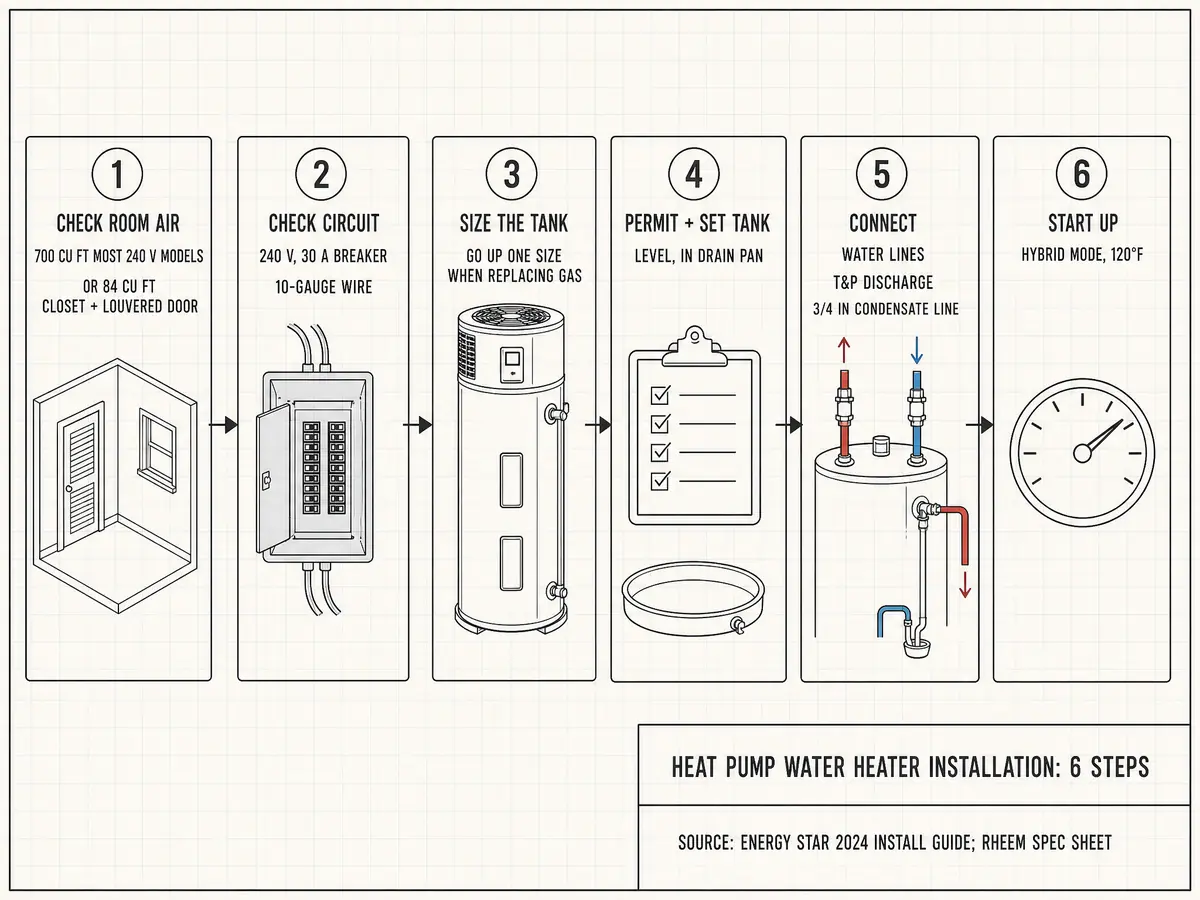
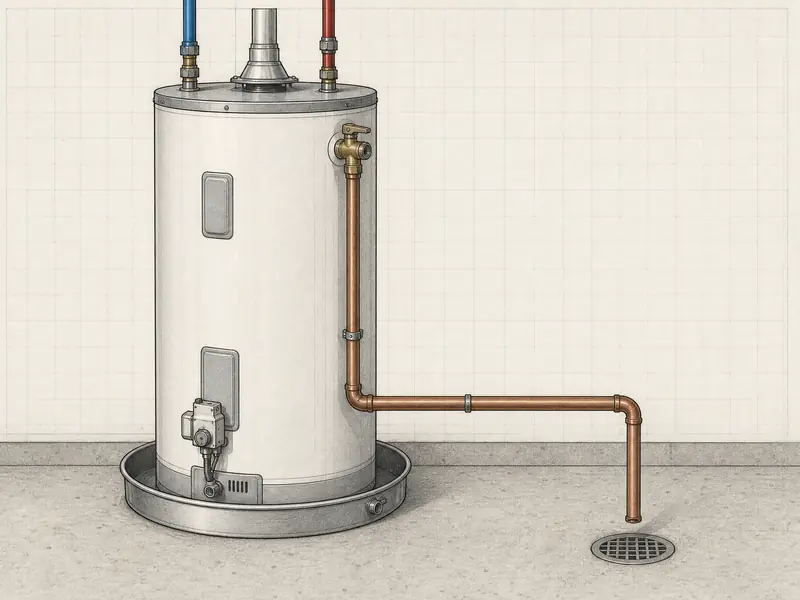
A heat pump water heater installation is a standard tank installation plus air, drain and electrical work. The plumbing side is familiar: shutoff valve, T&P relief valve with a full-size discharge line, drain pan where a leak could do damage, an expansion tank on closed systems and, in earthquake country, two straps. The extra items are the room check, a condensate line and a circuit sized to the model.
The order a licensed installer usually follows:
- Confirm the room volume and temperature against the model's manual, or plan louvers or ducting.
- Check the electrical panel for a 240 V, 30-amp circuit, or pick a 120V plug-in model.
- Size the tank. Heat pump units deliver about as much as a resistance tank, but ENERGY STAR advises sizing up when replacing gas.
- Pull the permit, then set the tank level in a pan with at least the clearances the manual lists.
- Connect water, T&P discharge and condensate; fill the tank completely before power goes on.
- Start the unit and set the mode (hybrid is the usual default) and a 120°F setpoint.
When gas service is retired, the old supply line has to be capped by a qualified gas fitter, and the abandoned flue opening dealt with to local code. Heat pump models need no flue of their own, since nothing burns.
How much space does the installation need?
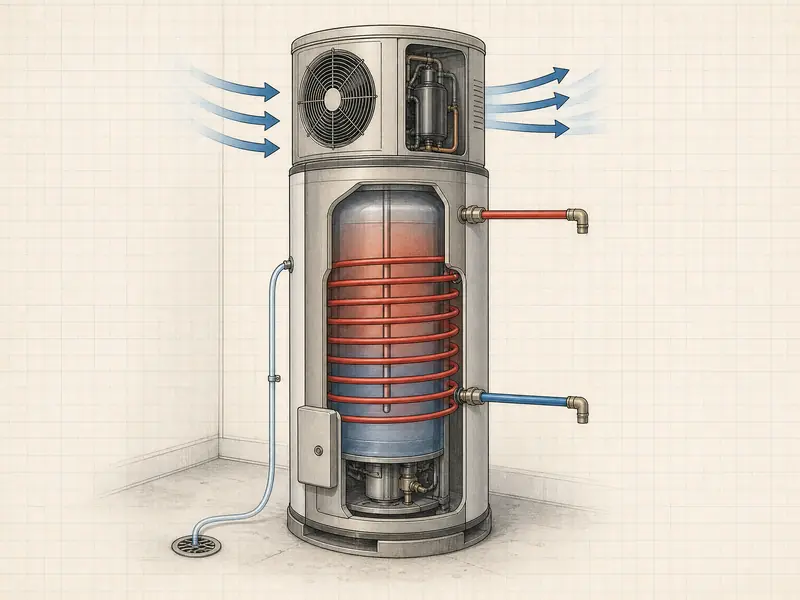
Most 240 V heat pump water heaters need at least 700 cubic feet of surrounding air, ENERGY STAR's example being a room 10 feet square under a 7-foot ceiling; some models work in 450. For a closet, ENERGY STAR sets the floor at 84 cubic feet behind a fully louvered door, and every major maker sells duct kits for tighter spots (ENERGY STAR install guide). Rheem's ProTerra sheet allows rooms down to 450 cubic feet "at reduced energy efficiency and reduced performance output" (Rheem spec sheet).
When the exhaust is ducted, ENERGY STAR says to aim the cold air away from thermostats and busy rooms and to keep at least 1 foot of clearance from walls, ceiling and objects. Temperature matters as much as volume: units do best in spaces that rarely drop below 38°F. Garages, basements and closet limits are covered in detail on the space and climate page.
| Check | Typical requirement | Source |
|---|---|---|
| Open room volume | 700 cu ft for most 240 V models (some 450) | ENERGY STAR |
| Closet | 84 cu ft minimum, louvered door | ENERGY STAR |
| Smaller rooms | Louvers top and bottom, or ducting kit | Rheem |
| Ambient range | 37–145°F (one maker's rating) | Rheem |
| Minimum space in a checklist | 750 cu ft or per the manufacturer | PNNL |
What electrical circuit does a heat pump water heater need?
A typical 240 V heat pump water heater needs a 30-amp breaker and 10-gauge copper, matching what a resistance tank uses, though ENERGY STAR notes some models run on 25 or even 20 amps. Rheem's 240 V ProTerra models list a 30-amp breaker, 4,500-watt elements and a 4,200 Btu/h compressor, and warn that element output drops 25% (from 4.5 kW to 3.375 kW) on 208 V supply. A licensed electrician should confirm panel capacity before the unit is bought.
Homes replacing a gas heater often have no 240 V circuit near the tank. That is the case 120 V plug-in models were built for: some need a dedicated 15-amp circuit, others share an ordinary outlet. They trade recovery speed for easy wiring, which the 120V guide works through.
Where does the condensate go?
The condensate from a heat pump water heater goes to a floor drain, laundry sink or condensate pump through a line from the unit's drain fitting. ENERGY STAR describes it as "a small amount of clean non-acidic condensate water" and stresses leveling the tank so the line drains freely. PNNL's installer checklist requires the condensate drain to follow local code (PNNL Building America Solution Center).
The condensate line is separate from the T&P discharge, which must not be reduced in size or blocked and, per A. O. Smith's manual, ends no more than 6 inches above the floor. In California, for example, San Diego's bulletin also bans ending the T&P drain in the water heater pan (San Diego RESD-5-1). Where no gravity drain exists, a small condensate pump is the usual fix.
How much does heat pump water heater installation cost?
ENERGY STAR reports $1,500 to $3,000 for the unit and, citing an informal survey of contractors, $1,000 to $3,000 for labor and materials (ENERGY STAR). The low end fits a like-for-like swap of an electric tank in a large basement. The high end fits a gas conversion that needs a new circuit, a capped gas line, a condensate pump or ducting.
For a single planning figure, DOE's 2024 rulemaking assumed an average installed cost of $1,855 for an electric storage unit at heat-pump efficiency, compared with $1,578 for a gas tank. Running costs then pull the other way: ENERGY STAR estimates about $550 a year in savings for four people at 14.6¢ per kWh. Lifetime math sits on efficiency and energy costs.
What rebates are left after the tax credit ended?
After the 25C credit ended, the remaining money is state and utility rebates. The federal credit had paid 30% of cost, up to $2,000 a year for a qualifying heat pump water heater, but the IRS notice says no credit is allowed for equipment placed in service once 2025 ended. Older ENERGY STAR articles that give a 2032 end date are out of date.
The High-Efficiency Electric Home Rebate (HEEHR) is federal money run by states. The statute caps the rebate at $1,750 per heat pump unit, covers up to 100% of cost below 80% of area median income and 50% from 80% to 150%, and runs through September 30, 2031 where funds remain (42 U.S.C. 18795a). DOE lists the program as available "in select states" and points buyers to the State Energy Office. Utility incentives typically run $300 to $1,000, per ENERGY STAR.
Sources and scope
Sources: ENERGY STAR's Best Practices installer guide (August 2024), its cost article (February 2024) and savings table, Rheem's ProTerra 240 V spec sheet, PNNL's heat pump water heater checklist, A. O. Smith's residential manual, the San Diego RESD-5-1 bulletin (May 2025), the IRS 25C notice and 42 U.S.C. 18795a, all checked October 2026. Not used: local contractor price lists, code section numbers that could not be opened, and brand rankings.
Frequently asked
Is heat pump water heater installation a DIY job?
Rarely. It combines plumbing, a 240 V circuit and often gas capping, and many towns require a permit and inspection. The safe split is a licensed plumber for water and gas and a licensed electrician for any new circuit.
Is a flue or vent needed for a heat pump unit?
No combustion vent. It may use an optional duct kit to bring in or exhaust air when the room is small, and the cold exhaust should not blow on a thermostat or a seating area.
Can a recirculation pump run with a heat pump water heater?
Yes, but not continuously. ENERGY STAR warns that nonstop circulation strains the unit and cuts hot water availability; an on-demand, timer or motion-activated pump avoids that.
Can the tank go next to a furnace?
Often, if the room still meets the air and clearance figures in the manual. A furnace room in winter can give the unit warm air, but heat taken from the room is heat the furnace replaces.
How long does a heat pump water heater installation take?
A like-for-like swap of an electric tank is commonly a single visit. Gas conversions that need a new circuit, capping and a condensate pump take longer, and permit inspection can add a return trip.
Does the installer have to set anything after startup?
Yes. Mode (hybrid is common), the setpoint and any vacation or demand-response settings are set at commissioning. DOE and CPSC both point to 120°F as the practical setting for most homes.
What reduces noise after installation?
ENERGY STAR suggests a rigid foam pad under the unit and cushioned or webbing straps where seismic strapping is used, so the cabinet does not rattle against the wall.
Related reading

Start over at types of water heaters compared · more in Heat pump