
Fix
Hot Water Smells Like Rotten Eggs
Why does hot water smell like rotten eggs? Usually because bacteria and the tank's magnesium anode rod make hydrogen sulfide inside the heater; if the cold water smells too, the gas is coming from the well.
Compiled by the Tank & Tankless desk · Revised
Ownership note. Tank & Tankless has the same owners as SoftPro Water Systems and Quality Water Treatment, two water treatment stores. We link to them only on pages about hard water, scale and well-water odor, and only for products they sell. Figures come from DOE, ENERGY STAR, the Federal Register, IRS, USGS and maker manuals, checked October 2026. Store product descriptions are the store's own claims. Ownership and store links
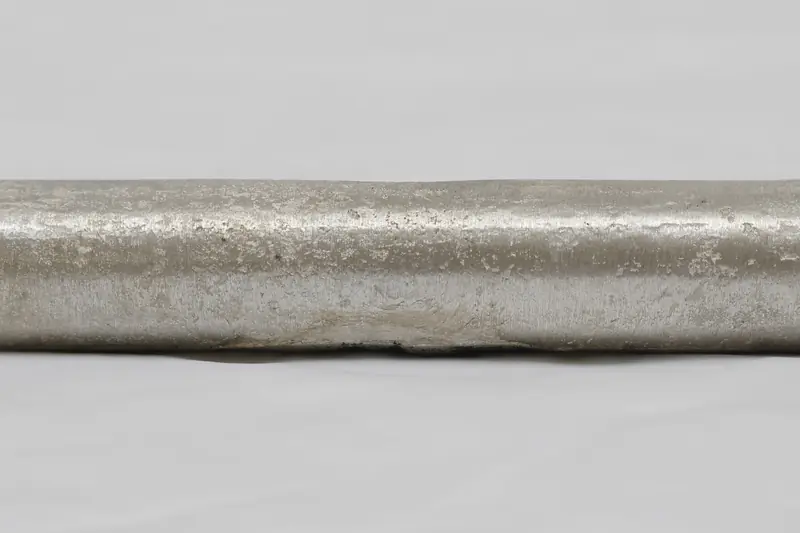
On this page
At a glance
- Hot water that smells like rotten eggs, with odor-free cold water, points to the water heater. Penn State Extension explains that the magnesium anode rod "can chemically reduce sulfates to form hydrogen sulfide."
- The usual fix is a replacement anode: aluminum (Penn State) or a special zinc rod (A. O. Smith). No water filter is needed for this cause.
- Never remove the anode for good. A. O. Smith says the tank must always have one "or the warranty is void."
- For a very strong odor, A. O. Smith suggests raising the tank to 140°F to cut bacterial growth, with mixing valves at the taps, since CPSC says 140°F water burns in six seconds.
- If the cold water smells too, hydrogen sulfide is in the well water. Test first; Penn State matches treatment to concentration, from carbon below 1 mg/L to chlorination above 6 mg/L.
- Hydrogen sulfide in water is mainly an odor, taste and corrosion problem. Most people smell it well below 0.5 mg/L, long before it is harmful (Penn State).
- 0.5 mg/Lhydrogen sulfide level most people can smell well belowPenn State Extension
- 2–3 mg/Lhydrogen sulfide an oxidizing filter can removePenn State Extension
- 6.0 mg/Llevel above which continuous chlorination is most often usedPenn State Extension
- 140°Ftank setting A. O. Smith suggests for a very strong odorA. O. Smith
Why does hot water smell like rotten eggs?
Hot water smells like rotten eggs because it contains hydrogen sulfide gas. When only the hot side smells, the gas is being made inside the water heater. Sulfate-reducing bacteria, common and harmless in tap water, multiply in the warm tank. The tank's magnesium anode rod then helps turn sulfate in the water into hydrogen sulfide. Penn State Extension describes the anode reaction, and the A. O. Smith gas guide describes the bacteria growing in water heaters.
The anode is there for a reason. It corrodes in place of the steel tank. A. O. Smith's electric manual calls the rotten-egg smell the most common complaint tied to the anode rod.
The same bacteria live in many wells. That is why the first job is to find out where the smell starts: in the heater, or in the water before it reaches the heater.
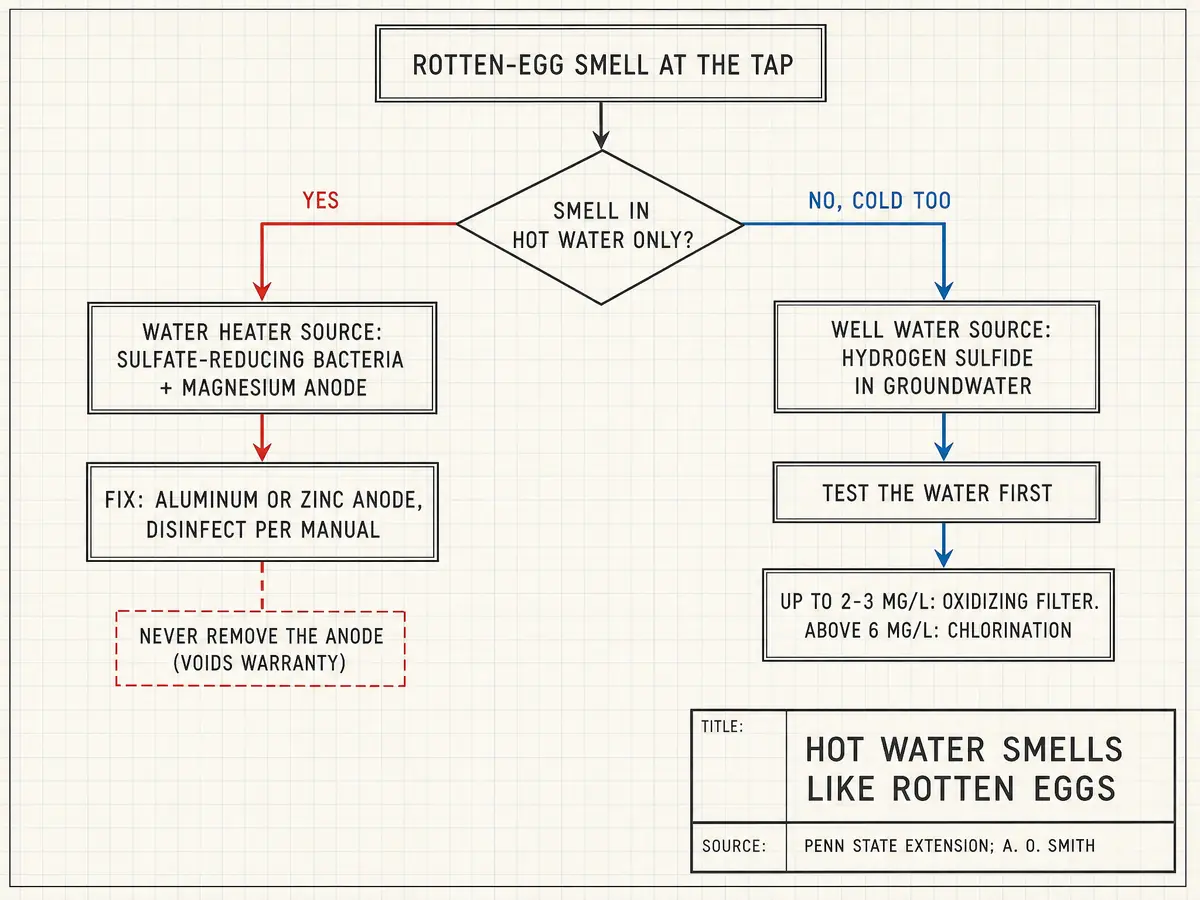
Is the smell only in the hot water?
To find out, run the cold tap and then the hot tap at the same faucet, one at a time, and smell each into a glass. Try a second faucet too. Three patterns tell you the source:
- Hot only, at every faucet: the water heater is making the gas. Work on the anode and the bacteria.
- Hot and cold, at every faucet: the gas is in the water supply, usually a well. Test the water.
- One faucet or one drain only: the source may be that fixture's drain or trap rather than the water. Smell the water in a glass away from the sink.
Penn State adds one more case: in rare cases a water softener can create a home for sulfur-reducing bacteria and cause the smell. Softened water also wears out anodes faster, so A. O. Smith asks for yearly anode checks on softened water (see water softeners and water heaters).
Does a new anode rod stop the smell?
A different anode rod is the main fix when the smell is in the hot water only, though neither source promises it works every time. The fix is to replace the magnesium anode with a different metal. Penn State says an aluminum rod "should eliminate the rotten egg odor while maintaining corrosion protection." A. O. Smith offers a special zinc anode that "may help reduce or eliminate the odor" and lists it as a repair part.
Expect some trial and error. A. O. Smith's electric manual says the special rod may reduce but not eliminate odor in every home. It also says some water supplies need filtration equipment. A. O. Smith adds that killing the bacteria is the only sure cure, which is why disinfection often goes along with the anode swap.
The one fix to avoid is pulling the anode and leaving it out. Penn State notes that this stops the smell but speeds corrosion and "will likely void the manufacturer's warranty," and A. O. Smith says the same. Anode swaps mean draining part of the tank and breaking a large threaded fitting, often with little headroom. The steps, rod types and check intervals are on water heater anode rods.
Can you disinfect the water heater?
Yes. The maker's simplest method is heat. For a very strong rotten-egg smell, A. O. Smith suggests raising the tank to 140°F to reduce bacterial growth. Its guide adds that higher tank temperatures kill the bacteria behind "smelly water."
Heat has a cost in scald risk. CPSC says 140°F water causes third-degree burns in about six seconds, against five minutes at 120°F. A. O. Smith tells owners who raise the setting to install thermostatic mixing valves at each point of use. The CDC makes the same trade-off for Legionella: 130–140°F kills more germs but raises scald risk, so mix hot and cold with mixing valves. The full trade-off is on water heater temperature setting.
Chemical disinfection is a second route, but only by the method and product your heater's manual allows. A. O. Smith warns against chemicals that could contaminate the drinking water, and says to contact a qualified person about odor treatment. A plumber who does this work can disinfect the tank, swap the anode and flush it in one visit. Flushing on its own removes sediment where bacteria can live (see how to flush a water heater), but it rarely stops the smell by itself.
What if the cold water smells too?
If the cold water smells too, the hydrogen sulfide is in the water supply, usually a private well, and an anode swap will not fix it. Penn State says the gas forms in groundwater from sulfur-reducing bacteria and is most common in wells drilled into shale and sandstone.
Test before you buy anything. Penn State notes that hydrogen sulfide escapes from a sample, so the test must be done at home or the sample chemically stabilized. Ask a state-accredited lab what it needs. Penn State matches treatment to the result:
| Hydrogen sulfide in the well water | Treatment Penn State describes | Notes |
|---|---|---|
| Below about 1.0 mg/L | Activated carbon filter | Carbon replaced periodically |
| Up to about 2 mg/L | Aeration | No chemicals; higher purchase cost |
| Up to 2–3 mg/L | Oxidizing filter, usually manganese greensand | Regenerated with potassium permanganate; Birm media not recommended |
| Above about 6.0 mg/L | Continuous chlorination, or permanganate feed, plus filtration | Most maintenance; carbon may follow |
| Any level, short term | Shock chlorination of the well | Odor often returns quickly |
Two whole-house filters sold by stores with the same owners as this site fit the aeration and oxidizing-filter rows of that table; Penn State lists aeration only up to about 2 mg/L of hydrogen sulfide. The SoftPro AIO Iron Master is an air-injection filter that the store says removes iron, manganese and hydrogen sulfide from well water without added chemicals. The Fleck 2510 Greensand Filter (sold by Quality Water Treatment, same owners as this site) at Quality Water Treatment is a manganese greensand unit regenerated with potassium permanganate, which the store says reduces hydrogen sulfide, iron and manganese. Both claims are the stores' own. Both need enough well pump flow to backwash: the stores list 5 to 10 GPM depending on size. Their listed prices in October 2026 were $1,517–$1,897 and $1,421–$1,826. Neither does anything for smell made inside the heater.
Is the rotten egg smell dangerous?
At the levels found in household water, the rotten egg smell is a nuisance rather than a health risk. Penn State says hydrogen sulfide "does not have a drinking water standard" because the water becomes undrinkable by taste and smell long before it reaches harmful levels. The sulfur-reducing bacteria themselves do not cause health concerns.
It does cause other problems. Hydrogen sulfide corrodes metal plumbing and leaves yellow or black stains on fixtures. If a well smell appears suddenly or comes with a change in color or taste, test for bacteria and other contaminants as well. A smell of gas near a gas water heater is a different matter: that is not sulfur in the water, and you should leave and call the gas supplier from a neighbor's phone.
Sources and scope
Built on Penn State Extension's hydrogen sulfide article (updated December 10, 2024), A. O. Smith's residential gas (2023) and electric manuals, CPSC publication 5098 and CDC's Legionnaires' prevention sheet, all checked October 2026. Product claims and prices come from the two stores' listings, read October 26, 2026. Left out: chemical doses for tank disinfection, which belong in your heater's manual, plus powered-anode claims and forum remedies.
Frequently asked
Why does my hot water smell like rotten eggs after vacation?
Water that sits warm in the tank for days gives the bacteria time to make more hydrogen sulfide. Run the hot taps to flush the tank's contents. A. O. Smith also warns that after two weeks or more of no use, hydrogen gas can collect in the lines, so run the kitchen hot tap for several minutes with no flame nearby.
Is it safe to shower in water that smells like sulfur?
At normal household levels, Penn State treats hydrogen sulfide as an aesthetic problem, and people smell it long before it is harmful. Good bathroom ventilation helps. If the smell is new and also in the cold water, test the well for bacteria and other contaminants too.
Why does only my new water heater smell like rotten eggs?
A new tank has a fresh magnesium anode, which drives the reaction hardest. If the old heater had an aluminum or zinc rod, the problem may return with the new one. Ask the installer to fit the maker's odor-control anode.
What kills sulfur smell in a water heater?
Heat and disinfection kill the bacteria, and a change of anode removes the reaction that makes the gas. A. O. Smith suggests 140°F with mixing valves for strong odors and says eliminating the bacteria is the only sure fix.
Will a water softener get rid of a rotten egg smell?
Usually not. A softener removes hardness minerals, not hydrogen sulfide, and Penn State says a softener occasionally makes the problem worse by hosting sulfur-reducing bacteria. Penn State's list of treatments uses carbon, aeration, oxidizing filters and chlorination instead.
Does a tankless water heater get the rotten egg smell?
It is far less likely, because a tankless unit stores no water and has no anode. If water from a tankless heater smells, check the cold water: the gas is probably coming from the well.
Related reading

Start over at the water heater type index · more in Fix