
Tankless
What Size Tankless Water Heater Do I Need?
What size tankless water heater do I need? One that delivers your peak flow in GPM at your temperature rise, usually about 70°F, which DOE says gas units manage near 5 GPM and electric near 2.
Compiled by the Tank & Tankless desk · Revised
On this page
- How is a tankless water heater sized?
- How many GPM do your fixtures use?
- What temperature rise do you need?
- How much tankless flow do two showers need?
- How does groundwater temperature change tankless size?
- What size tankless for a family of four or six?
- What if one tankless unit isn't enough?
- Frequently asked
At a glance
- DOE's sizing method has two inputs: the flow of everything running at once and the temperature rise, assuming 50°F incoming water and a 120°F target (a 70°F rise) unless you know better.
- ENERGY STAR's fixture figures: shower or tub 2.5 GPM, sink 2.2, clothes washer 3.3, dishwasher 1.3.
- DOE's typical capability at a 70°F rise: roughly 5 GPM for gas-fired units, roughly 2 GPM for electric.
- American Water Heater's tankless guide maps U.S. groundwater from 37–51°F in the north to 62–77°F in the south.
- In that guide's flow table, a 199,000 Btu/h non-condensing model drops from 8.5 GPM (40°F rise) to 5.5 GPM (70°F rise).
- ENERGY STAR certified gas tankless models must deliver at least 2.8 GPM over a 67°F rise.
- 70°FDefault temperature rise in DOE's tankless sizing methodDOE Energy Saver (archived)
- 2.5 GPMShower and bathtub flow used by ENERGY STARENERGY STAR
- 5.5 GPMOne 199,000 Btu/h unit's rated flow at a 70°F riseAmerican Water Heater
- 2.8 GPMMinimum max-flow for ENERGY STAR gas tankless, 67°F riseENERGY STAR
How is a tankless water heater sized?
A tankless water heater is sized by flow rate and temperature rise, not by gallons stored. DOE explains that demand heaters are "rated by the maximum temperature rise possible at a given flow rate," so you need two numbers: how many gallons per minute run at the same time, and how many degrees the heater must add.
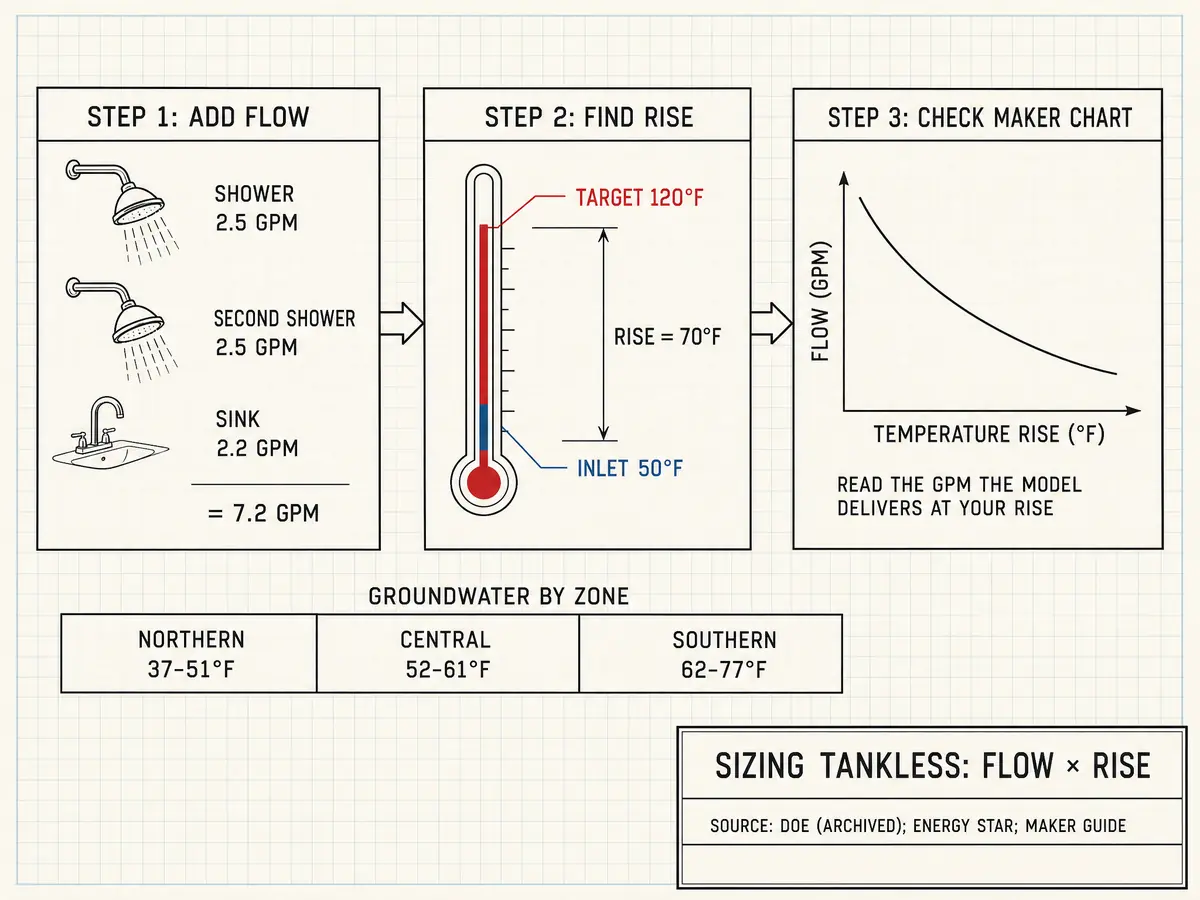
The method has three steps:
- Add the flows of every hot-water fixture you expect to run at once, in GPM.
- Work out the rise: target outlet temperature minus incoming water temperature.
- Read the maker's chart for the GPM the model delivers at that rise, and pick one that meets or beats your total.
In DOE's worked example, one faucet (0.75 GPM) plus one shower head (2.5 GPM) means the heater must pass at least 3.25 GPM. With 50°F water and a 120°F target, that unit needs a 70°F rise at 3.25 GPM.
How many GPM do your fixtures use?
Typical fixtures draw between 1.3 and 3.3 GPM each, using the figures ENERGY STAR publishes on its gas tankless page. A dishwasher draws about 1.3 GPM. Your own fixtures may be lower; the flow rate is often printed on the shower head or faucet aerator.
| Fixture | Flow rate | Source |
|---|---|---|
| Shower or bathtub | 2.5 GPM | ENERGY STAR |
| Kitchen or bathroom sink | 2.2 GPM | ENERGY STAR |
| Clothes washer | 3.3 GPM | ENERGY STAR |
| Dishwasher | 1.3 GPM | ENERGY STAR |
| Faucet in DOE's worked example | 0.75 GPM | DOE |
These are full fixture flows. A shower is usually a mix of hot and cold water, so the heater itself supplies only part of it. Stiebel Eltron's sizing guide, for example, assumes a shower at 1.5 GPM and 105°F. Sizing on the full flow is the cautious choice.
What temperature rise do you need?
Your temperature rise is the heater's set temperature minus the temperature of the water coming into the house. DOE suggests 120°F for most uses and says to assume 50°F incoming water unless you know otherwise, which gives a 70°F rise. That 120°F setting is also the one DOE and the CPSC recommend to limit scalds.
The rise matters because a heater has a fixed amount of heat to give. The more degrees it must add, the fewer gallons it can heat each minute. That is why every maker publishes flow at several rises rather than a single GPM.
How much tankless flow do two showers need?
Two showers at full flow need about 5 GPM at your temperature rise. At ENERGY STAR's 2.5 GPM per shower that is 5.0 GPM, and adding a sink brings it to 7.2 GPM. DOE notes that running a shower and a dishwasher together can already push a unit to its limit.
Compare that with what heaters deliver at a 70°F rise. DOE puts a typical gas unit near 5 GPM there, so two showers sit right at its edge. American Water Heater's 199,000 Btu/h non-condensing model is rated for 5.5 GPM at that rise, which covers two showers but not two showers plus a sink at full flow. Electric whole-house units fall short of two full showers at that rise; the electric tankless guide shows the numbers.
How does groundwater temperature change tankless size?
Colder incoming water means a bigger rise and less flow from the same heater. American Water Heater's guide splits the U.S. into three zones: northern at 37–51°F, central at 52–61°F and southern at 62–77°F. Its advice is to measure the cold water with a thermometer during the coldest season of the year.
The effect is large. Cut the rise from 70°F to 40°F and that maker's 199,000 Btu/h model goes from 5.5 to 8.5 GPM, about 55% more water. Stiebel Eltron's sizing guide for its largest electric model, the 36 kW Tempra, shows 8 GPM with 77°F incoming water but 3.6 GPM with 37°F water. Size for winter, not summer.
| Heater | Warm inlet | Rated flow | Cold inlet | Rated flow |
|---|---|---|---|---|
| 199,000 Btu/h gas, non-condensing | 40°F rise | 8.5 GPM | 70°F rise | 5.5 GPM |
| 36 kW electric (Tempra 36) | 77°F water | 8 GPM | 37°F water | 3.6 GPM |
| 24 kW electric (Tempra 24) | 77°F water | 5.9 GPM | 37°F water | 2.4 GPM |
What size tankless for a family of four or six?
Size by what runs at the same time, not by the number of people. A family of four that runs one shower and a sink at once needs about 4.7 GPM at full flow; a family of six that often runs two showers and the washer needs about 8.3 GPM. Then check that figure against the maker's chart at your winter rise.
For most homes at a 70°F rise, a single gas unit in the 5 GPM class covers one or two fixtures at a time. Larger households either stagger use, choose a higher-input unit, or add a second heater. Residential gas tankless units top out just under 200,000 Btu/h, the input limit in DOE's product definition and ENERGY STAR's criteria, so demand beyond one such unit's flow means a second heater. A bigger unit also asks more of the gas line and vent; the venting and gas line guide covers both.
What if one tankless unit isn't enough?
When one unit cannot meet peak flow, the usual answers are a second unit, point-of-use heaters at distant fixtures, or a different heater type. DOE notes that a demand heater at each hot water outlet can save even more energy in some cases. The point-of-use guide explains where small units fit.
If your peak use is high and short, such as filling a large tub, a storage tank may suit better: it can deliver a burst well above its recovery rate. Compare the two on the tankless vs tank page. Hard water also affects sizing in practice, because scale reduces heat transfer over time; see hard water and tankless heaters.
Sources and scope
This page relies on DOE Energy Saver's archived sizing page (snapshot July 2026), ENERGY STAR's tankless pages and Version 5.0 criteria, American Water Heater's tankless product guide and Stiebel Eltron's Tempra sizing guide and spec sheet (rev. 6.2025), checked October 2026. Flow totals are simple sums of the ENERGY STAR fixture rates. Left out: online calculators of unknown method, brand rankings and installer rules of thumb.
Frequently asked
What size tankless water heater for two bathrooms?
Plan on about 5 GPM for two showers at once, at your winter temperature rise. A gas unit rated for 5 GPM or a little more at that rise covers it; colder regions need more capacity.
How many GPM does a family of six need?
It depends on how many fixtures overlap. Two showers and a washer at ENERGY STAR rates add up to 8.3 GPM, which is beyond a single typical unit at a 70°F rise.
Is it better to oversize a tankless water heater?
Some margin helps in cold months, but a unit also needs a minimum flow to fire. One maker lists 0.5 GPM to start, so very large units are not a cure for small draws.
Does a low-flow shower head change tankless size?
Yes. Every GPM you remove from the peak total lowers the capacity you need. Check the flow printed on the head before sizing.
Which incoming water temperature goes into the math?
Measure the cold water at a tap during the coldest part of the year, as American Water Heater advises. If you cannot, DOE's default is 50°F, and northern homes can be colder.
Does square footage tell you the tankless size?
No. Floor area does not tell you how many fixtures run at once or how cold the water is. Use flow and temperature rise.
Does a tankless unit need a bigger size for a jetted tub?
Large tubs fill at high flow and can exceed a unit's GPM at your rise. Check the tub's fill rate against the maker's chart, or consider a storage tank for that use.
More on tankless and sizing
Start over at every water heater type, side by side · more in Tankless